


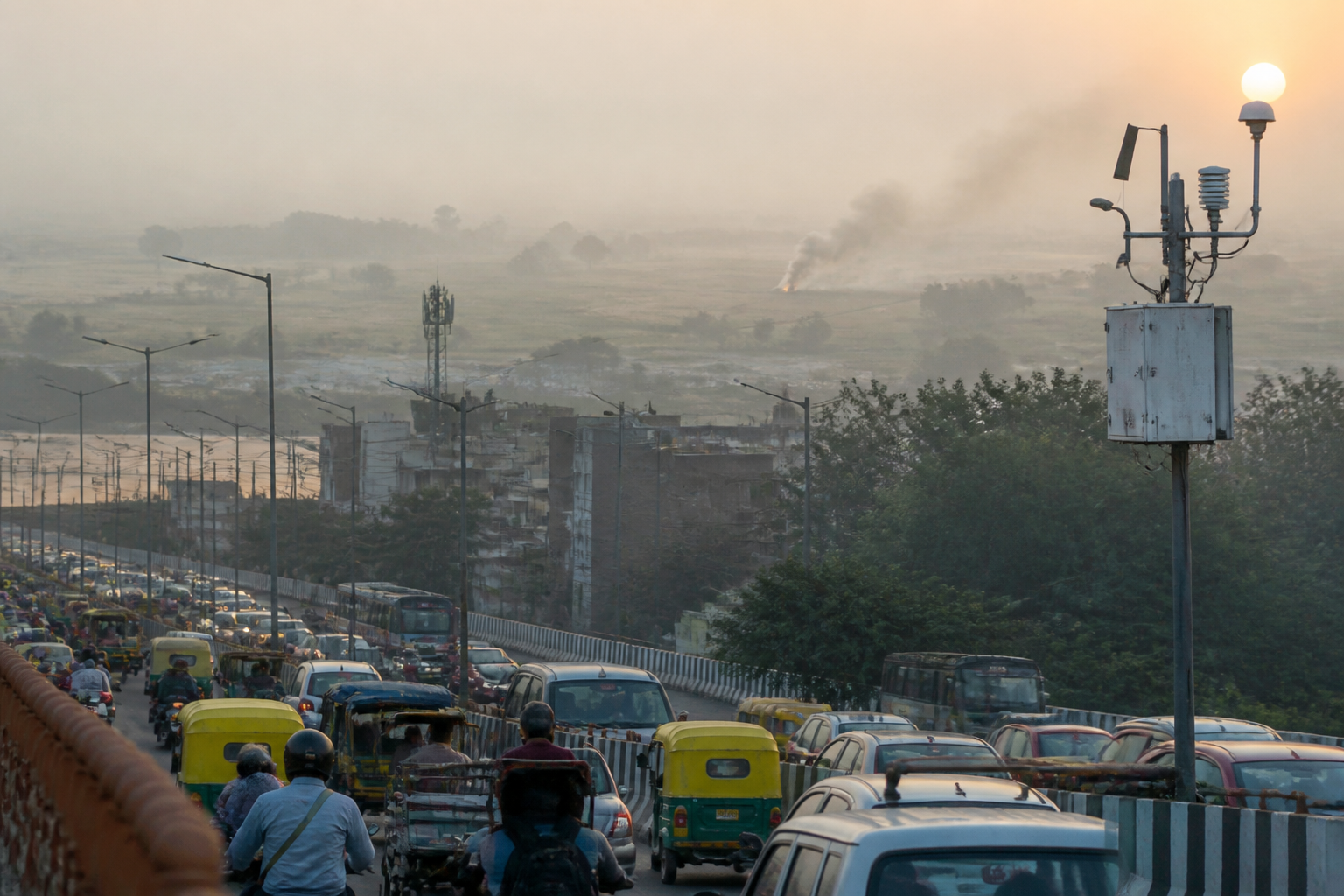
Delhi’s air quality slipped into the moderate category on Wednesday, with the city recording an Air Quality Index of 129 after five consecutive days of satisfactory readings, while satellite data detected 19 crop-residue burning events across six states, including Punjab and Uttar Pradesh.
The Central Pollution Control Board’s classification places an AQI between 101 and 200 in the moderate category. Of Delhi’s 45 monitoring stations, 42 recorded moderate air quality and three recorded satisfactory air quality. The IIT Delhi monitoring station recorded a poor AQI of 207 at 6 pm.
According to data from the ICAR-Indian Agricultural Research Institute, seven residue-burning events each were detected in Punjab and Uttar Pradesh on Wednesday. Madhya Pradesh recorded four events and Haryana one. The institute’s satellite data showed 114 residue-burning events across the six states between September 15 and 30.
Punjab accounted for 59 of the detected events during that period, followed by Uttar Pradesh with 32 and Madhya Pradesh with 17. Haryana recorded three events, Rajasthan two and Delhi one. Farmers burn crop residue to clear fields before cultivating wheat and vegetables.
Stubble burning in Punjab and Haryana is a recognised contributor to Delhi’s air-quality deterioration, particularly during the winter pollution season. The latest readings come as the city moves towards a period when atmospheric conditions can affect how quickly pollutants disperse.
The Air Quality Early Warning System said Delhi’s air quality was likely to remain in the moderate category from October 1 to 3 and during the following six days. It also reported that the ventilation index was expected to remain below 6,000 square metres per second, while average wind speed was likely to stay below 10 kmph—conditions considered unfavourable for pollutant dispersion.
The AQI scale classifies readings from 0 to 50 as good, 51 to 100 as satisfactory, 101 to 200 as moderate, 201 to 300 as poor, 301 to 400 as very poor and 401 to 500 as severe. The India Meteorological Department said Safdarjung, Delhi’s base weather station, recorded a maximum temperature of 34.2 degrees Celsius, 0.5 degrees below normal.
