


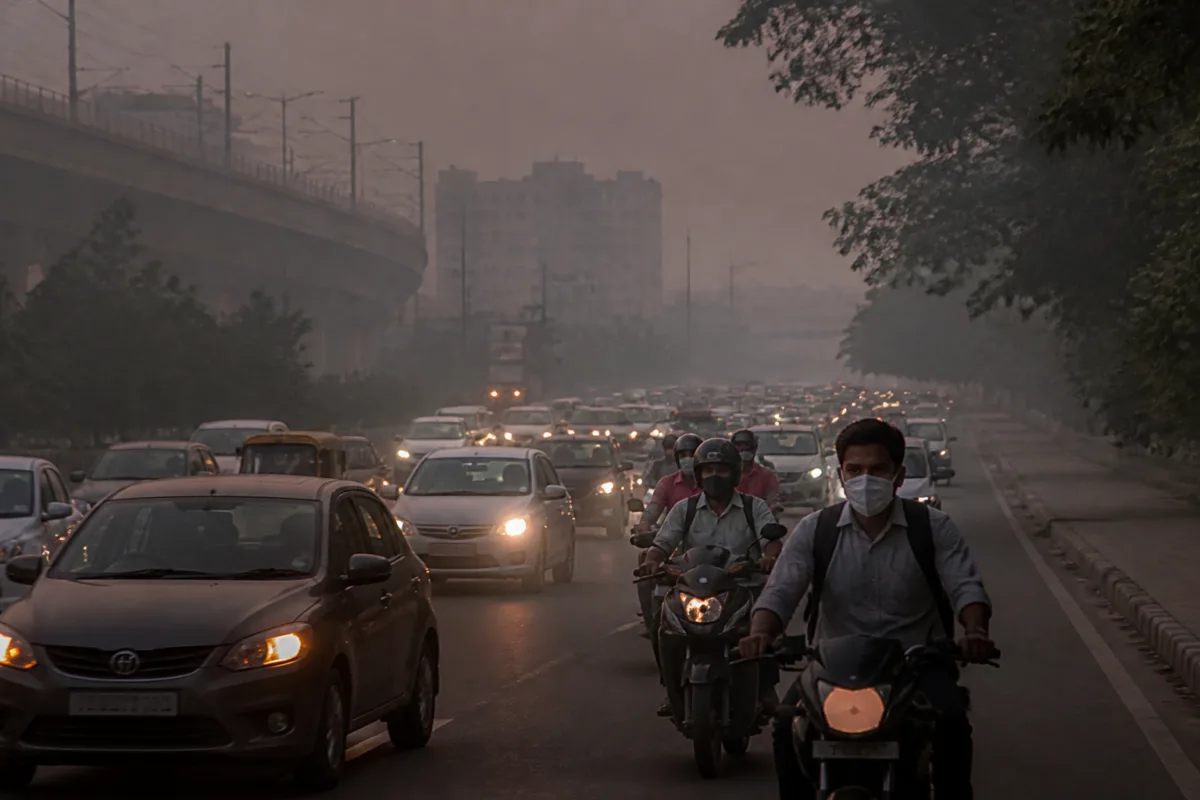
Delhi’s air quality remained in the ‘very poor’ category on Saturday as thick smog reduced visibility across the capital on Diwali eve, with authorities forecasting a shift to the ‘severe’ category on Sunday.
The city’s average Air Quality Index (AQI) stood at 369, improving marginally from 382 on Friday but remaining close to the severe threshold of 400. Of the 59 monitoring stations that recorded data, 16 reported severe air quality while 29 were in the very poor category. The highest reading, 452, was recorded near IIT Delhi.
The Air Quality Early Warning System said air quality was expected to remain in the severe category on Diwali and could fluctuate between severe and very poor levels over the following six days. The forecast places the capital’s pollution episode within a period when weather conditions are limiting the atmosphere’s ability to disperse pollutants.
According to the Central Pollution Control Board’s classification, AQI readings from 301 to 400 are categorised as very poor, while readings between 401 and 500 are classified as severe. The levels reported at several stations therefore indicate that parts of Delhi had already crossed into the most serious category even as the citywide average remained below 400.
Weather and air-quality experts cited in the report attributed the expected deterioration to unfavourable meteorological conditions, Diwali-related celebrations, vehicular emissions and the seasonal increase in stubble burning in neighbouring states. A ventilation index below 6,000 square metres per second, combined with average wind speeds below 10 kilometres per hour, can restrict the dispersion of pollutants, according to the early warning system.
PM10 was the predominant pollutant in Delhi on Saturday. The Decision Support System for Delhi identified transport as the largest contributor to the city’s pollution, accounting for 21.4 per cent of the total. The estimated contribution from stubble burning was 1.7 per cent on Saturday and was forecast to rise to 5.4 per cent on Sunday.
Satellite data recorded 589 farm-fire incidents across six states on Friday. Punjab accounted for 357 incidents, followed by Madhya Pradesh with 139, Rajasthan with 58, Uttar Pradesh with 23, Haryana with nine and Uttarakhand with three. Between September 15 and November 6, 6,226 stubble-burning incidents were recorded across the six states, according to data from the Consortium for Research on Agroecosystem Monitoring and Modelling from Space laboratory at the Indian Agricultural Research Institute.
The readings show how Delhi’s air-quality crisis is shaped by the interaction of local emissions, regional pollution and weather conditions. While transport was identified as the largest contributor in the city’s Saturday assessment, the anticipated rise in farm-fire pollution and the expected impact of Diwali celebrations point to multiple sources operating during the same period.
The Air Quality Early Warning System’s next forecast will determine whether the city’s average AQI moves into the severe category on Sunday, while station-level readings will continue to show how pollution levels vary across Delhi.

