


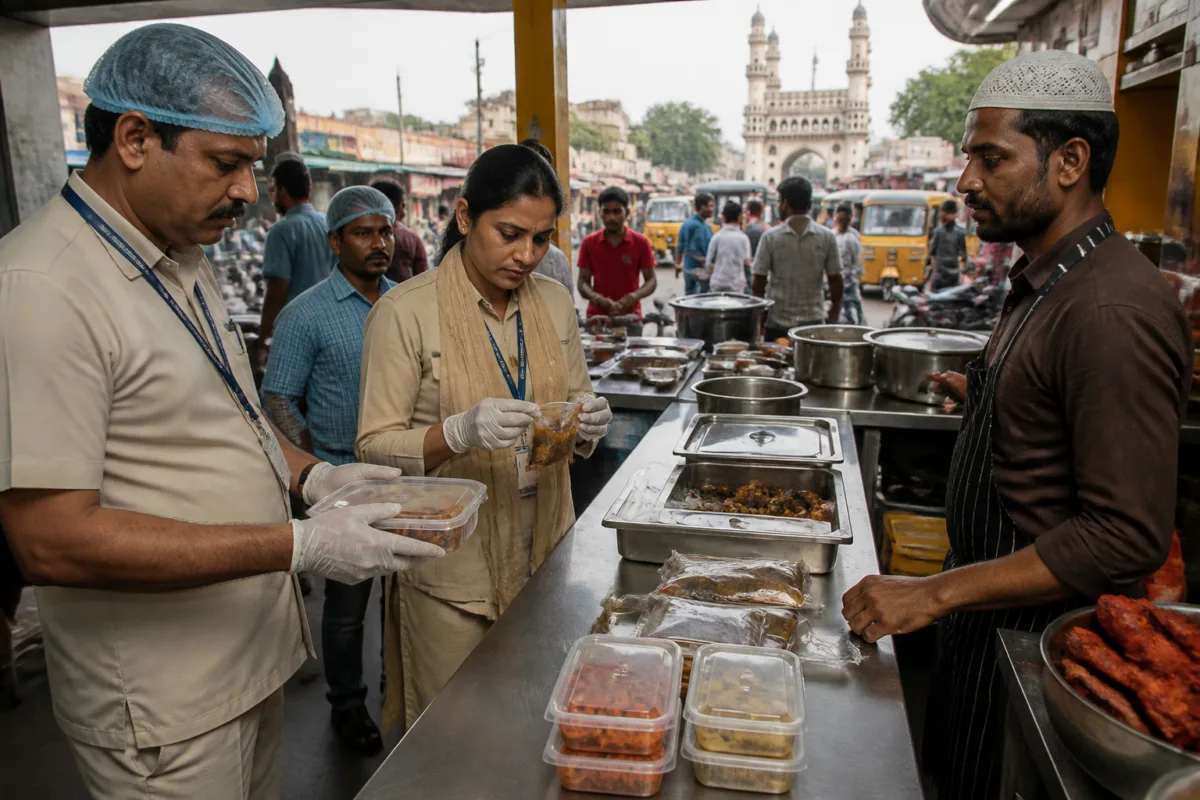
The Telangana High Court has directed food safety authorities to conduct regular inspections across the state and take action against violations, with enforcement to cover both licensed and unlicensed food establishments. The court has also ordered the commissioner of food safety to submit a comprehensive compliance report within eight weeks.
The directions require the commissioner to instruct all district food safety officers and designated officers to strictly enforce the Food Safety and Standards Act, 2006, along with the rules and regulations framed under it. The court stressed that inspections should be continuous, fair, transparent and non-discriminatory, irrespective of the size or location of a food business.
The order came during the hearing of a petition filed by a food business operator challenging the suspension of its licence. During the proceedings, the Telangana government informed the court that the licences of more than 17 food business operators had already been suspended following inspections. It also stated that similar action would be taken against other establishments found violating food safety requirements.
The court directed authorities to identify businesses operating without valid licences or registrations and initiate action in accordance with the law. The inspection drive is to cover restaurants, hotels, bakeries, sweet shops, meat and fish outlets, supermarkets, street food stalls and other establishments involved in selling food.
Food safety officers have also been instructed to collect samples and act against adulterated, expired and contaminated products. The court directed the authorities to establish an effective mechanism for receiving and addressing public complaints about unsafe or unhygienic food, linking enforcement to how residents report and experience food safety concerns.
The court observed that food safety involves public health, fundamental rights and statutory responsibility. Its directions place responsibility on the state food safety commissioner and district-level officers to ensure that enforcement does not remain limited to selected establishments or locations.
The case also brings attention to the administrative structure through which food safety rules are implemented. While the state commissioner is responsible for directing the enforcement system, district food safety and designated officers are expected to carry out inspections, collect samples and initiate action against violations. The court’s compliance requirement gives the state eight weeks to report how these directions have been implemented.
The immediate focus will be on the inspection of establishments without valid licences or registrations, the collection and testing of food samples, action against unsafe products and the functioning of the public complaint mechanism. The commissioner of food safety is required to place the comprehensive compliance report before the court within the stipulated eight-week period.

