


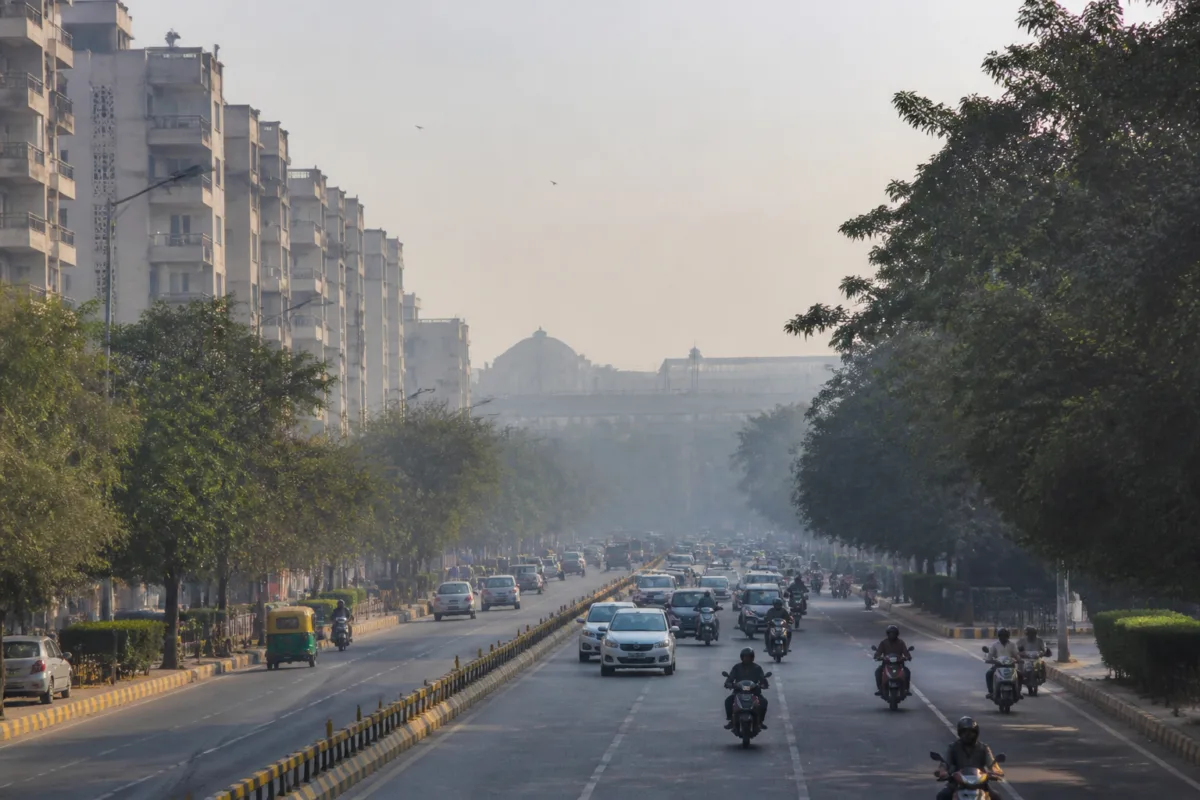
Delhi air quality improved from the ‘very poor’ to the ‘poor’ category on Tuesday after stronger winds helped disperse pollutants that had built up following Diwali, with the city’s average Air Quality Index falling to 299 from 344 a day earlier.
The improvement was the first reported movement into the ‘poor’ category since 1 November. Delhi’s average AQI had risen to 376 on Diwali and stood at 344 on Monday. Although a light layer of smog remained visible on Tuesday morning, visibility was better than on the previous days and pollution levels declined as the day progressed.
The change followed a shift in wind conditions across the National Capital Region. Mahesh Palawat, vice-president of Skymet and a weather expert, said wind direction and speed had changed, with north-westerly winds beginning to influence the Delhi region. Winds of 12-14 kilometres per hour helped disperse pollutants, he said.
Palawat said wind speeds were expected to remain higher over the next few days, which could lead to further improvement in Delhi’s AQI. The report attributed the sharp deterioration around Diwali to firecracker emissions and low wind speed, which limited the dispersal of pollutants.
The regional pollution picture remained severe despite the improvement in Delhi. In Punjab, six major cities — Ludhiana, Jalandhar, Amritsar, Khanna, Mandi Gobindgarh and Patiala — recorded AQI readings in the ‘poor’ category. Ludhiana’s average AQI was 314, placing it in the ‘very poor’ category, while its maximum AQI reached 439. Jalandhar recorded an average AQI of 248 and a maximum of 440.
Punjab Pollution Control Board data cited in the report showed that the state recorded 198 new stubble-burning cases on Monday, taking the total number of cases to 4,657. Adarshpal Vig, former chairman of the Punjab Pollution Control Board, said increasing cold and slow winds in November allowed smoke from firecrackers and stubble burning, along with fine particulate matter, to remain trapped in the lower atmosphere.
Several cities in Uttar Pradesh also continued to record high pollution levels. Aligarh recorded the state’s highest AQI at 353, while Baraut reached 334. Baghpat recorded 277, Gorakhpur 275, Sambhal 266, Bulandshahr 263, Meerut 262, Lucknow more than 250 and Kanpur 235. The report said dense layers of haze were visible in the morning and evening in several parts of the state.
The latest readings show how quickly Delhi’s air quality can change when weather conditions shift, even as pollution sources across the wider region remain active. The immediate next indicator will be whether higher wind speeds continue to disperse pollutants in Delhi and whether fresh stubble-burning and firecracker emissions keep AQI levels elevated in neighbouring states.

