


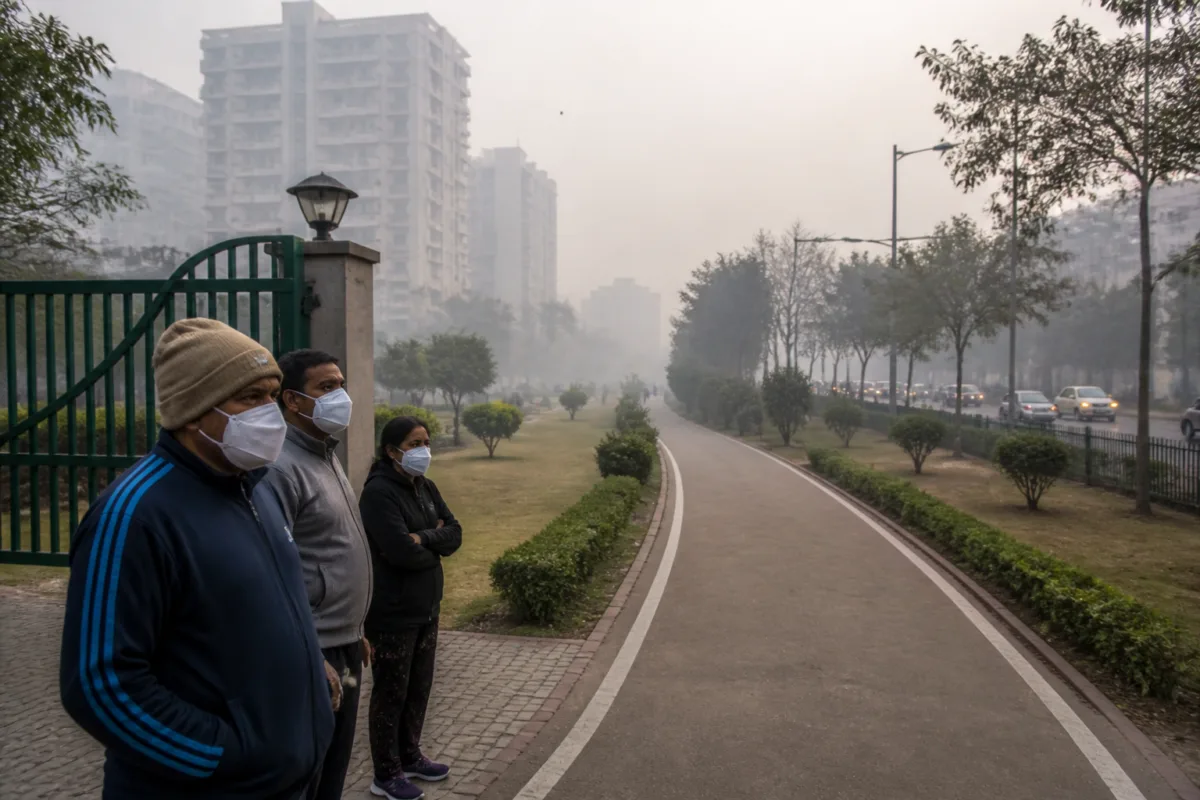
Delhi’s worsening air pollution is forcing a rethink of one of the city’s most routine public-health habits: the morning or evening walk. Experts from the All India Institute of Medical Sciences and other hospitals have advised residents to avoid outdoor exercise when pollution levels are high, warning that fine particles can move deep into the lungs and enter the bloodstream.
The warning, reported by Jagran, is particularly significant because walking, jogging and outdoor workouts are usually treated as accessible ways to maintain health in a city where many residents have limited access to gyms or private recreational spaces. During pollution episodes, however, the timing and location of physical activity can determine how much polluted air a person inhales.
The advice also exposes a wider urban problem. Delhi’s air-quality crisis is not confined to industrial areas, major roads or visibly hazy neighbourhoods. It affects how residents use parks, footpaths, school grounds and open spaces. When outdoor exercise becomes unsafe, the burden shifts to homes, indoor facilities and healthcare systems—resources that are not equally available to all residents.
### Delhi air pollution and the timing of exposure
Professor Anant Mohan, head of the pulmonary department at AIIMS, advised people to avoid morning and evening walks and outdoor exercise when pollution rises. He recommended exercising indoors or in a safer environment instead. The advice also extends to children, who should be encouraged to undertake physical activity indoors during periods of heavy pollution.
The timing of the warning is linked to seasonal conditions. The report states that during cold weather, pollutants can remain concentrated closer to the ground. Early morning and late evening activity may therefore increase exposure to polluted air, especially for people exercising outdoors and breathing more rapidly.
This creates a difficult trade-off for residents. Exercise improves health, but exercising vigorously in polluted air increases the volume of air inhaled and can raise exposure to fine particles. The result is that a public-health recommendation that normally requires more outdoor activity may need to be modified during pollution episodes.
For Delhi’s urban system, the issue is also one of environmental inequality. Residents with access to well-ventilated indoor spaces, air purifiers or private exercise facilities may be able to shift their routines more easily. Those who depend on public parks, streets and open grounds have fewer alternatives when outdoor air becomes hazardous. The supplied report does not quantify this difference, but the need to move activity indoors makes the access question unavoidable.
### What doctors are warning about
AIIMS pulmonary specialist Professor G.C. Khilnani said fine pollution particles can pass from the lungs into the bloodstream and affect the heart, blood vessels and other organs. He also warned that prolonged exposure to polluted air increases the risk of illness.
Former AIIMS director Dr Randeep Guleria said the health effects are not limited to people who already have respiratory or cardiac conditions. According to the report, otherwise healthy people are also experiencing throat irritation, coughing, breathing difficulty and wheezing.
Dr Vikas Maurya, senior director and head of respiratory medicine and respiratory critical care at Fortis Hospital, Shalimar Bagh, said toxic fine particles in polluted air can pass through the nose’s natural filtering system and reach the lungs. The report attributes increased inflammation, worsening asthma and bronchitis, greater pressure on the heart and chest discomfort to exposure to polluted air.
These warnings establish an important distinction between visible discomfort and deeper health effects. A person may not experience immediate severe symptoms but can still be exposed to particles that affect the respiratory and cardiovascular systems. That is why the experts’ advice is directed not only at patients but also at the wider population during pollution episodes.
The groups identified as requiring additional caution include children, older people, pregnant women and people with existing respiratory or heart conditions. For these groups, outdoor activity during high-pollution periods can carry greater health risks, according to the medical experts cited in the report.
### The indoor shift is not a complete urban solution
The immediate response recommended by the doctors is practical: avoid outdoor exercise when pollution is high, move physical activity indoors, keep windows closed during severe pollution and, where possible, use an air purifier with a HEPA filter. People who need to go outside are advised to wear a well-fitting N95 mask. The report says loose cloth masks and surgical masks do not provide sufficient protection against fine PM2.5 particles.
Patients with asthma and chronic obstructive pulmonary disease have also been advised to continue prescribed inhalers and medicines and not stop treatment without medical advice. The report further mentions adequate water intake, foods such as oranges, lemons and amla, and doctor-advised influenza and pneumococcal vaccination as part of the precautions discussed by the experts.
However, moving exercise indoors transfers rather than eliminates the city’s infrastructure problem. It assumes that homes have sufficient space, ventilation that can be managed safely, and the financial ability to purchase or operate air-cleaning equipment. It also raises questions about schools, community centres, public gyms and other shared facilities that could provide safer indoor activity during pollution episodes.
Delhi’s parks and open spaces remain important public-health assets, particularly for residents who cannot afford private facilities. Yet the pollution warning shows that the value of public space depends on environmental conditions. A park may be available, but it cannot function as a safe exercise facility when the surrounding air is heavily polluted.
The report does not provide a specific air-quality reading, duration for the current episode or a government-issued restriction on outdoor activity. Its central message is instead based on medical advice: residents should adjust their routines when pollution levels rise, with vulnerable groups taking greater precautions.
### The governance question behind a health warning
The medical advice points to responsibilities that extend beyond individual behaviour. Residents can alter the time of a walk, wear a suitable mask or exercise indoors, but those measures do not control the sources or persistence of pollution. The city’s response therefore depends on how air-quality information is communicated, how warnings reach schools and neighbourhoods, and whether public institutions can provide safer alternatives.
The supplied report does not identify a new government order, enforcement action or citywide programme linked to the warning. That absence is important. Expert advice can help people reduce exposure, but it is not a substitute for public measures that address pollution at its source or reduce exposure across neighbourhoods.
A citywide health response also needs to recognise that exposure is not evenly distributed. Children may spend time in school or outdoors, workers may have to remain outside, and people who walk or cycle for daily travel cannot always avoid polluted streets. The advice to remain indoors is therefore more feasible for some residents than for others.
The warning also underlines the need for health and urban authorities to communicate in a coordinated way. Medical institutions explain the risks; air-quality agencies measure conditions; schools and municipal bodies manage public facilities; and residents make daily decisions about travel and exercise. Without clear, timely information linking these functions, people may receive fragmented advice or change their behaviour only after symptoms appear.
Delhi air pollution is thus not simply a seasonal inconvenience or a personal health issue. It changes the functioning of public spaces, alters mobility and exercise patterns, and places additional pressure on households and hospitals. The current medical advice confirms the immediate risk of outdoor exposure during high-pollution periods, while the longer-term institutional response remains broader than the health guidance reported here.
For now, the evidence supplied by the report supports a cautious approach: residents should avoid outdoor exercise when pollution is high, vulnerable groups should take additional care, and people with respiratory or cardiac conditions should follow their doctors’ advice. The developments that require monitoring are the city’s air-quality readings, any official public-health advisories, and whether authorities provide practical indoor alternatives as outdoor activity becomes unsafe.

