


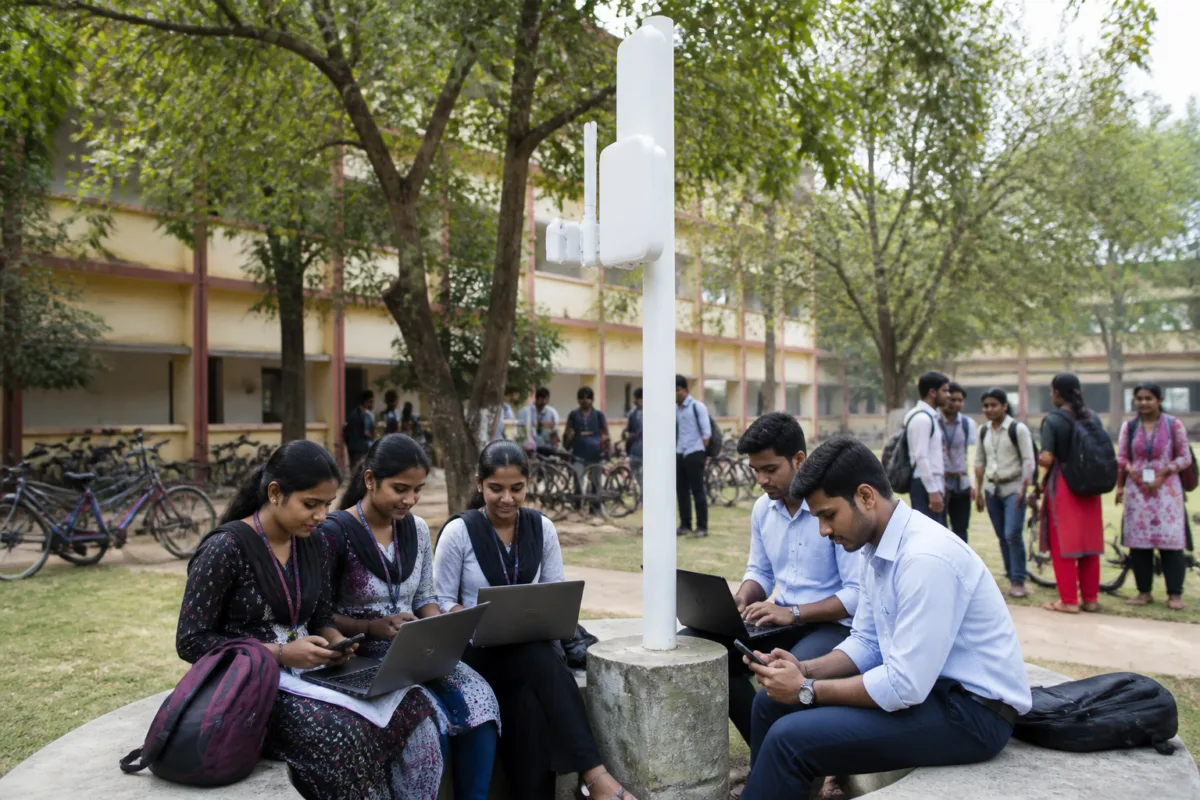
Odisha’s decision to provide free daily Wi-Fi to more than six lakh students, research scholars and teachers is the most visible part of a wider policy package that links digital access with education, public employment, agricultural administration and water infrastructure. Announced alongside the removal of the attempt limit for the Odisha Civil Services examination and new irrigation projects, the measures show how the state is presenting public access—not only welfare delivery—as part of its Viksit Odisha-2036 agenda.
The centrepiece is Odisha Shikshanet, a Rs 393.62-crore digital education initiative cleared by the state cabinet. The programme will provide 1 GB of free high-speed Wi-Fi data daily on campus across 601 government and government-aided colleges and universities. The stated beneficiary group includes students, research scholars and teachers. According to the report, the scheme is intended to improve access to digital learning resources, particularly for students from remote and tribal areas.
That framing is significant because the programme treats the campus as a shared digital-access point rather than limiting connectivity support to individual households. The supplied report does not specify the network architecture, the duration of the benefit, the procurement model, the service-level standards or how usage will be monitored. Those details will determine whether the scheme functions as a dependable education utility or mainly as a headline allocation. The difference matters for institutions where students may depend on campus connectivity for lectures, research material, examinations, applications and public-service information.
The policy also places colleges and universities within the state’s broader infrastructure system. Educational institutions are not only places of instruction; they are nodes through which public services, employment opportunities and digital participation are accessed. Extending Wi-Fi to 601 institutions could therefore reduce one layer of access inequality, but only for people who can reach and use those campuses. The report does not establish whether the service will be available throughout campus premises, whether students will need authentication, or what arrangements will apply during outages and high-demand periods.
The decision to scrap the attempt limit for the Odisha Civil Services examination addresses a different barrier: the cost of repeated participation in a competitive public recruitment system. Candidates will now be allowed unlimited attempts within the prescribed age limit, according to the report. The change does not remove the age ceiling, but it changes how eligible candidates can use the available years. It may be particularly relevant to aspirants who need multiple attempts because of the scale of the examination process, although the supplied material does not provide data on the earlier attempt cap, the number of affected candidates or the administrative date from which the change will apply.
Together, the Wi-Fi programme and the examination decision point to access as a policy theme. One expands access to digital learning infrastructure; the other removes a formal restriction on repeated participation in a public examination. Yet access is not created by formal eligibility alone. It also depends on the reliability of infrastructure, the availability of information, the ability to travel to institutions, and the capacity of departments to process applications and deliver services within stated timelines.
The government’s social-security announcement adds an administrative dimension to that question. BJP state spokesperson Tejeshwar Parida said that more than 5.05 lakh new beneficiaries had been brought under social-security schemes, ending the wait faced by eligible applicants. He also said future beneficiaries would receive assistance within days of applying. The report does not identify the individual schemes, the value of assistance, the number of pending applications before the decision, or the system through which the promised turnaround will be measured. Those omissions limit an assessment of whether the change represents a one-time clearance of pending cases or a durable redesign of welfare administration.
For urban governance, the distinction between announcement and delivery is central. A public programme can have a large approved outlay or a large beneficiary target while producing uneven results if implementation is fragmented. Odisha Shikshanet involves hundreds of institutions. Social-security delivery involves eligibility checks, applications and beneficiary records. The sharecropper registration system involves landowners, cultivators, procurement agencies and digital authentication. Each requires coordination across institutions rather than a single department acting alone.
The cabinet’s agriculture-related measure seeks to address one such coordination problem. For sharecroppers, the state has introduced Aadhaar-linked biometric authentication and a digital consent app through which landowners can approve paddy-procurement registrations remotely. The stated purpose is to enable registration without requiring landowners to be physically present. This could reduce an administrative obstacle for cultivators whose access to procurement systems depends on consent or land-related verification. However, the report does not detail how disputes, failed authentication, lack of smartphones, connectivity problems or consent withdrawal will be handled.
The use of biometric and app-based systems also makes institutional safeguards important. The supplied report does not state what alternative process will be available to people who cannot complete digital authentication, nor does it describe the data-protection or grievance-redress arrangements. These are not peripheral questions. When access to procurement registration is connected to a digital workflow, a technical failure can become an economic barrier unless there is a functioning offline or assisted channel.
The irrigation decisions extend the package beyond digital and administrative access. The cabinet approved seven mega lift-irrigation projects in Nuapada district, expected to irrigate around 8,800 hectares across 59 villages. It also cleared the 600 MW Upper Indravati Pumped Storage Project in Kalahandi and approved a new in-stream storage project in drought-prone Titilagarh intended to improve irrigation and drinking-water supply.
The numbers indicate a geographically distributed infrastructure agenda: seven irrigation projects, 59 villages and about 8,800 hectares in Nuapada, alongside a large energy-storage project and a water project in Titilagarh. But the report does not provide project costs, construction schedules, command-area details, land requirements, source rivers, financing arrangements or completion dates. It also does not explain how the pumped-storage project will be integrated into the electricity system. Without those details, the decisions can be understood as approvals and stated objectives, but not yet as evidence of completed capacity.
The combination of irrigation and pumped storage is notable because it places water security, agricultural production and electricity infrastructure in the same policy frame. The stated objectives are different—irrigation for villages, drinking water in a drought-prone area and 600 MW of pumped storage—but all depend on the management of water, land and large public works. Their eventual effect will depend on clear institutional responsibility, construction progress, operation and maintenance, and the ability to reach the communities identified in the announcement.
The package therefore reveals a recurring challenge in state-led development: the distance between approval, access and outcome. An approved Wi-Fi programme is not the same as usable connectivity. A relaxed examination rule is not the same as an affordable or fair recruitment pathway. A digital procurement app is not the same as frictionless registration. An irrigation project is not the same as water reaching a field, and a storage project is not the same as electricity being available when the grid needs it.
The immediate evidence confirms a broad set of government decisions and stated beneficiary targets. It does not yet establish implementation performance, delivery timelines or the safeguards that will govern access. The next meaningful milestones will be the operational rollout of Odisha Shikshanet across 601 institutions, the notification governing unlimited OCS attempts, the functioning of the sharecropper consent system, and the detailed execution plans for the Nuapada, Kalahandi and Titilagarh projects. Those steps will show whether the package becomes a connected public-service system or remains a collection of separate announcements.

