


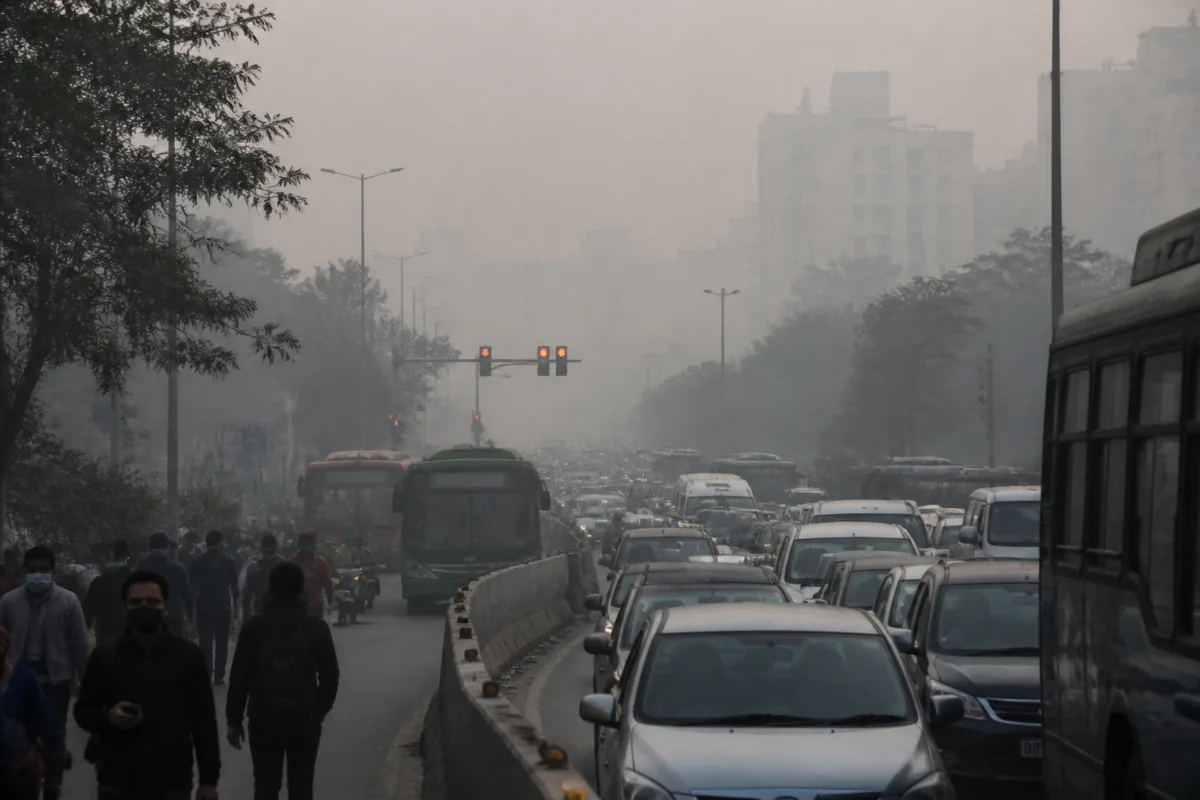
Delhi’s winter air pollution problem is exposing the limits of a city-management model that repeatedly escalates emergency restrictions but has not produced sustained improvement in air quality. An analysis by the Centre for Research on Energy and Clean Air (CREA) found that the average winter Air Quality Index rose from 280 in 2022-23 to 295 in 2025-26, even as restrictions under the Graded Response Action Plan were imposed on nearly four in five winter days.
The finding does not establish that the Graded Response Action Plan, or GRAP, caused pollution to worsen or failed in every respect. It does, however, raise a more consequential question for Delhi’s pollution governance: can emergency measures designed for severe episodes deliver clean air when the underlying emissions continue to generate repeated crises?
That distinction matters because GRAP is principally a response framework. It is activated when air quality deteriorates and introduces progressively stricter restrictions as pollution reaches higher stages. The framework is therefore designed to limit exposure and reduce additional emissions during a crisis. It is not, by itself, a substitute for a long-term programme that reduces pollution at its sources.
CREA examined 12 episodes in which Delhi’s AQI rose from below Stage III to Stage III or IV. The study assessed three episodes in each of the four winters covered. In 10 of those episodes, pollution worsened in the week after the city entered the severe GRAP stages, while it eased after two episodes. The pattern suggests that restrictions were frequently being deployed during periods when pollution was already moving into a prolonged and severe phase.
The largest increase identified by CREA followed the November 2, 2023 episode. Average AQI rose by 114 points, from 317 before the episode to 431 afterwards. Other major increases followed episodes on October 29, 2022, when the AQI rose by 100 points, and January 3 and January 28, 2025, when it increased by 94 and 92 points respectively.
These figures describe what happened after the episodes; they do not, on their own, prove why it happened. Weather conditions, the movement and accumulation of pollutants, and the timing of restrictions can all affect the sequence observed in an AQI record. CREA itself cautioned that its analysis does not show that restrictions caused pollution to increase or that they were ineffective.
This is the central analytical challenge in assessing emergency pollution policy. A city can experience worsening air after restrictions are announced for at least two different reasons. The measures may be too limited or too late to counter the pollution already present. Alternatively, the conditions producing the episode may be so severe that air quality would have deteriorated even more without the restrictions. A before-and-after comparison alone cannot fully separate those possibilities.
A separate study by scientists from IITM-Pune and the Commission for Air Quality Management offers evidence for the second possibility. Its assessment, titled “Possible effectiveness of Graded Response Action Plan restrictions in New Delhi, India”, found that without GRAP restrictions, the city would have experienced 60% more severe-AQI hours. It also estimated that the number of periods exceeding 30 severe-plus AQI hours could have been around 60% to two times higher without the curbs.
The two studies therefore do not necessarily cancel each other out. They examine different questions. CREA’s analysis focuses on the city’s continued pollution levels and the pattern of AQI after severe episodes. The IITM-Pune and CAQM study estimates what conditions might have looked like without GRAP. One points to the limits of the current response; the other indicates that the response may still be preventing a worse outcome.
Together, the findings suggest that GRAP may be functioning as a damage-limitation mechanism rather than a clean-air strategy. It can reduce the duration or intensity of severe pollution compared with a scenario without restrictions, while still leaving Delhi with persistently dangerous winter air. This distinction is important for both public communication and policy evaluation. A measure can be beneficial relative to no intervention and still be inadequate as the principal method of achieving acceptable air quality.
The numbers also show the administrative burden created by a response system that is repeatedly activated. Nearly four in five winter days saw restrictions at Stage II or higher, according to CREA. Such frequency indicates that emergency controls are no longer occasional interventions confined to exceptional episodes. They have become a recurring part of winter governance in the capital.
That recurring use changes the meaning of the framework. Restrictions on construction and other activities, when imposed repeatedly, affect workers, businesses, project schedules and urban services. Yet the supplied evidence does not quantify those costs or establish how consistently individual measures were implemented. It does show that the city remains dependent on a system that is triggered after pollution has already reached dangerous levels.
The institutional issue is therefore not simply whether GRAP should be imposed. It is whether the responsibilities and tools of the agencies involved are sufficient to reduce emissions before the emergency threshold is crossed. CREA’s conclusion is explicit: a long-term clean-air strategy should prioritise emission reduction at source, with GRAP serving as the last line of defence when severe pollution still occurs.
That approach reframes the policy sequence. Emergency restrictions are intended to respond to an immediate episode. Source reduction addresses the activities and conditions that repeatedly produce those episodes. The first can be measured through restrictions, AQI levels and severe-pollution hours. The second requires evidence of sustained changes in emissions, but the supplied material does not provide a breakdown of which source categories contributed to the winter trend or how their emissions changed across the four years.
This missing information is significant. The average winter AQI increased from 280 to 295 between 2022-23 and 2025-26, but that aggregate figure does not identify the causes of the increase or show how pollution varied by month, location or pollutant. Similarly, the 12 episodes examined by CREA provide a focused view of severe events, not a complete account of every winter day. The findings are strong enough to question the current balance between emergency response and prevention, but not to assign responsibility to a particular source or agency.
The evidence also argues against treating AQI outcomes as a simple pass-or-fail test of GRAP. If the IITM-Pune and CAQM estimate is correct, the restrictions prevented substantially more severe pollution than Delhi would otherwise have experienced. But if CREA’s broader winter comparison is also correct, the intervention has not delivered a sustained improvement in average winter air quality. Both conclusions can be true at the same time.
For Delhi’s residents, this distinction has a practical consequence. A GRAP announcement may reduce the severity of an episode without making winter air consistently clean. The framework can provide a layer of protection while leaving residents exposed to repeated periods of high pollution. That is why the effectiveness of emergency curbs cannot be judged only by whether they are imposed, or only by whether AQI worsens after they begin. It must also be assessed against the longer-term trend.
The four-winter record presented by CREA points to a governance gap between crisis response and pollution prevention. Delhi has a mechanism for escalating restrictions when air quality becomes severe. The evidence supplied here is less clear about whether the city has achieved a comparable reduction in the emissions that make such escalation necessary. Until that distinction is addressed through source-level evidence and sustained monitoring, GRAP will remain essential as a defensive measure—but insufficient as the city’s main clean-air strategy.

