


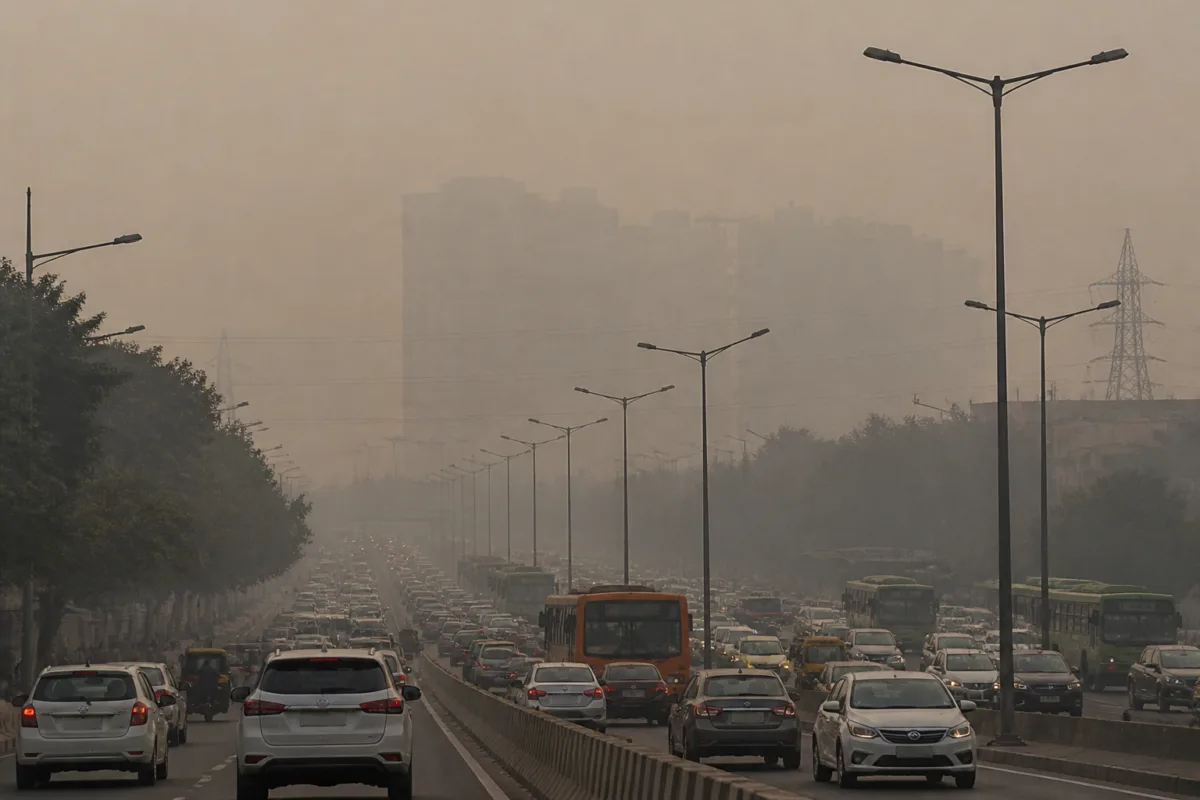
Delhi’s air quality remained in the very poor category on Saturday, with the 24-hour average Air Quality Index reaching 367, although forecast rain could bring limited relief over the next two days. The India Meteorological Department (IMD) provided the weather-related assessment on Friday, while the city’s air-quality early warning system indicated a possible marginal improvement in pollution levels.
The air-quality warning system forecast a reduction in particulate matter, including PM2.5 and PM10, during the following two days. The expected improvement is linked to the possibility of rain, which may help reduce the concentration of pollutants in the air. The forecast, however, described the improvement as marginal rather than a major change in conditions.
Pollution levels varied significantly across the capital’s monitoring network. Of the 59 stations that recorded data on Saturday, 17 reported air quality in the severe category, 38 recorded very poor air quality, three reported poor conditions and one station recorded moderate air quality.
Delhi’s citywide average AQI showed only a small improvement from Friday, when it stood at 373. A dense layer of haze had reduced visibility in several parts of the capital on Friday, with the effect particularly pronounced during the morning. Residents reported breathing difficulties and respiratory discomfort as the brownish haze persisted through the day.
The pollution build-up was linked in the report to unfavourable weather conditions and slow wind speeds, which kept pollutants concentrated close to the ground. Under the Central Pollution Control Board’s classification, an AQI between 301 and 400 is considered very poor, while readings from 401 to 500 fall in the severe category. The CPCB scale also classifies AQI readings from 0 to 50 as good, 51 to 100 as satisfactory, 101 to 200 as moderate and 201 to 300 as poor.
PM10 was identified as the principal pollutant in the capital on Saturday. Data from the Decision Support System showed that transport contributed the largest share of Delhi’s pollution, at 20.5 per cent. Stubble-burning incidents accounted for 13.3 per cent of the city’s total pollution contribution, according to the report.
Satellite data recorded 537 stubble-burning incidents across six states on Saturday. The figures listed in the report included 214 incidents in Punjab, 11 in Haryana, 33 in Uttar Pradesh, 33 in Rajasthan and 246 in Madhya Pradesh. The reported contribution from agricultural fires formed part of a wider pollution mix in which transport and weather conditions also played a significant role.
The immediate forecast is for a possible modest improvement in Delhi’s air quality as rain and changing conditions affect particulate concentrations over the next two days. The city’s monitoring stations and the air-quality warning system will provide the next indicators of whether the anticipated relief materialises.

