


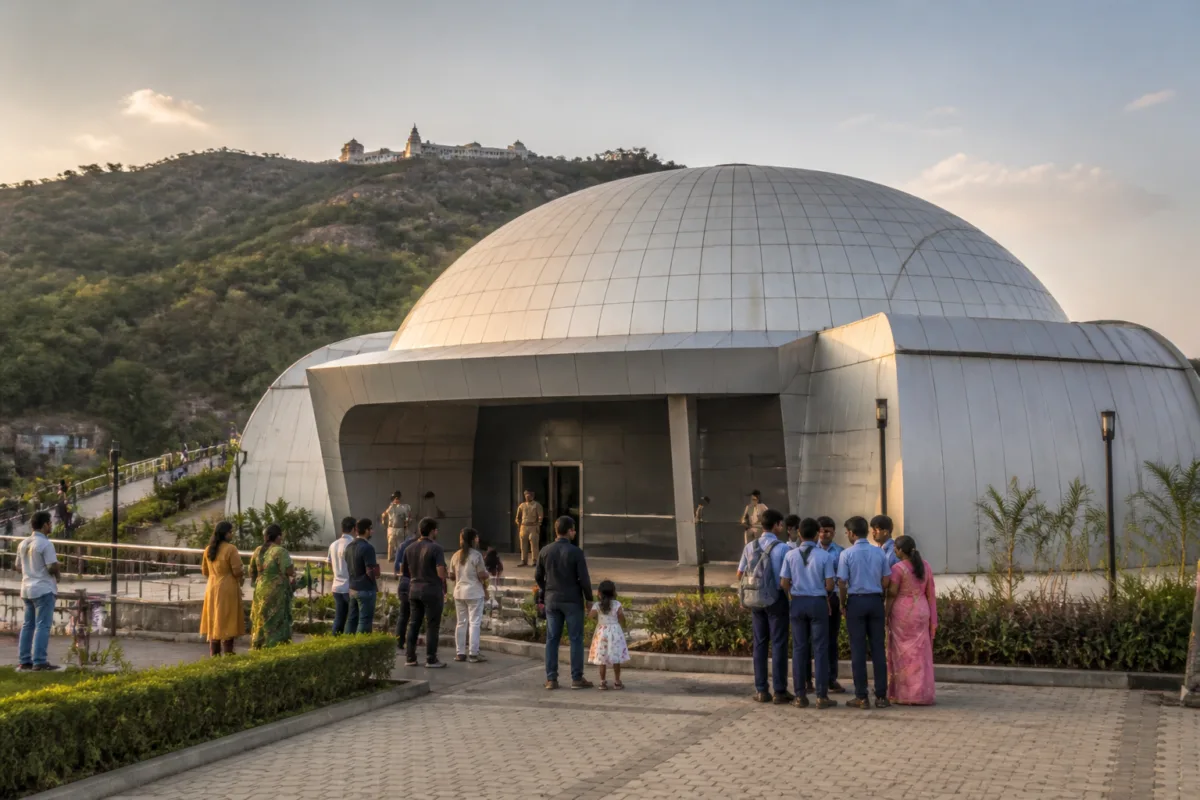
The Cosmos-Mysuru planetarium at the foothills of Chamundi Hill has not yet opened to the public, 10 days after its inauguration, leaving visitors and students unable to access a facility built at a reported cost of ₹115 crore.
The planetarium was inaugurated on November 13 by Prime Minister Narendra Modi, who also visited the facility and reviewed its operations, according to Prajavani. The event generated significant public interest, prompting visitors from outside Mysuru, local students and people interested in science and astronomy to visit the site.
However, visitors are still being denied entry. Prajavani reported that security personnel have not been able to provide a clear date for the public opening, while the department concerned has not issued an official public update. People visiting Chamundi Hill have been approaching the planetarium to enquire about access, only to return disappointed, the report said.
“ I had taken my son there because he wanted to see the planetarium. But we were not allowed in, and the security staff could not give a clear answer about when access would begin,” Mysuru’s Gokulam resident Pavan was quoted as saying.
A planetarium scientist told Prajavani that testing of the high-tech equipment was under way and that technical staff were receiving training. The scientist said the advanced systems required extensive training, including instruction in server-system management, and that public access would therefore not be permitted for the time being.
The scientist also said that the entry fee had not yet been decided. Public access could take several more weeks after training and related decisions are completed, with an expectation that the facility could open by the end of December, according to the report.
The facility is described as India’s first LED curved-dome planetarium. It has a 15-metre-diameter sky theatre with 160 seats and a 15-degree inclined LED dome. Its 353.4-square-metre display surface is reported to provide 42-megapixel resolution, exceeding standard true 8K capability.
Unlike conventional projection-based systems, the dome uses closely arranged LED panels that emit light directly from the interior surface. A high-capacity computer system with 14 GPUs and Sky Explorer software is intended to create immersive visualisations, including connections with remote locations such as Hanle in Ladakh, identified in the report as India’s first dark-sky reserve.
The delayed opening highlights the gap between inaugurating a public facility and making it operational for citizens. Until testing, staff training, access arrangements and ticketing decisions are completed, the planetarium’s public educational and visitor functions will remain unavailable.

