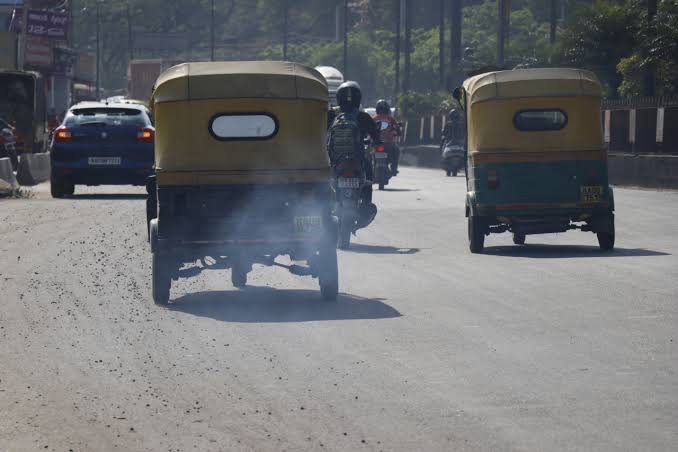
Bengaluru’s growing vehicle population is increasingly shaping the city’s nitrogen dioxide pollution profile, with the Karnataka State Pollution Control Board identifying vehicular emissions as a significant concern. The finding puts the city’s transport growth under scrutiny as rising motorisation adds pressure not only to road capacity but also to urban air quality.
Nitrogen dioxide, or NO₂, is a gaseous pollutant produced largely through fuel combustion. In a city dominated by road-based travel, vehicle exhaust becomes an important source, particularly around busy roads and junctions where traffic volumes remain high. The concern comes as Bengaluru continues to add vehicles while its urban footprint expands. New residential layouts and employment districts have increased the distance between homes and workplaces, creating greater dependence on cars, two-wheelers, buses and other motorised transport. For residents, the problem extends beyond the familiar issue of traffic congestion. Vehicles moving slowly or remaining in queues continue to burn fuel, keeping emissions concentrated close to the streets where pedestrians, cyclists, traffic personnel, roadside workers and nearby residents are exposed. The city’s air-quality challenge also illustrates why vehicle numbers alone cannot be treated as a mobility statistic. More vehicles mean greater demand for road space, parking and fuel, while congestion can increase the amount of time vehicles spend travelling. Even as newer vehicles become cleaner, rapid growth in the overall fleet can offset part of those gains.
Bengaluru’s expanding metro network offers one route towards reducing dependence on private vehicles, but rail cannot solve the problem by itself. Commuters need reliable buses, safe footpaths, cycling routes and convenient last-mile connections to make public transport practical for daily journeys. The location of new housing and employment is equally important. Development that places large residential populations far from workplaces can lock households into long motorised commutes. Better coordination between transport infrastructure, housing and employment centres could reduce the need for cross-city travel. Electric vehicles can help lower tailpipe emissions, but they do not remove congestion or the demand for road space. A long-term response therefore needs to combine cleaner vehicles with fewer unnecessary private-vehicle trips. Air-quality monitoring will also be important. Tracking NO₂ levels across major traffic corridors can help identify hotspots and assess whether transport interventions are producing measurable improvements. More localised data could also help planners target measures where exposure is highest. The economic implications are significant. Poor air quality can affect worker productivity, public health and the overall liveability of neighbourhoods. For a city whose economy depends heavily on a large daily workforce moving across metropolitan distances, transport efficiency and clean air are closely connected. Bengaluru’s vehicle growth therefore presents a planning challenge rather than simply an environmental one.
Expanding public transport, improving pedestrian access and encouraging more compact, mixed-use development can reduce pressure on both roads and the atmosphere. The KSPCB findings reinforce the need to treat mobility and air quality as interconnected urban systems. Bengaluru’s future growth will be more resilient if increased economic activity does not automatically translate into more private-vehicle dependence and higher roadside pollution.