


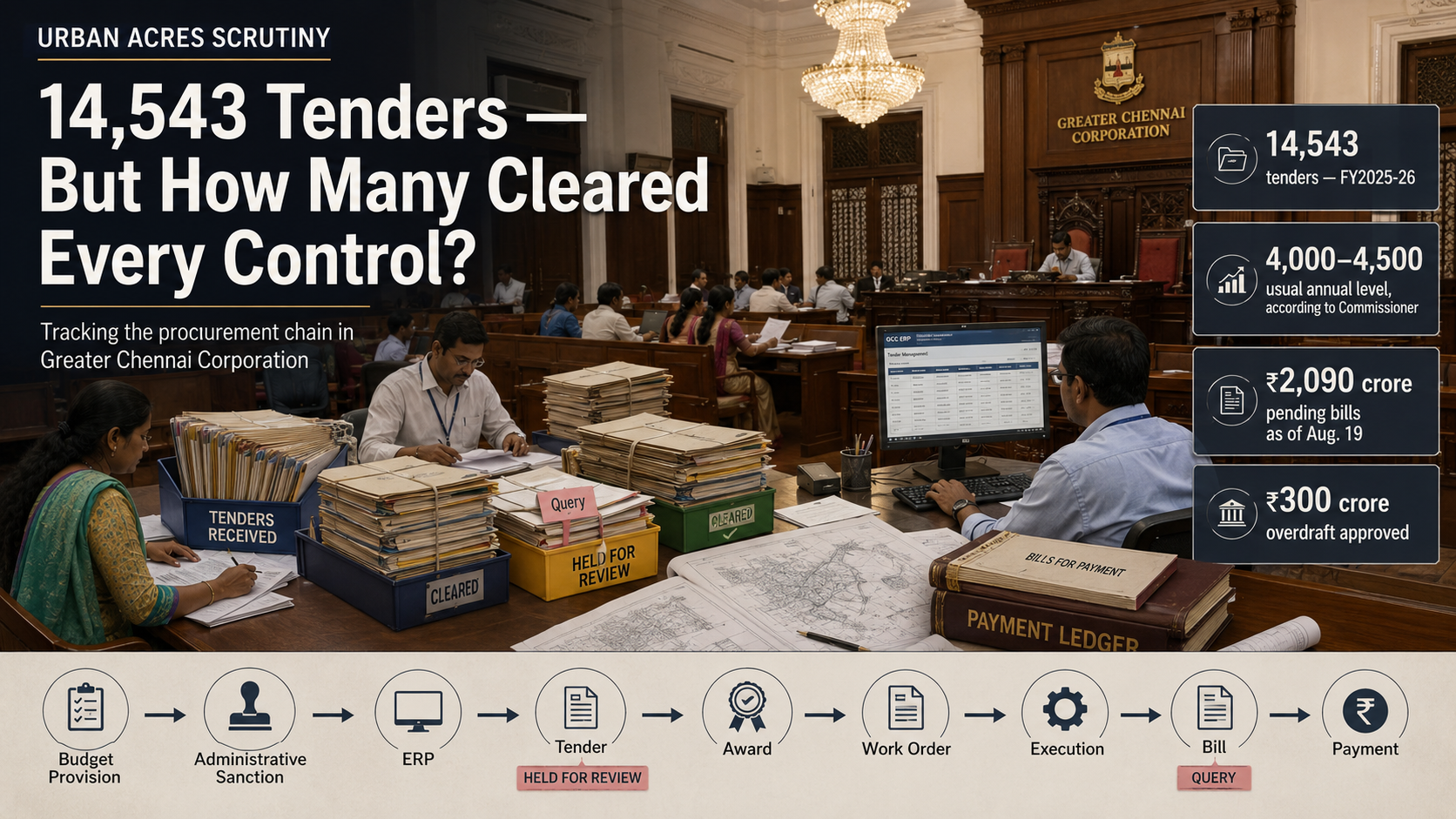
Greater Chennai Corporation’s tender count more than tripled in FY2025-26. But the more consequential disclosure is that some works allegedly moved outside normal administrative-sanction, budget and ERP controls while the civic body accumulated thousands of crores in pending bills.
CHENNAI: Greater Chennai Corporation’s extraordinary procurement year has become an accountability question after Commissioner G.S. Sameeran disclosed that the civic body called 14,543 tenders in FY2025-26, compared with what he described as a normal annual level of about 4,000 to 4,500.
The number is striking. It is not, however, the most important fact.
What matters is Sameeran’s accompanying disclosure at the August 28 Corporation Council meeting: several works from the previous financial year had, according to him, proceeded without completing the prescribed sequence of financial provision, administrative sanction and entry into the Corporation’s Enterprise Resource Planning system. Some works had also been undertaken without tenders, he said. A Finance Department exercise is now examining the affected cases.
That changes the story from one about procurement volume into one about municipal commitment control.
A tender is only one stage
GCC’s own explanation before the Council illustrates why the 14,543 number should be handled carefully.
A municipal work must first have the authority and financial provision to exist. It then needs to enter the city’s administrative and financial systems before procurement, bidder selection, award, work order, execution and eventual payment.
Calling a tender therefore does not mean that a contract was awarded. An award does not mean that construction began. Execution does not necessarily mean that the bill has been paid.
This distinction matters because the current controversy appears to span several different failures: tendered works for which work orders were reportedly not issued, works allegedly undertaken before required approvals, and works that may have generated liabilities beyond the city’s immediately available finances.
Why ERP matters
ERP can sound like an administrative detail. It is actually central to the issue.
A functioning municipal financial-management system should connect a project to its sanction, budget head, procurement record, contractor, work order, measured work, certified bill and payment.
If physical work can begin outside that chain, the Corporation faces several risks simultaneously: expenditure can exceed available provision; liabilities can surface only after work has been completed; duplicate or unauthorised commitments become harder to detect; contractor bills can accumulate; and the Council loses visibility over what the city has actually committed to pay.
GCC’s Financial Management Unit is officially responsible for budget preparation, receipts of loans and grants and oversight/control of expenditure.
The audit therefore needs to establish whether the problem was isolated non-compliance or whether the city’s pre-commitment controls were systematically bypassed.
The payment problem makes the procurement problem more consequential
This scrutiny is occurring while GCC is experiencing substantial cash-flow pressure.
At the August 28 Council meeting, the Corporation was reported to have ₹2,090 crore in pending bills as of August 19, including ₹1,280 crore in capital bills and ₹809 crore in revenue bills. The Council approved a ₹300-crore overdraft facility for pending payments and other immediate requirements.
The overdraft should not be described as new infrastructure funding. It is a financing instrument intended to bridge a cash-flow gap.
The relationship between the procurement surge and the payment backlog now requires detailed reconciliation.
There is supporting evidence that expenditure commitments had become difficult to absorb. In July, a GCC official told DT Next that multiple works in the previous year had been taken up under capital expenditure “beyond our limits”, while property-tax receipts were being used to settle outstanding contractor dues.
That does not prove that the 14,543 tenders caused GCC’s financial stress. Revenue expenditure, operation-and-maintenance contracts and other liabilities also contribute to the backlog.
But it makes one question unavoidable: what value of works did GCC commit itself to during FY2025-26, and how much of that commitment had an identified budget source before procurement began?
Earlier cancellations suggest this is not an entirely new concern
The August disclosure also follows an earlier GCC review.
Around 150 low-value tenders worth roughly ₹17 crore were cancelled in June after the commissioner said officials had found procedural issues, including inadequate opportunity for bidding and cases involving direct quotations.
Again, that should not be extrapolated to the entire procurement universe.
Tamil Nadu law itself recognizes specific categories of low-value procurement and exceptions. Under the published rules, low-value thresholds currently include procurements below ₹50 lakh for construction and ₹25 lakh for most other categories.
The correct test therefore is not whether every GCC procurement used an identical competitive procedure. It is whether the method used in each case was legally available, properly authorised, documented and justified.
Tender volume alone can mislead
There may also be perfectly legitimate reasons for a municipality as large as Chennai to issue thousands of separate tenders.
GCC operates roads, drains, public buildings, parks, street infrastructure, public-health facilities, solid-waste systems and numerous small ward-level assets across 15 zones. Small geographically distributed works can generate large numbers of procurement packages.
Fragmentation can sometimes expand competition or accelerate local execution.
But excessive fragmentation can also create a different set of risks: thousands of small files are harder to supervise, repeated procurement can increase administrative overhead, and packaging decisions can affect the level of approval or competition required.
There is currently insufficient public evidence to establish which explanation dominates Chennai’s 14,543-tender year.
That is precisely why GCC should publish the underlying data.
Residents experience procurement failure as service failure
For residents, procurement controls are not an abstract finance-department concern.
At the same Council meeting, councillors complained about the progress of stormwater drain, desilting and road works ahead of Chennai’s northeast monsoon. Some linked the delays to contractor payments and staffing constraints.
The citizen-facing chain is straightforward:
Sanction → Procurement → Work order → Contractor mobilisation → Construction/maintenance → Bill certification → Payment → Reliable service
A failure near the beginning of that chain can eventually appear on the street as an unfinished drain, delayed road repair, stalled maintenance contract or contractor unwilling to mobilise without payment.
The measure of procurement governance is therefore not the number of tenders issued. It is whether Chennai can convert properly authorised contracts into timely, durable public services without generating unfunded liabilities.
What the audit now needs to establish
The Finance Department review should not end with a aggregate statement that some files were irregular.
For every questioned work, GCC should identify the project, department, zone, procurement method, estimated value, administrative-sanction date, budget provision, tender date, bidder participation, award value, work-order date, physical status, bill value, amount paid and the exact procedural departure identified.
It should also separate four fundamentally different categories:
procedural irregularity, financial over-commitment, procurement non-compliance and completed work awaiting legitimate payment.
They are not interchangeable.
A contractor who completed duly authorised work but has not been paid poses a different governance issue from a work that began without sanction.
Likewise, a tender cancelled before award cannot be treated as expenditure already incurred.
The next Council meeting is now the accountability deadline
Sameeran told councillors that the affected tenders would be reviewed and an explanation presented at the next Council meeting.
That presentation should answer a more useful question than why 14,543 tenders were issued:
How many of them passed every financial and administrative control required before Chennai became liable to pay?
That is the number the public needs next.
