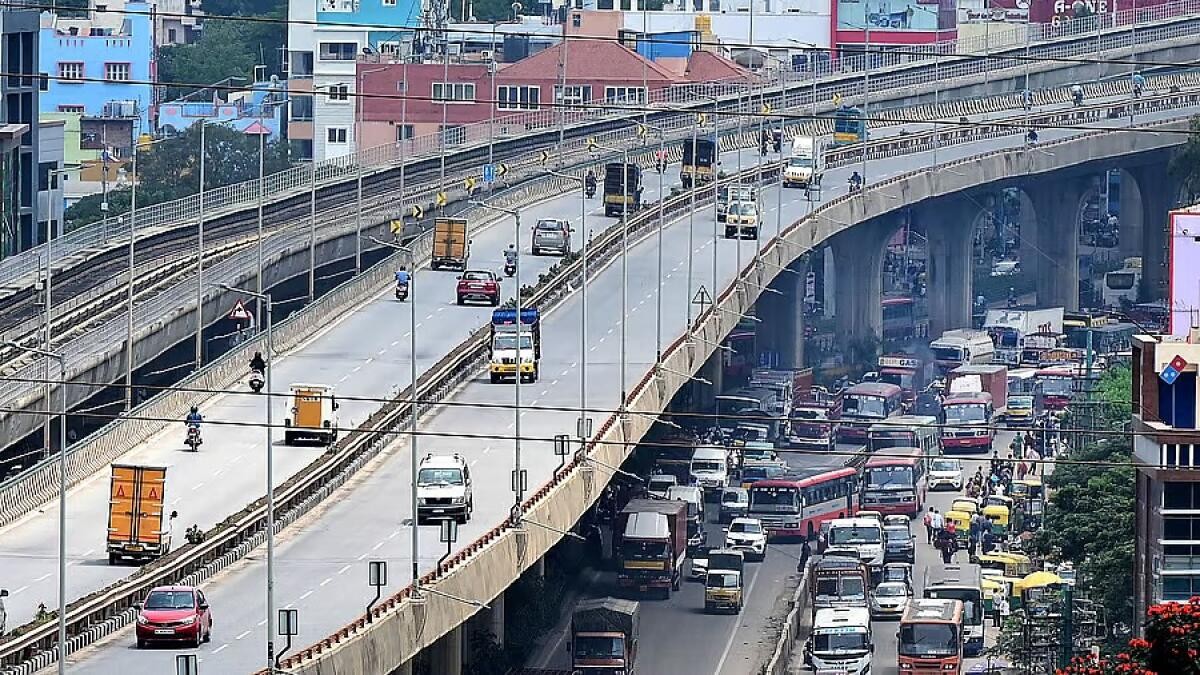
Bengaluru Flyovers Struggle Between Green And Grey
Bengaluru’s attempt to bring greenery onto its flyovers is revealing a wider urban-design challenge: planting vegetation on elevated road structures does not automatically create a functional green space. Recent concerns around plants and trees on flyovers point to questions over root space, irrigation, maintenance and whether such interventions can deliver meaningful environmental benefits without compromising infrastructure.
The Bengaluru flyovers in question reflect the city’s growing interest in integrating greenery into heavily engineered transport corridors. While planting along roads and structures can improve visual quality, the conditions on elevated decks are fundamentally different from those at ground level. Limited soil depth, intense sunlight, wind exposure and restricted access can make long-term plant survival difficult. The problem is particularly relevant in Bengaluru, where the demand for additional road capacity has grown alongside concerns about heat, air pollution and the loss of natural vegetation. Green infrastructure is increasingly being considered as part of the city’s response, but its effectiveness depends on selecting locations and planting systems suited to local conditions. On flyovers, conventional trees may not always be the most appropriate solution. Structural loading limits, root growth and water requirements need to be considered before planting.Without adequate irrigation and maintenance, vegetation can deteriorate rapidly, turning an intended green intervention into another neglected urban asset. For Bengaluru flyovers, the issue also raises a question about where limited public resources should be directed. Green infrastructure can provide greater environmental value when it supports shade, stormwater absorption, biodiversity and pedestrian comfort. Ground-level parks, avenue trees, restored lakes, wetlands and continuous shaded walking corridors can deliver several of these functions simultaneously. Elevated road structures offer fewer such opportunities.
Their primary purpose is moving vehicles, and their environmental footprint is largely determined by the wider transport system in which they operate. Adding plants may improve the appearance of a structure, but it does not compensate for inadequate public transport, excessive road demand or fragmented pedestrian infrastructure. Urban planners increasingly distinguish between decorative landscaping and functional green infrastructure. The latter is designed to provide measurable benefits such as cooling, rainwater management, habitat creation or improved public-space quality. Bengaluru’s future projects could benefit from applying these criteria before investing in greenery around transport structures. The maintenance question is equally important. Bengaluru has numerous examples of infrastructure that initially receives attention but becomes difficult to sustain once routine upkeep is overlooked. Any planting programme on flyovers therefore needs a defined maintenance responsibility, reliable water supply and periodic assessment of whether the vegetation remains viable. The lesson from the city’s Bengaluru flyovers is not that greenery and transport infrastructure are incompatible. Rather, green interventions need to be designed around the physical and ecological realities of each site.
As Bengaluru expands its road and transit infrastructure, the more useful goal is to build a connected green network at street level while using elevated structures selectively for planting. That approach could deliver greater climate resilience, pedestrian comfort and ecological value than treating greenery as an addition to every concrete surface.