


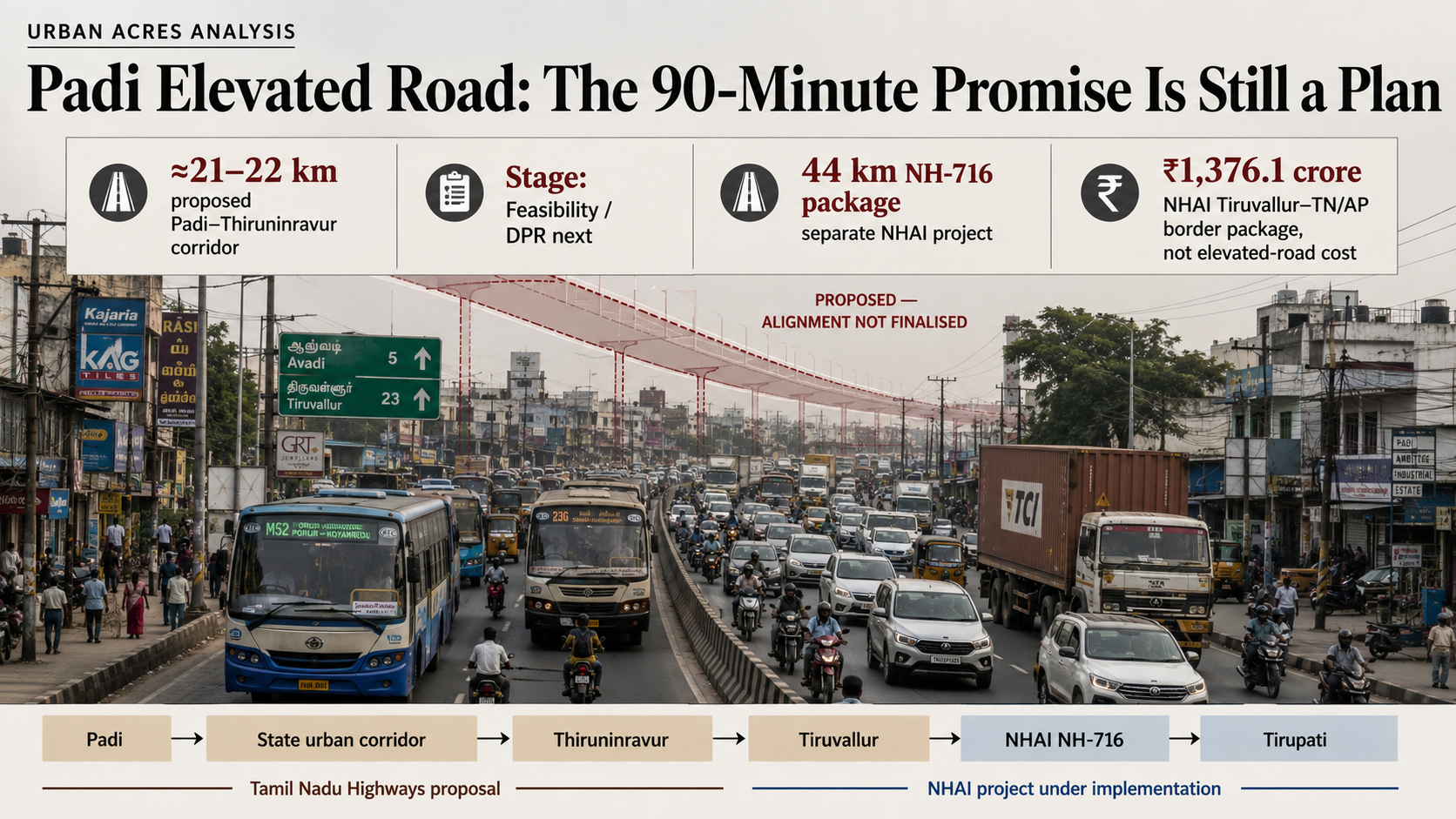
Tamil Nadu’s proposed elevated road between Padi and Thiruninravur could address one of north-west Chennai’s most persistent road bottlenecks. But the headline travel-time promise is several project stages ahead of reality: the corridor still needs feasibility work, a detailed project report, a final design, land resolution, financing, sanction and procurement before construction can begin.
The Tamil Nadu government announced an elevated corridor between Padi and Thiruninravur during the Highways Department’s Assembly discussions on August 18. Contemporary reports describe the proposed length variously as 21 km and 22 km, an inconsistency that should remain unresolved until the government publishes final chainages through its feasibility study or DPR.
The New Indian Express subsequently reported that Highways officials expect widening of the existing Chennai–Tiruvallur High Road to precede construction of the elevated facility. Consultants are expected to undertake a feasibility study, with a DPR to follow. That places the proposal at an early planning stage rather than at construction sanction.
This distinction matters because the most striking number attached to the project—the possibility of cutting the Chennai–Tirupati journey to roughly 90 minutes—is still an estimate. TNIE reported that the congested Padi–Thiruninravur section could potentially fall from about 90 minutes to roughly 25 minutes once the corridor is completed. No publicly accessible traffic-modelling document reviewed by Urban Acres establishes the assumptions behind those estimates.
A new solution to an old right-of-way problem
The congestion itself is not new.
Padi–Thiruninravur was once part of NH-205, the predecessor numbering of today’s Chennai–Tirupati highway. In March 2013, Tamil Nadu formally declared the stretch a State Highways Urban Stretch. The change followed difficulties surrounding the earlier highway-expansion programme.
The core constraint has persisted: a regional radial road through dense suburbs also functions as a local commercial, industrial and commuter street.
Padi, Ambattur, Thirumullaivoyal, Avadi and Pattabiram generate substantial everyday traffic of their own. Through-traffic towards Tiruvallur and Tirupati is therefore competing for road space with buses, two-wheelers, local deliveries, industrial freight and neighbourhood access.
Tamil Nadu has continued pursuing widening. In 2025, 153 owners in Thirumullaivoyal were reported to have received acquisition notices covering approximately 3.5 acres for expanding the road from four lanes to six.
CUMTA’s metropolitan mobility planning also lists the Chennai–Tiruttani–Renigunta road among corridors targeted for capacity expansion, reinforcing that the elevated-road announcement is part of a longer effort to solve the north-west radial’s capacity problem.
The elevated road does not eliminate the widening problem
An elevated road can reduce conflicts between through and local traffic, but it does not make right-of-way constraints disappear.
Highways officials told TNIE that the road would first need to be widened to roughly 80–90 feet where feasible to provide sufficient construction space. The report identifies shops and religious structures among the physical constraints along the corridor.
That makes land and urban-interface management a central delivery risk.
The eventual DPR will therefore need to establish more than the engineering of a viaduct. It will have to show where ramps can physically fit, how traffic enters and exits the elevated road, whether service roads are required, what happens at bus stops and junctions, how utilities are shifted, and how walking and local access are maintained below the structure.
Without that information, the elevated corridor remains a mobility proposition rather than a buildable project.
Two governments control different parts of the journey
There is another distinction hidden by the phrase “Chennai–Tirupati highway”.
The proposed elevated section from Padi to Thiruninravur is a Tamil Nadu Highways project. Farther west, the National Highways Authority of India is implementing separate access-controlled upgrades on NH-716.
A Rajya Sabha answer dated April 1, 2026 lists the approximately 44-km Tiruvallur–Tamil Nadu/Andhra Pradesh border section at a capital cost of ₹1,376.1 crore and categorises it as under implementation.
MoSPI’s February 2026 infrastructure monitoring report recorded 28% physical progress on this NHAI package, with December 2026 then listed as its target completion period. TNIE’s August reporting subsequently put the work at around 30%.
These projects are complementary, but they are not the same project and their finances should not be combined.
The state government’s ₹21,524-crore Highways and Minor Ports Budget allocation likewise cannot be described as funding for the Padi elevated corridor. A project-specific cost and financing plan have not yet been established publicly in the material reviewed by Urban Acres.
The correct outcome test is not only Tirupati travel time
Reducing travel time for Chennai–Tirupati motorists would be significant, particularly once downstream NH-716 capacity improves.
But the public-interest test is broader.
For residents of Ambattur, Avadi, Thirumullaivoyal and Pattabiram, success would mean shorter and more reliable everyday journeys, safer intersections, predictable bus movement, usable footpaths, reduced local conflict with heavy vehicles and functioning access to businesses and homes.
A poorly designed elevated corridor could move through-traffic faster while leaving congestion concentrated around ramps and surface junctions. An effective design would instead separate movement types while improving the surface road as an urban street.
That distinction must be tested in the DPR.
What Tamil Nadu should publish next
The Highways Department should make the feasibility study and subsequent DPR publicly traceable, including the exact chainage, elevated length, ramp locations, existing and proposed right-of-way, traffic counts by section, land required, affected properties and structures, utility-relocation plan, capital cost, financing mechanism and implementation schedule.
It should also publish the travel-time model supporting the 25-minute Padi–Thiruninravur and 90-minute Chennai–Tirupati projections.
Until those documents exist, the most accurate description is straightforward:
Tamil Nadu has announced an elevated-road solution for the Padi–Thiruninravur bottleneck. It has not yet approved a construction-ready elevated highway.
The project’s significance will ultimately be measured not by how ambitious its travel-time promise sounds, but by whether the state can solve the right-of-way and local-mobility problems that frustrated improvement of this corridor for more than a decade.
