


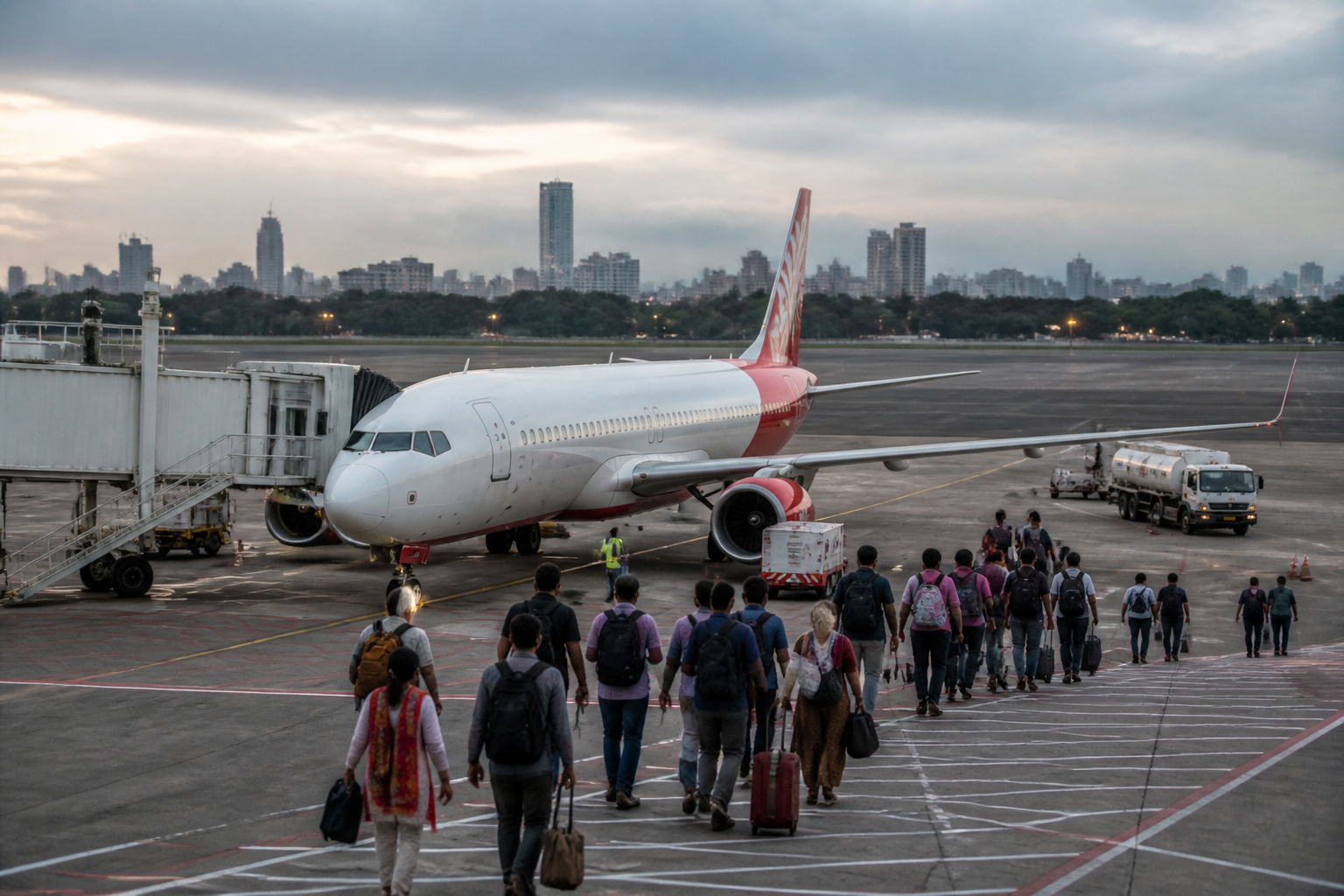
The restructuring of Air India and Air India Express is creating a clearer division of roles within the Tata Group’s airline network. Air India is concentrating on international, long-haul and major metropolitan routes, while Air India Express is taking a larger role in domestic aviation, including connections between smaller cities and the country’s principal metro markets. The change is not simply a matter of transferring flights between two brands. It points to a network strategy in which the two airlines are being positioned to serve different parts of India’s increasingly layered urban and regional economy.
According to a report by Loksatta, Air India Express has gradually reduced its presence on some routes from smaller regional cities while Air India has increased its attention to international and major metropolitan services. At the same time, Air India Express began services in August on routes involving Coimbatore, Bhopal, Chhatrapati Sambhajinagar, Madurai, Tirupati, Jodhpur and Jamnagar. The airline has also taken over operations on the Mumbai–Kochi and Kochi–Delhi routes that were earlier operated by Air India.
This creates an apparent tension in the strategy. Air India Express is described as reducing services from some smaller cities, yet it is also being assigned a larger role in domestic aviation and has introduced services from several regional locations. The distinction appears to be less about abandoning regional markets altogether and more about deciding which airline should operate which kind of route. The available report does not provide route-wise schedules, passenger volumes or explanations for individual service changes, so the precise commercial logic behind each transfer is not established.
The broader direction, however, is clear. Air India is being positioned around international travel, long-distance flying and major metro markets. Air India Express is being positioned around domestic routes and regional connectivity. Such segmentation can allow each airline to use a different operating model, aircraft deployment plan and customer proposition, although the supplied material does not specify the fleet, pricing or cost assumptions behind the division.
The urban significance lies in the way airline networks connect India’s metropolitan centres to regional cities. Air connectivity is not only a service for tourists or business travellers. It also links smaller urban economies to larger markets, supports access to institutional and commercial centres, and affects how quickly people can move between cities that may be separated by long road or rail journeys. When a route is shifted from one airline to another, the immediate question for passengers is whether the service continues. The larger question is whether the frequency, timing and reliability of that connection remain suitable for the city it serves.
The report states that, from 1 September, Air India Express began domestic services from six locations, connecting them with Delhi, Mumbai, Chennai and Hyderabad. These four cities are among the country’s most important metropolitan aviation markets and function as major points of access to employment, business, education and onward travel. The structure suggests that Air India Express’s domestic network will increasingly use large metros as anchors for regional routes.
That model can strengthen connectivity if the metro links are frequent and operationally dependable. It can also make regional travel more dependent on a limited number of metropolitan gateways. The source material does not provide enough information to determine whether the new arrangements are direct city-pair services, timed connections or part of a wider hub-and-spoke plan. It does show, however, that the domestic network is being organised around a combination of regional origins and large urban destinations.
The numbers cited in the report indicate the scale of Air India Express’s existing operations. In financial year 2026, the airline operated 474 flights each day across 46 domestic and 17 international stations. The figure places the carrier well beyond a narrowly regional role. It also explains why the division of responsibilities between the two airlines matters to the functioning of the wider group: a change in the network of an airline operating hundreds of daily flights can affect a substantial number of city connections even when individual route changes appear limited.
The report attributes the decision to reduce some Air India services from smaller cities to a strategy adopted under former chief executive Campbell Wilson. It also says that the policy direction under the new chief executive, Tewolde Gebremariam, will be important to watch. The supplied material does not establish whether the new leadership has formally changed, reviewed or endorsed the earlier plan. That uncertainty is significant because airline network strategies are shaped by executive decisions, aircraft availability, airport capacity, demand patterns and the financial performance of individual routes.
For cities, airline connectivity is closely tied to the availability of other transport systems. A regional airport may provide a fast link to a metro, but its usefulness depends on how passengers reach the airport, whether flights operate at practical times and whether onward connections are available. The report contains no evidence on airport access, fares, load factors or passenger experience. Those gaps prevent a fuller assessment of whether the changes will improve mobility or merely reorganise existing services between brands.
The Tata Group’s approach also raises an institutional question about the role of separate airline brands within one corporate network. Air India and Air India Express are being given distinct market responsibilities, but passengers may experience them as parts of the same group. The success of such a division will therefore depend not only on route allocation but also on how clearly schedules, bookings, transfers and service standards are integrated. The supplied report does not provide details on these arrangements.
The distinction between international and domestic operations is particularly important for Mumbai, Delhi, Chennai and Hyderabad, which are named as destinations for Air India Express’s new regional services. These metros can serve as both final destinations and transfer points. A regional passenger travelling to one of these cities may be using the flight to access a wider urban region, a business district, an education centre or another flight. However, the report does not identify the share of passengers travelling onward or the extent to which these airports function as connecting hubs for the affected routes.
The available evidence confirms a strategic reallocation of roles, but it does not yet establish its outcomes. There are no route-level passenger numbers, changes in flight frequency, fare comparisons or information on routes that have been withdrawn. Nor does the report state whether the smaller-city services mentioned as being reduced have been permanently cancelled, transferred to Air India Express or adjusted temporarily. These details will determine whether the policy represents a net expansion of regional connectivity or a redistribution of capacity.
The immediate development to monitor is the continuation of the new domestic services introduced from 1 September and the implementation of the route strategy under Tewolde Gebremariam’s leadership. The key test will be whether Air India can build its international and metro network while Air India Express maintains a sufficiently broad and dependable domestic network for smaller cities. For now, the evidence shows a deliberate attempt to separate the two airlines’ roles, with regional urban connectivity becoming a central responsibility of Air India Express.
