


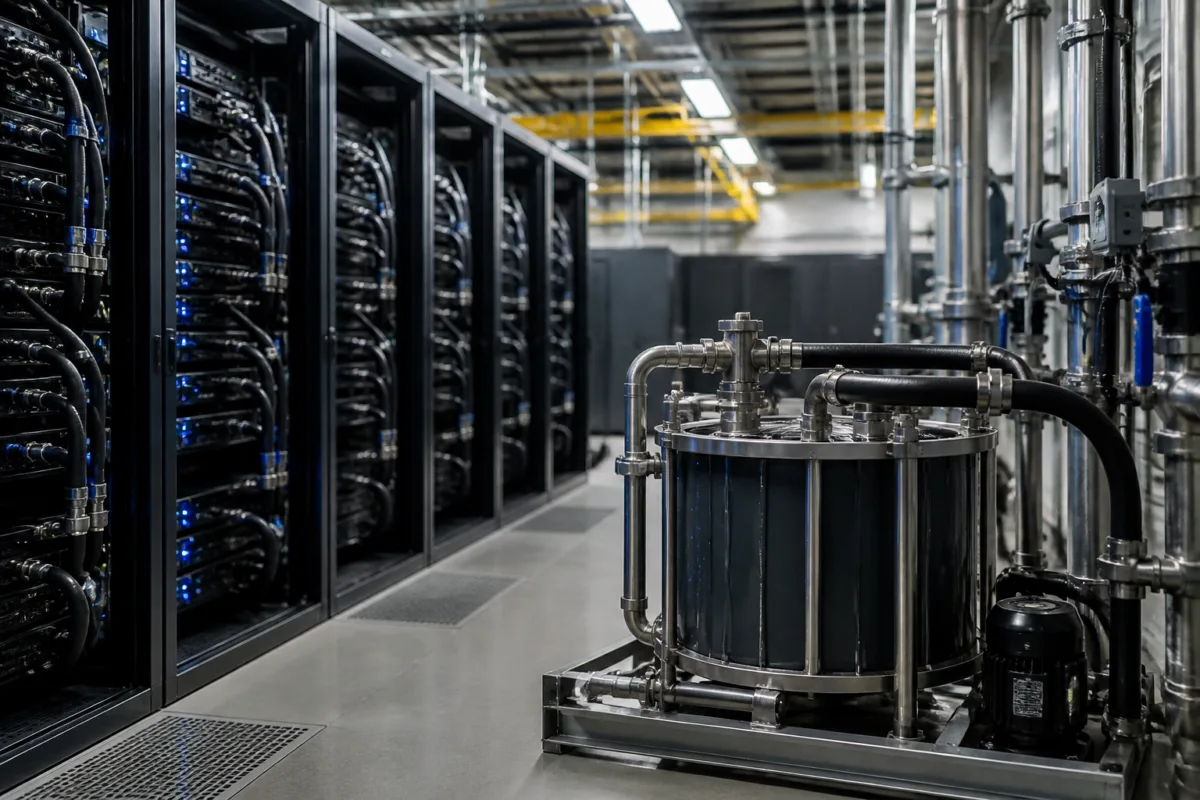
Honeywell Aerospace has announced that Equinix tested and installed its Thermal Response Module at the company’s Co-Innovation Facility in Ashburn, Virginia, as AI data centres adopt higher-density computing and direct-to-chip liquid cooling. The module is designed to stabilise coolant temperatures during power disturbances, rapid changes in GPU demand and fluctuations elsewhere in the cooling system.
The Thermal Response Module acts as a short-duration thermal buffer between the coolant distribution unit and servers. Honeywell said it can be installed as a drop-in solution within existing cooling loops without requiring a redesign, and is compatible with different coolant distribution unit vendors and architectures.
The technology uses proprietary phase-change materials that store and release thermal energy when required. According to Honeywell, the module can deliver 7.6 times more cooling power than chilled water, stabilise the cooling loop within seconds and be configured to provide several minutes of thermal buffering. The company said this response is intended to reduce temperature excursions, limit performance throttling and lower the risk of damage to high-value computing equipment.
The announcement comes as operators deploy more direct-to-chip liquid-cooling systems for increasingly powerful AI processors. These systems move heat away from processors through liquid circulating close to the chip, but their operation depends on stable temperatures across the cooling loop and supporting equipment. A short interruption or sudden load change can affect GPU performance and place additional stress on the wider cooling system.
Equinix said testing at its Ashburn facility demonstrated the module’s ability to manage rapid changes in GPU cooling demand while occupying a smaller footprint than buffer tanks. “Testing at our Ashburn Co-Innovation Facility demonstrated the technology’s capability to manage rapid GPU cooling load fluctuations while requiring a smaller footprint in comparison to buffer tanks,” said Pawel Wlodarczak, design innovation director, Global Design, Equinix.
Honeywell said the module combines phase-change materials, heat-exchanger designs for rapid or sustained cooling, and onboard state-of-charge sensing. These functions are intended to help stabilise temperatures and improve the consistency and efficiency of chillers, coolant distribution units and other upstream cooling assets. The company said the system can be scaled from edge deployments to large AI clusters.
The company is adapting technology developed for thermal management in aerospace and defence systems for use in data-centre infrastructure. Rich DeGraff, president and CEO of Control Systems for Honeywell Aerospace, said the thermal demands created by AI workloads present a comparable challenge in protecting mission-critical systems and maintaining continuous operation.
The announcement also highlights the expanding role of cooling in data-centre capacity planning. Honeywell, citing Omdia, said liquid cooling is currently deployed in fewer than half of data centres, while the market is expected to record annual growth of 20% over the next five years. The figures indicate that operators are still moving through a transition from conventional cooling systems to infrastructure capable of supporting higher-density AI computing.
Honeywell said the Thermal Response Module can help operators expand their thermal safety margin, shift some power from cooling to computing and reduce service-level agreement risk. The technology’s deployment beyond the Ashburn testing facility, including commercial availability and specific installations, was not detailed in the announcement.

