


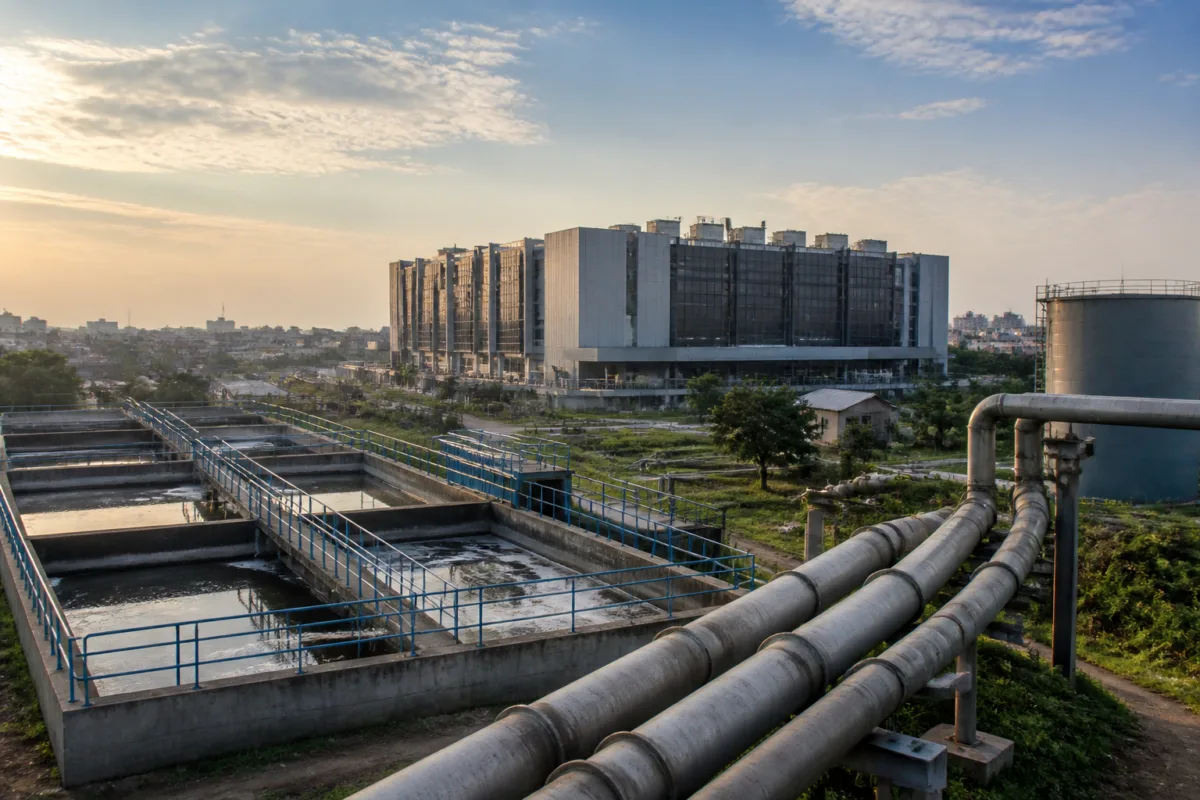
Patna’s proposed supply of recycled water to an artificial intelligence data centre is more than a facility-level arrangement. It brings together two urban systems that are usually planned separately: sewage treatment and digital infrastructure. A proposal to provide around 10 lakh litres of treated wastewater every day from the Digha Sewage Treatment Plant to the AI data centre at Patliputra Industrial Area could reduce the facility’s dependence on freshwater, although the final decision has not yet been taken.
The proposal has been sent to the Bihar Urban Infrastructure Development Corporation, or BUIDCO. Its significance lies in the type of demand the data centre represents. Unlike many conventional industrial users, a high-performance computing facility operates continuously and generates substantial heat. Its servers require cooling to maintain operating temperatures, making water and electricity central to the facility’s functioning rather than peripheral utilities.
The proposed arrangement therefore raises a practical question for Patna: how should the city supply water-intensive infrastructure without increasing pressure on freshwater resources? The answer suggested in the proposal is to use treated sewage water for an industrial purpose while allowing the city’s freshwater supply to serve other needs.
That approach depends first on the capacity and location of the wastewater system. Digha STP has a total treatment capacity of 100 million litres per day. At present, around 60-70 million litres is being treated daily, while the treated water is discharged into the Ganga. A proposed allocation of 10 lakh litres a day to the AI data centre would represent a small share of the plant’s total treatment capacity, but it would also create a dedicated use for water that is currently being discharged after treatment.
The availability of treated water could increase when additional drainage channels are connected to Digha STP. This is important because reuse arrangements require more than a treatment plant with nominal capacity. They depend on the volume of wastewater reaching the plant, the quality of treated output, the reliability of conveyance systems and the ability of the receiving facility to draw water consistently. The information available on the proposal does not establish the final operating arrangements, treatment standards or delivery infrastructure.
The data centre is expected to have an IT load capacity of 12 MW. It will house high-performance computing systems for artificial intelligence applications, ChatGPT-like tools and other data-intensive services. Those systems generate heat continuously, and the cooling system selected for the facility will determine how much water is actually consumed.
The distinction between cooling technologies is central to the proposal. A closed-loop cooling system circulates water through pipes and cooling equipment. After the system is filled, the same water can be reused for months or even years, although this arrangement generally consumes more electricity. An open-loop system uses evaporation to remove heat. It generally requires less electricity, but water lost through evaporation must be replenished regularly.
This trade-off means that the proposed figure of 10 lakh litres per day should not automatically be treated as the data centre’s fixed or permanent water consumption. Actual demand will depend on the cooling technology, the facility’s operating conditions and future expansion. The proposal indicates that the facility may require a regular supply of this scale, but the source material does not state which cooling system will be installed.
The initial filling requirement also illustrates the difference between commissioning demand and ongoing consumption. The cooling network may require around one lakh litres when it is first filled. Once operations begin, the recurring requirement will depend on whether the system is designed primarily around recirculation or evaporation. As the data centre expands its capacity, its water requirements may rise, creating a continuing need to match digital infrastructure growth with a reliable non-freshwater source.
For Patna’s urban water system, the proposal creates a potential circular relationship. Sewage collected from the city would be treated at Digha STP, a portion of the treated output would be diverted to an industrial facility, and freshwater resources would not have to meet the entire cooling requirement. The arrangement would also change the role of a sewage treatment plant from an endpoint for wastewater treatment into a source of industrial water.
That shift requires coordination between institutions with different responsibilities. BUIDCO is the agency currently considering the proposal, while the treatment plant and the data centre would have to support the operational side of the arrangement. The proposal’s progress will consequently depend on decisions about allocation, conveyance, quality assurance, storage and the interface between the treatment plant and the facility. None of those final arrangements has been confirmed in the supplied material.
The plan also demonstrates why water demand from data centres cannot be assessed only through the lens of electricity or computing capacity. A 12 MW IT load describes the computing scale, but it does not by itself reveal the facility’s water footprint. Cooling design is the intermediary between computing demand and water demand. Two facilities with similar computing loads could require different quantities of water depending on the systems they use.
For urban planners and infrastructure agencies, this makes utility planning increasingly interconnected. A data centre needs dependable power, cooling, water and wastewater arrangements. A sewage treatment plant needs sufficient inflow and a reliable destination for treated output. Connecting the two can produce efficiency, but only when the technical and administrative systems work together. The proposal makes that connection visible in a city where the treated output of Digha STP is currently discharged into the Ganga.
The numbers in the proposal show both the opportunity and the limits. Digha STP has a stated treatment capacity of 100 MLD, while current treatment is around 60-70 MLD. The proposed data centre supply of 10 lakh litres per day is equivalent to 1 MLD. On the figures provided, the demand is modest compared with the plant’s total capacity, but it would still require a dedicated system and a dependable daily supply. Future demand could increase if the facility expands, while the availability of treated water could change as additional drainage channels are connected.
The arrangement would also need to account for the difference between treatment capacity and usable recycled water. A plant may be capable of treating a certain volume, but reuse depends on how much wastewater actually arrives, whether the treated water meets the required quality and whether it can be transported to the user. The source material identifies the proposal and the broad capacities involved, but it does not provide the technical specifications needed to assess those questions.
This is why the decision by BUIDCO matters. Approval would move the idea from a reported proposal towards an institutional arrangement, but it would not by itself establish the final water balance of the data centre. That would depend on the chosen cooling technology, the operating schedule, the quantity of water lost through evaporation, the extent of recirculation and the facility’s expansion plans.
The larger urban question is whether treated wastewater can become a dependable input for new infrastructure rather than being viewed only as a disposal challenge. Patna’s AI data centre provides a specific case in which the answer may be tested. The proposed arrangement could reduce freshwater dependence and create a productive use for treated output from Digha STP, while also exposing the technical and governance conditions required for such reuse to work.
What is established is that a proposal has been sent to BUIDCO for supplying approximately 10 lakh litres of treated water daily from Digha STP to the data centre. What remains unresolved is whether the proposal will be approved, what cooling technology the facility will adopt and how the water will be delivered and monitored. Those decisions will determine whether the plan becomes a practical model of urban water reuse or remains an infrastructure proposal awaiting institutional and technical clearance.

