


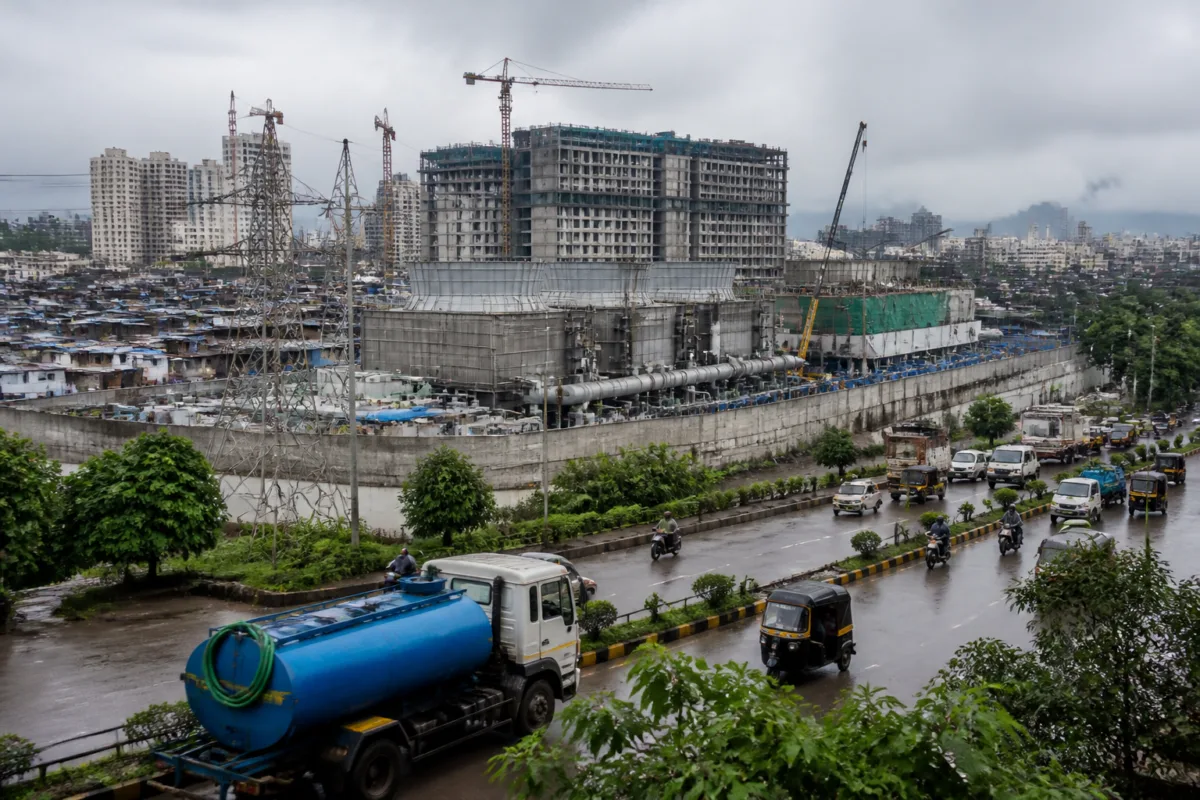
The renewed opposition to the Balkum data centre in Thane is not simply a dispute over one construction site. It has brought a larger urban question into focus: how should cities decide whether major digital infrastructure can proceed when the same urban system is struggling to provide reliable water to existing residents?
Activists from WakeUp Thanekar have urged Maharashtra Chief Minister Devendra Fadnavis to halt construction of the proposed hyperscale facility until the state’s water crisis eases and a committee headed by nuclear scientist Dr Anil Kakodkar completes its review of the state’s data centre policy. The demand has also received political expression, with Manoj Pradhan, district president of the NCP (Sharadchandra Pawar), putting up protest posters around the proposed facility.
The supplied report does not establish the data centre’s precise water requirement, the status of its statutory permissions or the project’s approved construction schedule. It does, however, identify the central concern raised by opponents: whether a large facility with substantial cooling and operational needs is appropriate in a densely populated part of Thane while several localities continue to depend heavily on private tankers for daily water supplies.
That distinction matters. Data centres are often discussed as technology or investment projects, but their physical operation depends on ordinary urban systems: electricity, water, roads, fire protection, waste management and land. Their digital output may be invisible to residents, while their demands on municipal infrastructure are concentrated in a specific location. This makes the planning question less about whether a city should permit technology investment and more about how it should measure the cumulative burden of that investment.
The Balkum controversy has emerged during a period that the report describes as a water crisis in Maharashtra. In that context, the demand for a construction freeze is being framed by activists as a question of public priority. Dayanand Nene, who wrote to the chief minister, argued that government should suspend work until the drought situation stabilises and the Kakodkar committee submits its recommendations. His stated position is not opposition to investment or technological progress, but a demand that new development account for water security, environmental safeguards and residents’ quality of life.
The state-appointed committee is therefore central to the dispute. According to the report, the committee has been constituted to review Maharashtra’s data centre policy and recommend safeguards and standard operating procedures. Its existence indicates that the policy framework is still being examined at the state level. For projects with significant civic and environmental implications, the timing of that review becomes important: decisions taken before common safeguards are finalised can create a precedent for other facilities, while a blanket pause could affect projects already moving through the approval process.
The report does not say whether the committee has issued interim guidance or whether the Balkum project is legally required to await its final report. It also does not provide the government’s response to the activists’ request. Those are important gaps because the authority to halt construction, the conditions attached to the project and the division of responsibility between state agencies and local bodies will determine whether the demand can be acted upon.
Water is the most immediate issue raised by opponents. Data centres require cooling systems to manage the heat generated by computing equipment, although the quantity and source of water vary according to the technology and design used. The available report establishes only that Nene has raised concerns about substantial water use for cooling and operations; it does not provide a project-specific consumption figure or confirm the proposed cooling system. Any assessment of the Balkum facility must therefore begin with disclosure of its projected daily water demand, source, recycling arrangements and contingency plans.
Without those details, public debate risks becoming polarised between two incomplete positions. One presents the data centre as an automatic threat to scarce water resources. The other treats it as an automatic symbol of modernisation and investment. A sound planning decision requires a more basic accounting: how much water the facility would need, whether that water is potable or treated, how much can be recycled, who will supply it, and whether supply to the project could affect existing users during shortages.
The tanker reference gives the issue a direct ground-level dimension. The report says that several parts of Thane and its suburbs depend heavily on private tankers for daily needs. That dependence is not, by itself, proof that the proposed data centre would worsen local shortages. It does show why residents may view a new high-consumption facility differently from authorities or investors. Where water access is already uneven, the approval of an industrial or commercial user can become a test of whether urban infrastructure is being allocated transparently.
Opponents have also raised concerns about noise pollution, diesel-generator emissions, fire safety, heat generation and traffic disruption. These issues reflect the fact that a data centre is not an isolated digital box. It is a built facility with mechanical equipment, backup power systems, service vehicles and round-the-clock operations. Manoj Pradhan said the opposition was not against development or the data centre itself, but questioned why it was being built in a densely populated urban area and warned that sustained noise could affect residents’ well-being.
Again, the supplied material does not establish the facility’s expected noise levels, generator configuration, traffic volumes or fire-safety design. Those details should not be inferred from the fact that it is described as a hyperscale data centre. They should instead be part of the information made available to residents and local authorities. The absence of such information can deepen mistrust even when a project is technically capable of meeting regulatory requirements.
This is where the dispute becomes an institutional question. A project of this kind may pass through multiple approval and oversight systems, while residents experience its consequences as one combined impact. Water supply, land-use permissions, environmental safeguards, fire safety, road access and power infrastructure may be handled by different authorities. A policy review that focuses only on investment incentives or data capacity would not fully address the neighbourhood-level effects raised in Balkum.
The Kakodkar committee’s proposed safeguards and standard operating procedures could provide a common framework, but the report does not yet specify what those safeguards will contain. The pending review therefore represents more than a technical policy exercise. It is an opportunity to clarify whether Maharashtra’s data centre policy will measure projects individually or account for cumulative pressure on water, power, roads and surrounding communities.
The timing also raises a question about sequencing. If the state is reviewing its policy while a major project is under construction, residents may ask whether new rules will apply to facilities already approved or only to future proposals. Developers, in turn, may seek clarity on whether regulatory conditions can change after permissions are granted. The supplied report does not establish the project’s approval stage, so it cannot resolve that question. It does show why the sequencing of policy review and project execution has become politically and civically important.
For Thane, the immediate issue is not whether digital infrastructure has a place in the city. It is whether the city’s planning system can demonstrate that the facility will not shift hidden costs onto residents. A credible assessment would need to connect the project’s resource requirements with local water availability, especially during drought conditions, and explain how noise, emissions, heat, fire risk and traffic will be controlled. It would also need to identify which authority will monitor compliance after construction.
The Balkum dispute thus exposes a recurring weakness in urban decision-making: infrastructure is often evaluated project by project, while residents experience the combined effect of many projects at neighbourhood level. The report confirms that activists and political representatives are asking for a pause until the state’s policy review is complete. It does not establish whether the government has accepted that demand, whether construction has been legally suspended, or what safeguards the project currently carries.
The next significant development will be the response from the Maharashtra government and the findings of the Kakodkar committee. Until then, the central evidence needed for an informed decision remains project-specific: the facility’s water demand and source, recycling plans, environmental and civic safeguards, fire-safety arrangements, and the status of its approvals. Those details will determine whether Balkum becomes an example of infrastructure planned around urban limits or a test of how cities respond when new demand meets existing scarcity.

