


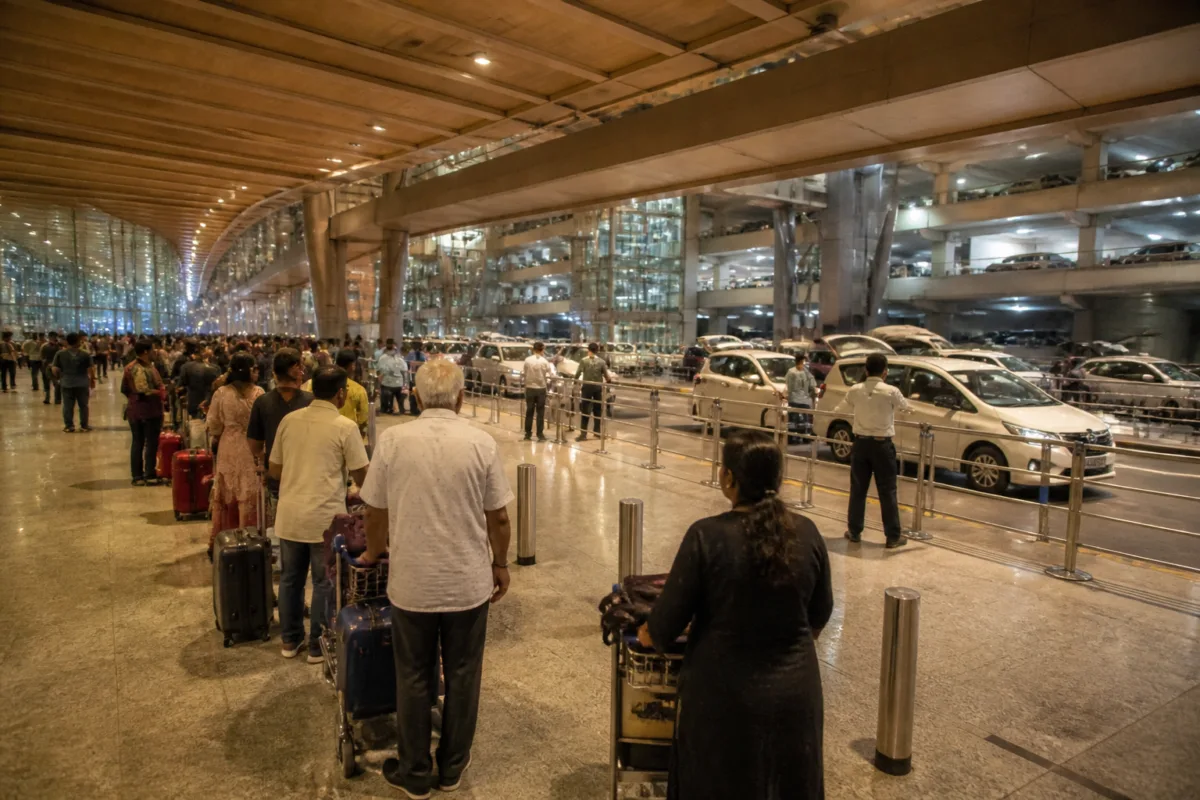
Mumbai airport’s Terminal 2 has reorganised its parking and app-based taxi pickup areas, moving VIP parking from the arrivals level to P4 and leaving the P6 arrivals stretch exclusively for Uber. The changes have made pickup arrangements less straightforward for passengers using Ola and Rapido, while creating new cost and access problems for drivers.
The reorganisation followed the expiry of Ola and Rapido’s space rental agreements with Mumbai International Airport Ltd. (MIAL) on October 31. According to internal MIAL sources cited by the Free Press Journal, the two platforms have not had dedicated pickup bays since November 1.
Under the revised layout implemented on November 3, VIP parking was moved from P6 to P4. The P6 area at the arrivals level was leased entirely to Uber, providing its passengers with a direct boarding route from the arrivals concourse. Traditional prepaid taxi services, including Kaali Peeli taxis and Cool Cabs, as well as private operators such as Akbar Travels and Shree Sai, continue to operate from P4.
Passengers booking Ola or Rapido are being directed to alternate pickup points, including upper levels or areas outside the airport premises. Drivers using the general parking area at P5 have to pay a Rs 250 entry fee, according to the report. Drivers said the charge can reduce their earnings, particularly when passengers cancel after being asked to walk to a different pickup location.
MIAL said the changes were based on evolving passenger travel patterns. A spokesperson said app-based cabs account for nearly 40% of Terminal 2’s parking and pickup traffic, while VIP or premium parking accounts for about 10%. The operator said shifting VIP parking to P4 would provide a dedicated facility with direct access from the arrivals hall without requiring users to move through the common arrivals area at P6.
The operator also said that the P4-P6 interchange would allow more passengers to benefit from a convenient pickup experience. General parking at P5 and P9 remains unchanged, according to the details provided to the newspaper.
However, the reported experience at the terminal suggests that the revised arrangement has not eliminated congestion. During the Free Press Journal’s visit, queues were observed at the Uber Premier pickup bay. Reported waiting times were between 15 and 20 minutes and rose to as much as 45 minutes during peak arrival periods. The report said other Uber categories, including Uber Go, Uber Black, Uber Electric and Uber XL, had little or no waiting at the time of the visit.
One passenger quoted in the report said he was willing to use an upper-level pickup point for Rapido if it reduced the waiting time. Another passenger said the pickup points were confusing and that the estimated arrival time shown after booking had not changed despite a 20-minute wait.
For Ola and Rapido drivers, the issue is not only passenger convenience but also access economics. Drivers said that asking passengers to walk to outer roads often led to cancellations. Entering general parking instead exposes them to the Rs 250 fee, which they said was not charged when dedicated Rapido access was available.
The arrangement has also altered conditions for other taxi operators. A Cool Cab driver quoted by the report said Ola and Rapido drivers had been waiting near the airport perimeter and that longer queues had increased bookings for Cool Cabs.
MIAL’s stated rationale highlights a common airport-management challenge: allocating scarce kerbside and parking capacity among private vehicles, premium parking users, traditional taxis and app-based mobility services. A layout that improves access for one passenger segment can transfer walking, waiting or payment burdens to another, particularly when competing operators do not have equivalent access to the terminal’s primary pickup zone.
At Terminal 2, the immediate questions are whether the revised arrangement can distribute demand across available levels, whether passengers receive clear directions before leaving the arrivals hall, and whether drivers can access passengers without absorbing disproportionate entry costs. The reported queues and complaints indicate that the physical reallocation has changed the problem rather than removed it for all users.

