


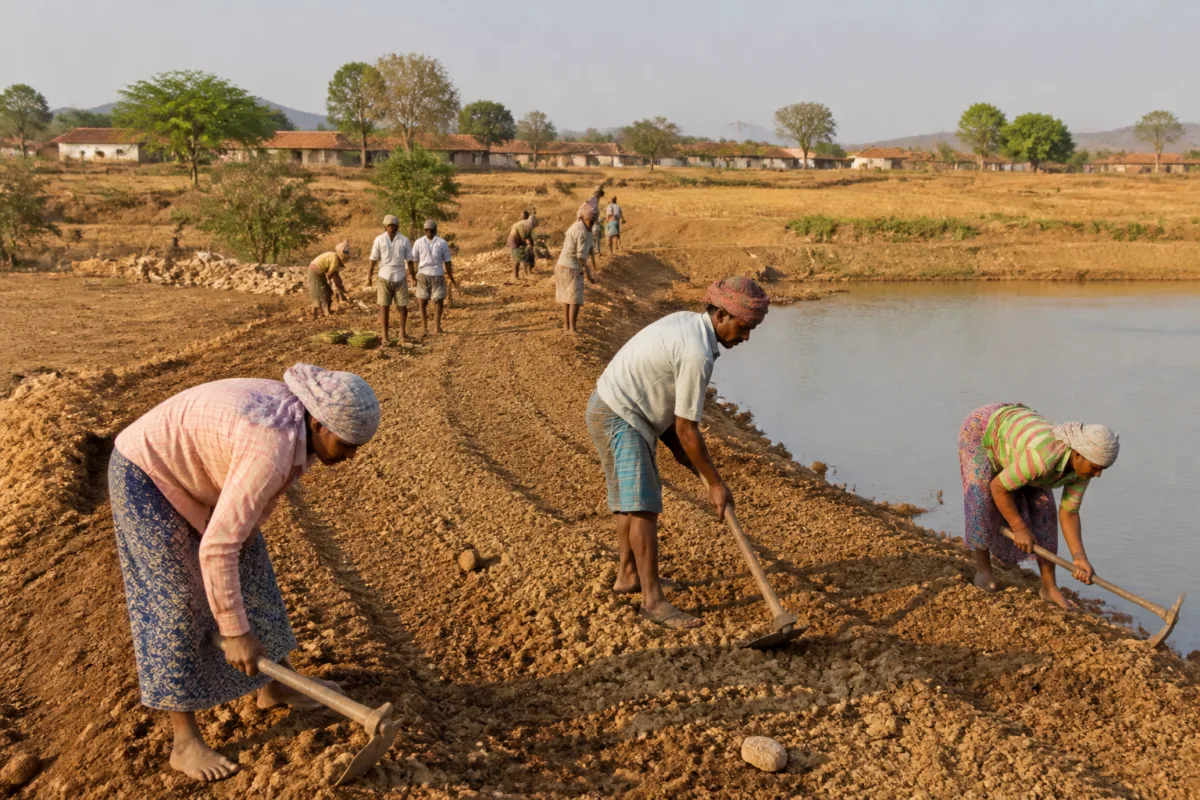
Telangana’s rural employment programme reportedly provided work to more than five lakh people on a single day as drought conditions increased demand for wage employment, but the figures published in the report contain a significant discrepancy that requires clarification from the state government.
The Panchayat Raj and Rural Development department was reported to have provided employment to 5,00,166 persons on Tuesday under the VB-G RAM G Act, 2025. The report described this as a sharp increase linked to drought conditions attributed to the El Nino weather system. However, the same account later stated that 2,54,812 workers reported for work on October 8, calling it the highest single-day attendance recorded since the employment guarantee programme began.
The difference between the two figures is material. It is not clear from the supplied report whether 5,00,166 refers to workers provided employment across approved works, while 2,54,812 refers to workers physically recorded as present, or whether one of the figures has been reported incorrectly. The distinction matters because attendance, sanctioned employment and actual work participation can represent different stages of programme implementation.
The reported rise in demand is nevertheless substantial. Average daily attendance during October was reported at 2.16 lakh this year, compared with 24,750 in October last year. The report also cited average October attendance of 1.28 lakh in 2021, 80,000 in 2022, 1.23 lakh in 2023 and 32,000 in 2024. These figures indicate considerable year-to-year variation, although the reasons for each change are not established in the supplied material.
Nalgonda reportedly recorded the highest district-level employment, with 53,280 persons receiving work. It was followed by Medak with 27,296, Siddipet with 23,845, Vikarabad with 23,731, Sangareddy with 22,222, Kamareddy with 21,178, Jagtial with 18,918 and Nirmal with 18,300. Seventeen other districts were reported to have provided employment to between 10,000 and 17,000 workers, while five districts recorded fewer than 10,000 each.
The figures place rural employment within a wider question of how drought response is organised. When rainfall conditions weaken farm activity or reduce the availability of agricultural work, employment guarantee programmes can become a direct source of income for rural households. Their effectiveness, however, depends not only on the number of people listed for work but also on whether work is available continuously, wages are paid on time and the projects create useful assets.
The VB-G RAM G Act, 2025, replaced MGNREGA and provides a statutory guarantee of 125 days of wage employment per rural household in a financial year, according to the report. Telangana’s rural development administration has said it wants to use the programme for more than wage support, positioning it as a mechanism for strengthening rural infrastructure and conserving natural resources.
Minister Danasari ‘Seethakka’ Anasuya congratulated officials on the reported increase and directed them to sustain the momentum by generating more person-days. She said employment generation should be combined with water conservation, the development of village water resources and the creation of durable rural infrastructure.
The minister instructed officials to identify works according to the specific requirements of each village and prepare plans that would ensure a continuous supply of employment for rural labourers. The stated objectives were to provide livelihood security, conserve water resources and create permanent assets that would benefit villages over the long term.
The works identified for priority reportedly include rainwater harvesting, development of water bodies and strengthening of rural infrastructure. Such projects can connect short-term income support with longer-term resilience, but the supplied report does not provide details on the number of works sanctioned, the expenditure involved, wage payment timelines, the area covered or the condition of the assets created.
The reported attendance figures also need to be reconciled before the claim of a single-day record can be treated as established. If 5,00,166 represents the number of people given employment and 2,54,812 represents actual attendance, the two measures should be presented separately. If both refer to attendance on the same day, the discrepancy is larger and requires a corrected official statement.
For rural households, the immediate issue is whether the programme can provide predictable work as drought-related pressure continues. For village administrations, the challenge is to match employment demand with technically sound projects that address local water and infrastructure needs. The report does not establish how long the higher demand is expected to continue or whether funding and administrative capacity are sufficient to maintain it.
The available evidence confirms a sharp reported increase in Telangana’s rural employment activity and a policy emphasis on combining wage employment with water conservation. It does not yet establish the correct single-day employment figure. Clarification of the conflicting numbers, along with official details on attendance, sanctioned works, wage payments and district-level implementation, is necessary before the record claim can be published as verified.

