


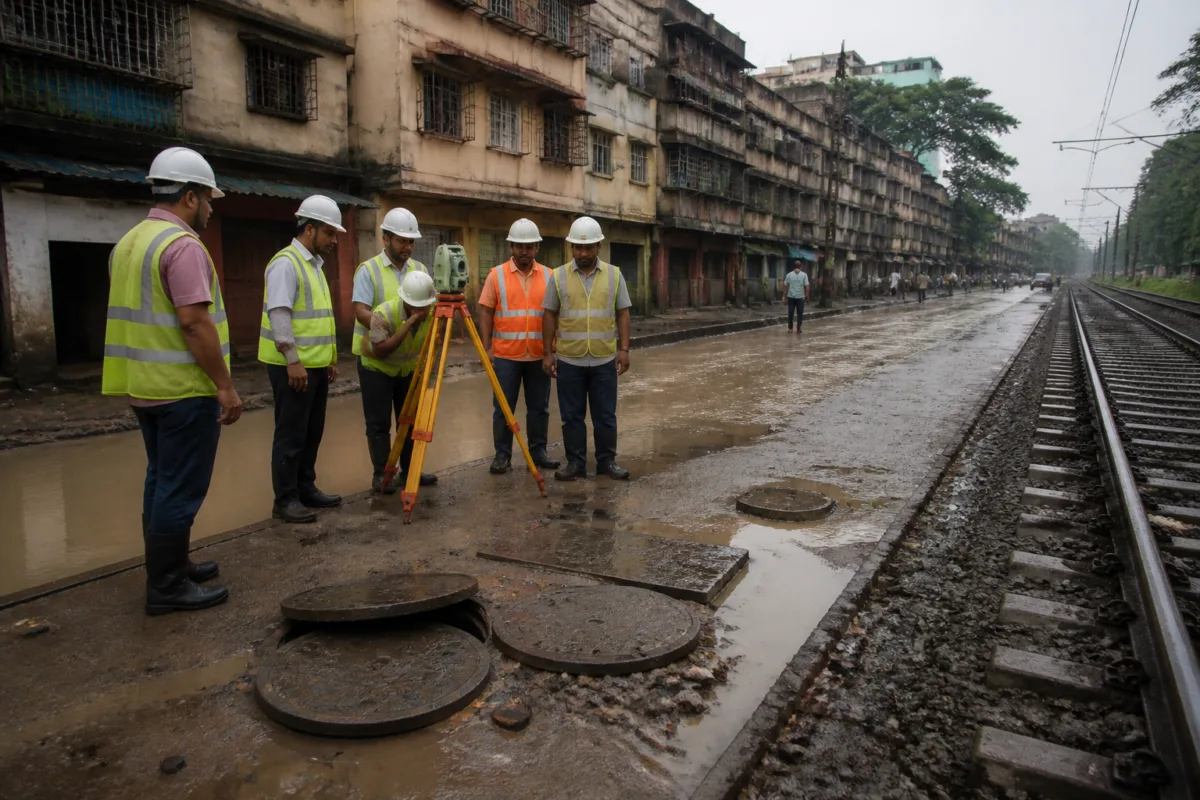
Kolkata Municipal Corporation has formed a five-member committee to assess the condition of the 72-inch pipeline supplying potable water to the Tallah reservoir and recommend repairs after leaks disrupted supply across parts of the city.
The pipeline carries water from the Palta water works in North 24-Parganas to the Tallah reservoir, which feeds booster pumping stations across Kolkata. It was laid around 1911, along with the Tallah water tank, and passes beneath railway tracks.
Water supply to several parts of the city was disrupted for days after leaks emerged on November 9. The leakage also caused inundation around Tallah and nearby railway tracks, according to a report by The Telegraph. Water flow through the affected pipeline has since been stopped.
The civic body is maintaining supply through an alternative 48-inch line. However, senior KMC engineers told the newspaper that the smaller pipeline cannot carry the same volume of water as the 72-inch line, leaving several parts of Kolkata with low pressure.
The committee was set up by KMC commissioner Smita Pandey. It includes former directors-general of the civic water supply department Bibhas Maity and Mainak Mukherjee, current director-general Rihan Sanyal, KMC special commissioner Soumya Bhattacharya and Gokul Mondal, a professor in the construction engineering department at Jadavpur University.
The panel will identify the locations of the leaks, assess the overall condition of the underground pipeline and oversee repair recommendations. Mondal told The Telegraph that the committee planned to use ground-penetrating radar to examine the pipeline and locate problem areas, particularly along welded sections.
Ground-penetrating radar uses high-frequency electromagnetic pulses to create images of objects and conditions below the ground. The proposed survey is intended to provide information about the pipeline without relying only on surface-level inspection, although the report does not specify when the assessment or repairs will be completed.
Mondal also said repair planning would consider the need for manholes to ensure an uninterrupted oxygen supply underground during repair work. The committee will examine whether a similar-diameter alternative pipeline should be laid as a backup, he said.
The pipeline’s location beneath railway tracks adds another layer of coordination. Senior KMC officials have met Eastern Railway representatives to discuss the clearances needed for repair work. A senior railway official told The Telegraph that the railway would provide traffic blocks and take steps to protect track safety while limiting disruption to train services during the repair operation.
The KMC is expected to submit a detailed action plan covering the proposed technical measures and the way forward. Until the 72-inch pipeline is assessed and repaired or replaced, the alternative line will remain the reported basis for maintaining supply, with the smaller diameter limiting capacity and contributing to low-pressure conditions in some areas.
The episode places a critical part of Kolkata’s water network under formal technical review. It also links drinking-water resilience to coordination between the civic water department, engineering specialists and the railway authorities, because the pipeline’s route restricts how repair work can be carried out.

