


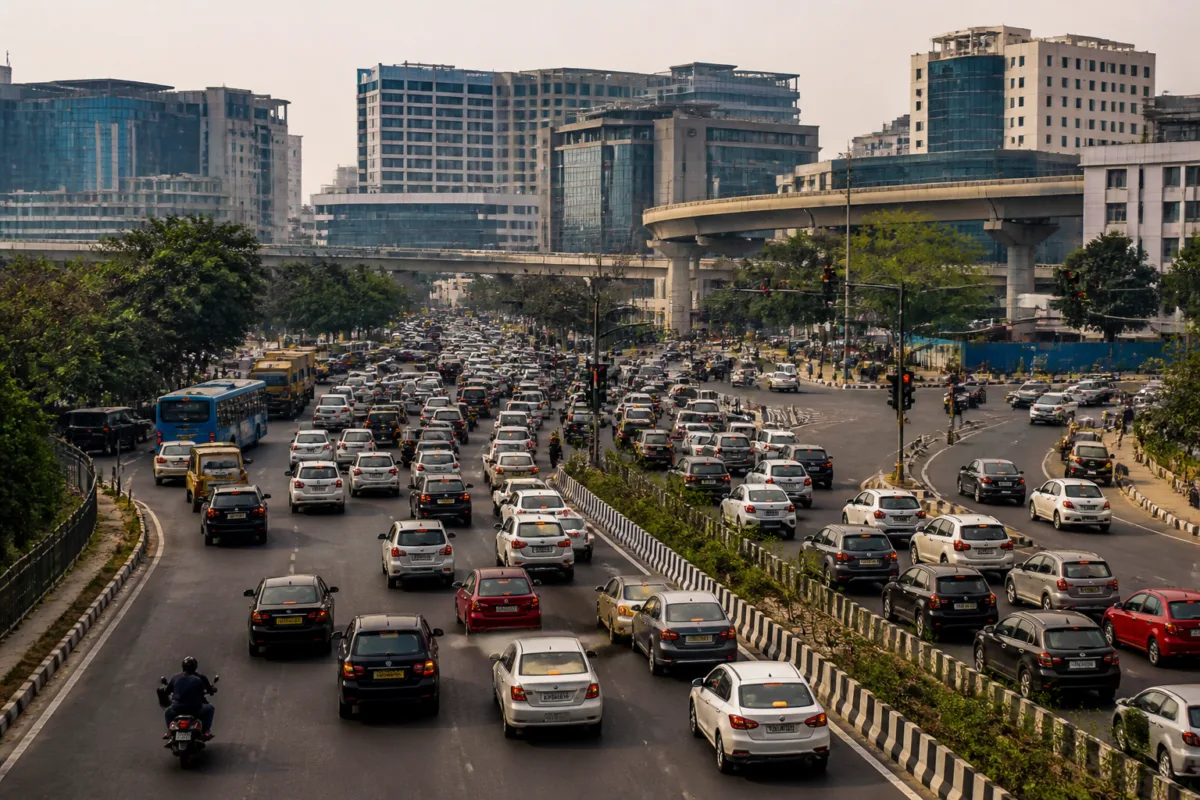
Cyberabad Traffic Police is preparing a proposed one-way loop through Hyderabad’s Hi-Tech City and Biodiversity areas to address peak-hour gridlocks at four major bottleneck junctions, with traffic simulations and stakeholder consultations planned before any phased rollout.
The continuous loop would begin at Biodiversity Junction and run through IKEA Rotary, Raheja Mindspace’s C-Gate, Knowledge City and Dallas Center before taking a right turn at My Home Bhooja and reconnecting with Biodiversity Junction. Officials said the plan is intended to make fuller use of the available carriageway width, reduce delays at junctions and support uninterrupted vehicular movement along the corridor.
The proposal is being formulated by Cyberabad Traffic Police in collaboration with the Society for Cyberabad Security Council (SCSC). Cyberabad Police Commissioner Dr. M. Ramesh, Joint Commissioner of Police (Traffic) Sunpreet Singh, senior traffic police officers and SCSC chief executive officer Naveed Khan were part of an on-ground walkthrough of the proposed route.
During the inspection, the team assessed existing road infrastructure and examined challenges at individual junctions. The walkthrough forms part of a feasibility exercise, and the authorities have not yet announced a final implementation schedule or confirmed that the loop will be introduced in its proposed form.
Detailed traffic simulation trials are expected to be conducted in the coming days. These trials will evaluate vehicle speeds and traffic density under the proposed arrangement, according to the report. The results are expected to inform the final execution plan and the manner in which traffic would be managed at the connected junctions.
The authorities also plan to hold coordination meetings with information technology companies, business establishments and other local stakeholders. These consultations are intended to gather feedback from organisations and users operating along the corridor before the plan is finalised.
The proposed loop covers a high-intensity urban employment and commercial area where morning and evening traffic peaks regularly place pressure on junctions and connecting roads. Its route links major office districts, commercial destinations and residential developments, making the effects of any diversion or traffic-control change relevant to employees, residents, service providers and visitors.
Ramesh said the system would be rolled out in phases only after suggestions and feedback from stakeholders were considered and the execution plan finalised. He also said comprehensive traffic advisories and official details of route diversions would be issued well in advance to help commuters prepare for any changes.
The next formal steps are the traffic simulation trials, stakeholder coordination meetings and preparation of the final execution plan. Until those stages are completed, the one-way loop remains a proposal under feasibility assessment rather than an operational traffic arrangement.

