


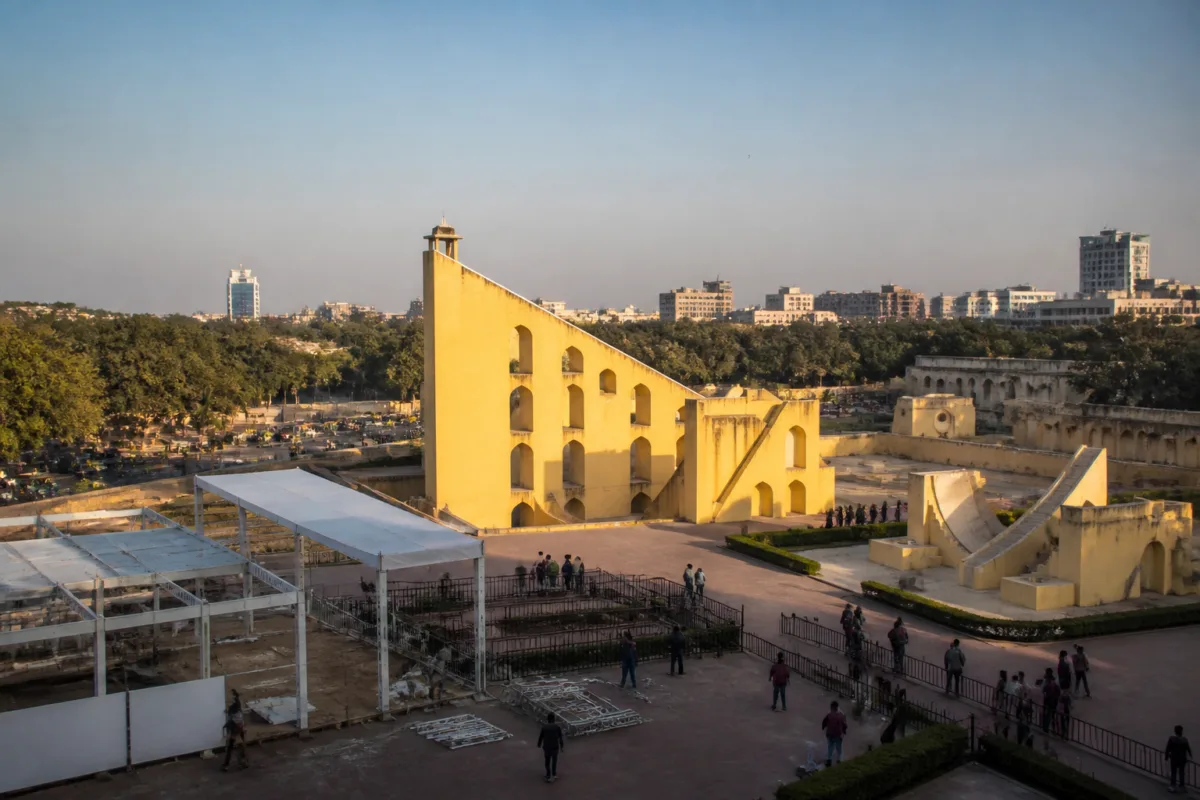
Jantar Mantar’s proposed role as a prime venue for India Biennale 2026 is more than a cultural programming decision. It places one of Delhi’s most recognisable public spaces at the intersection of heritage conservation, event-led urban management and the shrinking institutional space for protest. The announcement comes within days of the area around the 18th-century astronomical observatory being denotified as a protest site and notified as a “no protest” zone.
The India Biennale is scheduled to begin on December 4 and continue until March 21. The Culture Ministry has conceived the event as a large-scale programme covering art, architecture and design, with exhibitions, performances and other experiences spread across monuments, museums, galleries, public spaces and communities. Jantar Mantar is expected to be added to the list of venues, which already includes Red Fort, Qutub Minar, Hauz Khas, Agrasen Ki Baoli, Humayun’s Tomb, Lodhi Garden, Mehrauli, Qila Rai Pithora, Safdarjung Tomb, Sabz Burj, Firoz Shah Kotla, Sakri Ghumti and Choti Ghumti.
That sequence matters because public space in a capital city is not defined only by its physical form or official land use. It also acquires an institutional identity through repeated public use. For more than three decades, Jantar Mantar functioned as Delhi’s designated protest site. Its location near Parliament and important government offices was also repeatedly cited as a concern, according to the report. The site therefore carried two overlapping roles: it was a protected historic monument and an officially recognised location for political expression.
The change in status shifts the governing question from where protests can take place to what kinds of public activity the city is willing to facilitate at a strategically located heritage site. A curated biennale and a protest gathering are different activities, but both depend on access, visibility and the symbolic power of central Delhi. The decision to host a major cultural event at Jantar Mantar shortly after the protest-site notification makes that overlap difficult to ignore.
The reported decision followed protests seeking the removal of Chief Election Commissioner Gyanesh Kumar. The area surrounding Jantar Mantar was then notified as a “no protest” zone, and sources told the Times of India that the biennale venue decision was taken after that notification. The source does not provide the text of the notification, its duration, the precise boundaries of the restricted zone or the alternative arrangements made for demonstrators. Those details are important because a change in the formal status of a public site can have consequences well beyond the duration of a single event.
Jantar Mantar’s physical location makes it particularly valuable for a citywide cultural programme. The observatory sits in the heart of Delhi, with metro stations nearby, and the venue would be accessible to residents and visitors moving through the central city. That accessibility is also what made the site useful for demonstrations. The same characteristics that support cultural footfall—centrality, visibility and proximity to major institutions—also make it significant as a civic forum.
The biennale itself represents an expansion in the scale of the country’s built-environment and cultural programming. The first India Art, Architecture and Design Biennale was held at the Red Fort in 2023, but the report describes that edition as limited in scale. The 2026 edition is being presented by the Culture Ministry as the second edition and as a first in terms of its ambition to bring together work from across India and more than 20 other countries. Nine countries, including France, Italy, Hungary, Switzerland and Sri Lanka, have confirmed participation, according to the report.
The venue list indicates a distributed model rather than a single exhibition complex. Red Fort, Qutub Minar, Humayun’s Tomb, Safdarjung Tomb and other historic sites would become components of one cultural geography. The programme also includes the National Museum, the Indira Gandhi National Centre for the Arts, the National Gallery of Modern Art, Lalit Kala Akademi and Sangeet Natak Akademi. This spreads visitors and programming across institutions with different ownership, management, conservation requirements and public-access arrangements.
That model creates an administrative challenge. A heritage monument is not an empty events venue. It has conservation restrictions, visitor-management requirements and, in many cases, an existing daily relationship with residents, tourists, vendors, workers and surrounding neighbourhoods. The supplied report does not specify how the biennale will manage crowd movement, operating hours, security, accessibility, transport connections, temporary installations or the protection of Jantar Mantar’s historic fabric. It also does not establish whether the venue will host exhibitions, performances, installations or all three.
These omissions do not invalidate the cultural programme, but they identify the information that will determine whether the event works as an urban intervention. The website’s description says that, for 108 days, Delhi’s monuments will become the canvas and that heritage monuments, museums, galleries, public spaces and communities will come together under a single curatorial vision. Such a programme makes the management of everyday access central to its success. A public-facing event cannot be evaluated only through its international participation or the number of venues; it must also be understood through how the city continues to function around it.
The choice of Jantar Mantar is particularly revealing because it shows how urban space can be reclassified through administrative decisions. The site’s designation as a protest location was itself a form of planning: it concentrated demonstrations in a known place near the institutions they sought to address. Removing that function changes the relationship between citizens and the central administrative district. The available material does not state where protests will now be permitted or how the authorities will handle requests for demonstrations, so the broader effect of the notification remains unclear.
At the same time, the biennale’s proposed use of the site may give Jantar Mantar a new public identity centred on culture and design. That could increase public engagement with a protected monument and connect it to a wider network of Delhi’s historic and cultural institutions. But the change also raises a basic governance question: whether a site can remain genuinely public when access is shaped primarily by curated programming, security controls or restrictions on assembly.
The issue is not a simple opposition between culture and protest. Both cultural events and demonstrations are forms of public participation, and both require a city to manage space without erasing its civic character. The institutional distinction lies in who authorises them, how long they last, what controls apply and whose presence is treated as desirable. In Jantar Mantar’s case, the close timing of the “no protest” notification and the proposed biennale use makes those distinctions part of the story rather than a peripheral concern.
The India Biennale will also test how Delhi coordinates heritage, culture, policing, transport and municipal operations across a large number of sites. The report identifies monuments, museums, academies, galleries, public spaces and communities as part of the programme, but it does not identify the complete administrative structure responsible for coordination. Nor does it provide a budget, attendance target, mobility plan or public consultation process. Without those details, the event’s operational impact cannot yet be measured.
What can be established is that Delhi is being presented as the principal landscape of the 108-day programme and that Jantar Mantar is being repositioned within that landscape. The proposed inclusion of the observatory links a major international cultural event to a live question about the allocation of central public space. It also demonstrates that heritage sites in the capital are not only conservation assets; they are active urban institutions whose meaning changes according to how government permits, restricts or programmes their use.
The evidence currently confirms the biennale’s scale, its planned dates, its expanding venue network and the reported link between Jantar Mantar’s proposed inclusion and the recent protest-site notification. It does not yet establish the operational rules that will govern the venue, the future arrangements for demonstrations, or how authorities will balance visitor access, conservation and security. Those details will determine whether the biennale adds a new cultural layer to Jantar Mantar without displacing the site’s wider civic role.

