


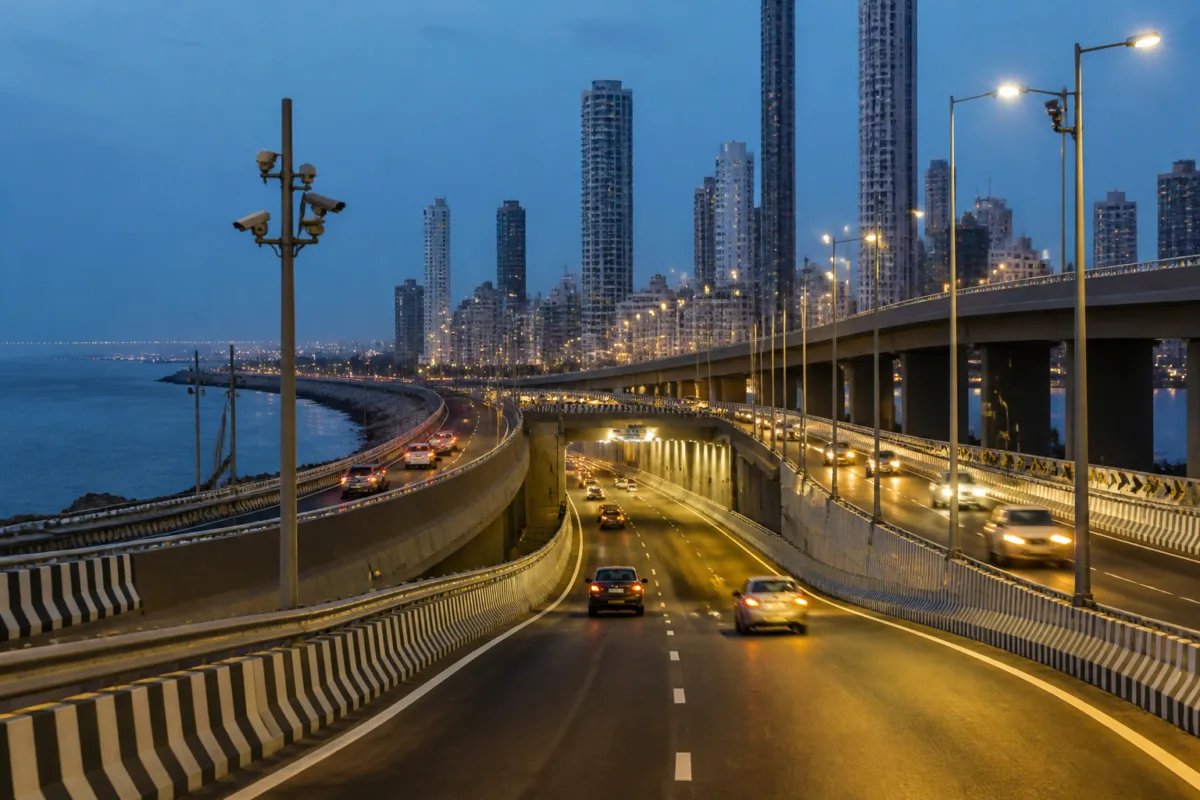
More than 80,000 traffic challans were issued on Mumbai’s Coastal Road during the year between September 2025 and September 2026, according to information obtained through an RTI query. The figure, which includes more than 30,000 speeding violations and penalties of up to Rs 11 crore, shows that the road’s challenge is no longer only one of connectivity or construction. It is also a question of whether enforcement, surveillance and road design are keeping pace with the speed of a new urban corridor.
The data comes into sharper focus after a fatal BMW crash on the Coastal Road in which three students, including a minor, were killed and another student was injured. The car crashed into a barrier and fell about 75 metres into an under-construction site near Lotus Jetty in Worli. CCTV footage showed the vehicle travelling at high speed before it plunged from the second-level ramp, a height of about 70 feet. The crash brought public attention to speeding on a road designed to move vehicles rapidly through one of Mumbai’s most prominent waterfront stretches.
The RTI response from the traffic police separates the enforcement problem into two broad categories. More than 30,000 challans were issued for speeding. Over 50,000 more were issued to vehicles that failed to follow traffic signs. Together, the numbers point to two different but connected failures: drivers are not complying with speed controls, signs and restrictions, while enforcement systems are required to detect and penalise violations across a long, complex corridor.
Light motor vehicles—including cars, vans and jeeps—accounted for 29,727 challans, with fines of up to Rs 5.9 crore, the traffic police told the RTI applicant. The Coastal Road prohibits two- and three-wheelers as well as medium and heavy motor vehicles, but drivers of these categories have also received speeding challans. The information therefore reflects not just behaviour by private car users but also violations of the road’s access rules.
That distinction matters because the Coastal Road is not a conventional city street. It includes tunnels, ramps, elevated sections, curves and connections to existing roads. The source report identifies the stretch between the tunnel exit and Haji Ali as a location where speeding is particularly frequent. A local resident, Nigum Lakhani, said high-speed driving is often seen late at night and in the early morning. He also said that some motorists use modified mufflers, creating considerable noise for nearby residents.
The enforcement figures do not by themselves establish how many challans were paid, contested or repeatedly issued to the same vehicles. They also do not show the number of crashes, near-misses or prosecutions associated with the violations. But they do establish the scale of recorded non-compliance. More than 80,000 challans in a year means that enforcement is not dealing with isolated exceptions. It is operating against persistent rule-breaking on a major public road.
The issue is especially significant because the road’s physical form can magnify the consequences of a violation. On a slower urban street, speeding may endanger pedestrians, cyclists and other motorists at junctions. On a limited-access corridor with ramps, tunnels and elevated sections, high speed can also reduce the time available to respond to barriers, lane changes, breakdowns or construction conditions. The fatal crash near Lotus Jetty demonstrates the severity of that risk, although the available report does not establish whether any specific design feature caused the crash.
The Coastal Road’s enforcement problem is also a monitoring problem. Repeated theft and cutting of cables have disabled between 60 and 65 surveillance cameras, according to the report. The loss of cameras affects more than the ability to identify traffic violations. It can reduce visibility during crashes, obstruct incident reconstruction and leave stretches of the corridor without continuous observation. A road that depends on speed management and controlled access requires a functioning surveillance network to support those objectives.
Viren Shah, chairman of the Worli ALM, said residents had complained after one resident saw people removing and carrying cables near Markandeshwar. The BMC is working to replace the cables, the report said. That response indicates that the surveillance gap is recognised by the civic administration, but the information supplied does not specify how long the cameras have been offline, how many cameras remain operational or when the replacement work will be completed.
This creates a gap between the formal presence of enforcement and its practical reach. Police patrols can respond to visible violations, while cameras and automated systems can provide continuous coverage. When surveillance equipment is disabled, the system becomes more dependent on patrol timing and the likelihood that an officer will be present at the exact location of a violation. The source material does not state how the traffic police divide patrols across the Coastal Road or whether enforcement is concentrated at particular hours.
The financial value of the challans is another visible measure of enforcement, but it is not the same as improved safety. The RTI response records penalties of up to Rs 11 crore across violations, including up to Rs 5.9 crore involving light motor vehicles. The figures show that the system is issuing penalties. They do not show whether the penalties are changing behaviour, whether repeat offenders are being identified or whether high-risk locations are receiving additional engineering and policing measures.
Lakhani told the newspaper that monetary fines may not be a sufficient deterrent for owners of high-end vehicles and suggested stronger action against repeat offenders, including suspension of driving licences. That is a citizen suggestion rather than an announced policy change. The available material does not indicate that the traffic police or the BMC has adopted such a measure. It does, however, underline a central administrative question: whether enforcement is being measured by the number of challans issued or by a reduction in dangerous behaviour.
The distinction is important for a new urban corridor. A high challan count can indicate active detection, widespread violations, or both. Without accompanying information on repeat offences, crash rates, payment compliance and the location and time of violations, it cannot establish which of these explanations dominates. The RTI data is therefore a strong signal of an enforcement burden, but not a complete performance assessment of the road.
The institutional responsibilities are divided. The traffic police provide the violation data and issue challans. The BMC is responsible for replacing stolen or cut surveillance cables, according to the report. Residents’ associations are reporting local conditions, including darkness and the removal of cables. The road’s safety outcomes consequently depend on coordination between traffic enforcement, civic infrastructure maintenance and local reporting.
That coordination becomes more difficult when a road is treated as a finished transport project while parts of its safety system remain vulnerable. Cameras, cables, lighting, barriers, signs and patrols are not peripheral additions to a high-speed corridor. They are part of its operating infrastructure. The available evidence does not show whether the Coastal Road has a single integrated system for reporting equipment failures, restoring surveillance and publishing safety performance. It does show that the loss of cameras has left between 60 and 65 surveillance points affected and that some stretches have been left in darkness.
The numbers also reveal the limits of looking at transport capacity alone. The Coastal Road was built to improve movement through Mumbai, but a faster route can transfer risk if speed controls are weak or if road users interpret a wide, relatively open carriageway as an invitation to drive faster. The report does not provide a design-speed figure or an official explanation of how speed limits are selected. It therefore cannot establish whether the current controls are appropriate. It does show that speeding is the largest specifically identified violation category in the RTI response.
For residents near the corridor, the effects are not limited to traffic safety. Lakhani’s account of modified mufflers and late-night driving points to noise as an additional urban externality. The report does not provide noise measurements or identify enforcement action related to vehicle modifications. Still, the testimony shows how the operation of the road is experienced beyond its carriageway: nearby communities encounter the corridor through sound, darkness and the perceived presence or absence of surveillance.
The larger urban question is whether Mumbai’s new transport infrastructure is being managed as a living public system rather than as a completed construction project. The available data confirms extensive enforcement activity, but it also records widespread violations and weaknesses in surveillance. It does not yet show whether the road is becoming safer, whether repeat offenders are being deterred or how quickly damaged monitoring infrastructure is restored.
The next useful public indicators would be the number of crashes and fatalities on the corridor, the status of the 60 to 65 affected cameras, the timeline for cable replacement, the distribution of speeding challans by location and time, and the treatment of repeat offenders. Until those details are available, the more than 80,000 challans should be read as both an enforcement record and a warning that operating a high-speed urban corridor requires continuous maintenance, monitoring and accountability after construction is complete.

