


Tamil Nadu’s plan to expand Chennai airport with a fifth terminal has reopened a larger question than where the next airport building will stand: how should a growing metropolitan airport be connected to the city when the region’s second-airport strategy changes course? The proposed Terminal 5, or T5, is now being examined alongside a metro link, an underground monorail and new road connections after the state dropped the Parandur airport project.
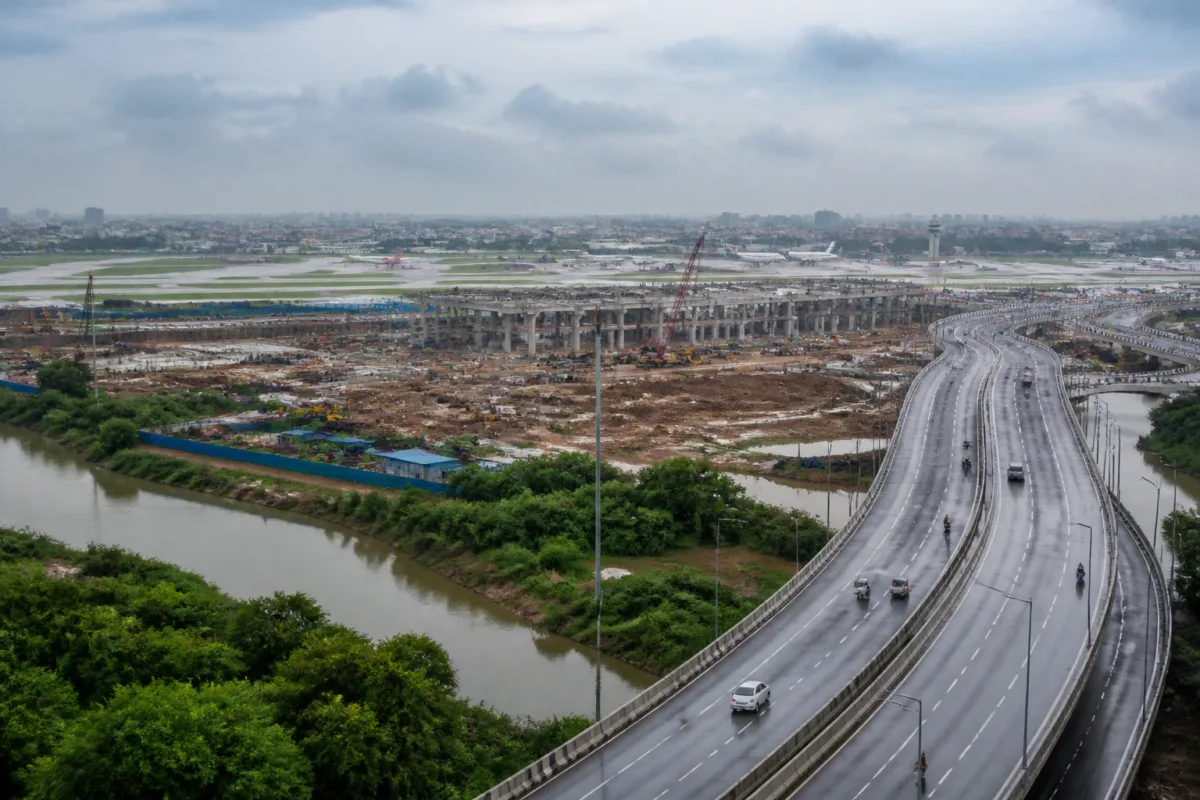
The significance of the proposal lies in the fact that T5 will not function as a simple addition to the existing airport complex. It is planned on the western side of Chennai airport, between the runways, and will initially have a road connection to the Tambaram–Maduravoyal bypass. Tamil Nadu is also studying a second connection to GST Road and the existing terminals, with the aim of allowing passengers to move between the new and existing facilities without making a lengthy detour.
That places transport connectivity at the centre of the airport’s expansion strategy. A terminal’s passenger capacity cannot be separated from the time, reliability and physical route required to reach it. In Chennai’s case, the state is considering several modes at once: metro, underground monorail and expressway access. The decision will determine not only how passengers reach T5, but also how the airport integrates with the city’s existing road and transit networks.
## From a second airport to a satellite terminal
The decision to revisit the airport’s expansion follows the scrapping of the proposed second airport at Parandur, according to the Times of India report. That change brought back an earlier Airports Authority of India proposal for a satellite terminal at the existing Chennai airport. The state has since indicated that it will support the expansion and build the required connections.
The shift changes the planning problem. A separate airport would have distributed aviation activity across two sites, while a satellite terminal at the existing airport concentrates more passengers, aircraft movements and surface access requirements in one complex. The new arrangement therefore requires careful coordination between terminal design, internal airport circulation, external roads, public transport and the movement of freight.
Chennai airport director M Raja Kishore said adequate links to the existing terminals could push the airport’s saturation point to 2050, giving the state time to build a second airport. His statement makes connectivity more than an access issue: it is being treated as part of the airport’s capacity strategy. If passengers can move efficiently between terminals and reach the city through more than one corridor, the existing airport may be able to handle demand for longer than previously expected, according to the official assessment reported by the Times of India.
## The capacity plan depends on the links
T5 is planned to handle 20 million passengers a year. The proposed expansion would also increase Chennai airport’s parking bays from 84 to 124 and aerobridges from 17 to 42, M Raja Kishore said. The terminal design remains at an early stage, and work is expected to begin in earnest after the completion of the T3 integrated terminal.
These numbers describe a substantial increase in the airport’s physical operating capacity, but they also show why the transport question cannot be treated as a later-stage detail. More parking bays, aerobridges and terminal space will bring more passengers into the airport system. Without corresponding access routes, the additional capacity could shift congestion from check-in halls and aircraft stands to approach roads, inter-terminal connections and passenger transfer routes.
The state’s stated aim is to establish a multimodal transport facility. Chennai Metro Rail’s earlier plan to extend a line from the airport to the Parandur site through Tiruneermalai and Sriperumbudur is now expected to be reworked to end at T5. The change illustrates how airport and transit plans remain linked to larger regional decisions. When the destination airport changes, the route, catchment area and function of the proposed transit line also have to change.
The report does not establish which mode will ultimately be selected. Instead, it records an ongoing assessment of alternatives. That distinction matters because each option would create a different relationship between the airport and the wider metropolitan area. A metro connection would tie T5 to the existing rail-based urban transport system. An underground monorail would represent a separate dedicated link. A road along the airport perimeter could improve internal and local access, while an expressway would prioritise faster regional and freight movement.
## One terminal, several institutions
The planning process also reveals how many agencies are involved in delivering a single airport connection. Tamil Nadu Industrial Development Corporation, or TIDCO, is to prepare the detailed project report. Officials from TIDCO, the National Highways Authority of India and the Water Resources Department have met to determine responsibility for the report, while Chennai Metro Rail was also considered for the role. TIDCO was ultimately assigned the task, and the agencies are working out the terms of reference.
This institutional arrangement is important because the project cuts across different administrative responsibilities. TIDCO is handling the detailed planning assignment, NHAI has proposed a major road connection, the Water Resources Department is examining possible river impacts, and Chennai Metro Rail’s earlier alignment may have to be redesigned. The final transport system will depend on whether these agencies can produce one integrated plan rather than a collection of separate projects.
The proposed NHAI road connection would be a four- or six-lane expressway from T5 to the Tambaram–Maduravoyal bypass. It would include a cloverleaf interchange at Tharapakkam and a link to the Outer Ring Road. The stated objective is to accelerate cargo movement from the Sriperumbudur industrial belt as well as improve airport access.
That freight dimension broadens the project beyond passenger convenience. Chennai airport’s connections would serve at least two different mobility requirements: passengers travelling between the city, existing terminals and T5, and cargo moving between the airport and industrial areas. A road designed for regional freight movement may not solve inter-terminal passenger circulation, while a passenger-oriented rail connection may not address cargo access. The planning challenge is therefore to match each connection with the movement it is meant to support.
## The unresolved water and flood question
The proposed links also bring environmental and hydrological concerns into the design process. The Water Resources Department is studying whether pillars built in the Adyar river would obstruct water flow and increase flooding in nearby areas. Urban planner Pavithra Sriram told the Times of India that ecological considerations should be incorporated because constructing pillars on waterbodies could have a negative impact.
This is a crucial constraint because transport infrastructure around airports often requires elevated structures, interchanges, bridges or long approach corridors. In this case, the location of any proposed structure in relation to the Adyar river is not simply an engineering question. It involves the behaviour of water, the capacity of the river channel and the consequences for nearby areas during heavy flows. The supplied report does not provide the department’s final findings, so the flood and ecological implications remain under assessment.
The environmental review also demonstrates why a transport connection cannot be judged only by travel time. A route that shortens the passenger journey but obstructs drainage or river flow could create costs outside the airport boundary. For a project intended to extend the operating life of Chennai’s main airport, resilience and safety will have to be evaluated alongside capacity and speed.
## What the planning process reveals
The proposed T5 is an example of infrastructure planning being repeatedly reshaped by changes in regional strategy. The Parandur airport plan had implied one model for Chennai’s future aviation network. Its cancellation has produced another model centred on expanding the existing airport, adding a satellite terminal and building new links around it.
The immediate decision is therefore not simply whether Chennai needs more airport capacity. It is how that capacity should be distributed across terminals, roads and transit systems, and which public agencies should coordinate the resulting network. The report indicates that the state is still at the detailed project report stage. The route options, the final mode choice, the engineering design and the environmental implications have not yet been settled.
For passengers, the most visible issue will be whether T5 is connected directly to the existing terminals and to the city. The proposed GST Road link is intended to help passengers move between T5 and the current terminals, while a connection to the Tambaram–Maduravoyal bypass would provide another access route. For freight operators, the proposed expressway and Outer Ring Road connection could change the relationship between the airport and the Sriperumbudur industrial belt.
For the city, however, the larger test will be coordination. The airport’s capacity targets, the proposed metro realignment, the expressway design and the Adyar river assessment all need to be considered together. A terminal may be completed on schedule while its surrounding network remains incomplete or poorly integrated. The evidence supplied so far shows that Tamil Nadu’s agencies recognise this interdependence, but it does not yet show how the competing options will be resolved.
The next concrete milestone is the preparation of the detailed project report by TIDCO. Officials are expected to finalise the terms of reference, and bids for a consultant were planned for November, according to the Times of India report. The completion of the T3 integrated terminal is another stated milestone before work on T5 begins in earnest. Until the report and subsequent designs are available, Chennai’s airport expansion remains a capacity plan whose success will depend on the transport and environmental decisions built around it.

