


Anna University’s plan to revive a five-decade-old ethanol vehicle research programme is more than a historical footnote. It brings back a technical question that India’s current ethanol-blending policy has made urgent: can vehicles, fuel systems and public institutions adapt to a transport transition without shifting the costs to motorists, food systems and water-intensive agriculture?
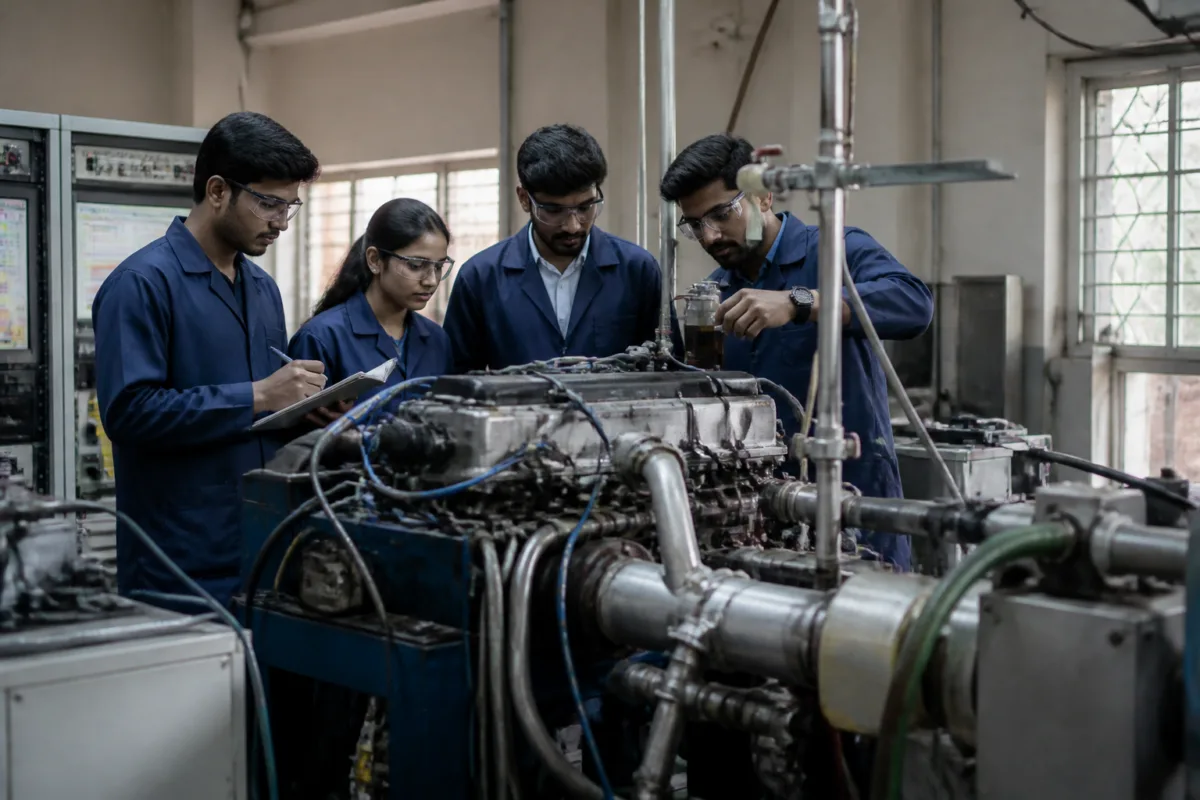
The original work began in Tamil Nadu during the 1970s, after petrol prices increased from ₹4 to ₹6 a litre in 1973. The state government asked professors at the Internal Combustion Engine Laboratory of the College of Engineering, Guindy, to examine alternative fuels. A team led by Professor T R Jagadeesan modified petrol engines to run on 100% ethanol, changing the carburettor, ignition system, cooling system and heating system.
The research is significant because it addressed the engineering challenge at the vehicle level rather than treating ethanol blending only as a fuel-supply issue. The team found that ethanol had a high flame speed and burned without producing black smoke, but its lower heat energy affected mileage. According to Jagadeesan, ethanol produced about 60% of the heat energy generated by petrol, creating a direct efficiency penalty unless the engine was modified.
Road trials recorded that trade-off. In a 1979 test, one car travelled 7.2 km per litre on ethanol, compared with 11.46 km per litre on petrol. On highways, the figures were 9.38 km per litre and 14.9 km per litre respectively. An Ambassador tested on city roads on January 21, 1980, recorded 6.2 km per litre on ethanol against 9.54 km per litre on petrol.
Those figures show why the current ethanol debate cannot be reduced to whether the fuel burns more cleanly or whether it can reduce crude-oil imports. A fuel transition changes the relationship between the vehicle, the engine, the fuel retailer and the consumer. If the fuel contains less energy per litre, the effect can be felt directly in the form of mileage and operating costs. If engines are not designed or calibrated for higher ethanol content, questions of compatibility and durability become equally important.
The Guindy team’s experiments suggested that engineering changes could narrow some of those disadvantages. It increased the compression ratio of a Fiat engine from 7:1 to 11:1 and altered the carburettor and other components. At the normal compression ratio, the ethanol-powered engine recorded thermal efficiency of 26%, compared with 25% for petrol. At the higher compression ratio, efficiency rose to 32%.
This distinction between fuel quality and system design is central to India’s present policy. A fuel blend is not used in isolation. Its performance depends on the design of the engine, the calibration of the fuel system, the materials used in components and the conditions in which the vehicle operates. The historical research indicates that higher ethanol use can require a coordinated response from universities, vehicle manufacturers, fuel companies and regulators.
The Tamil Nadu project also tested the practical limits of the technology on roads rather than only in a laboratory. In one 2,000-km drive, two cars travelled from Chennai to Ooty, then to Kanyakumari and back to Chennai. The vehicles negotiated hill roads and were restarted at Ooty without difficulty. The trial provided an early demonstration that the technology could operate across different terrains and operating conditions.
The work attracted the attention of then chief minister M G Ramachandran, who wanted Ambassador cars at the state secretariat to run on ethanol. Vehicles used by senior officials were subsequently operated on ethanol and brought to the Anna University laboratory for refuelling. The technology was also demonstrated to Prime Minister Indira Gandhi and finance minister R Venkataraman.
Yet the demonstrations did not lead to large-scale implementation. The principal barrier was not simply whether an engine could run on ethanol. It was how the fuel would be produced at scale. At the time, ethanol production was closely linked to sugarcane, and policymakers were concerned that using agricultural resources for fuel could divert them from food consumption. The project therefore encountered a policy problem that remains relevant today: energy security can conflict with food security when the same land and crops are expected to serve both purposes.
The researchers extended their work beyond petrol engines. They achieved an 80% ethanol blend in a diesel motor pump set and a 40% blend in a bus engine supplied by Ashok Leyland. Because ethanol and diesel do not blend easily, the two fuels were supplied separately. These tests are relevant to the wider transport system because buses, commercial vehicles and agricultural equipment have different duty cycles and fuel requirements from private cars.
The research, conducted between 1975 and 1985, was presented at international forums in the United Kingdom, the United States, Canada and Brazil. Jagadeesan says the team proved that modified petrol engines could operate on 100% ethanol and that, after five years of testing, engine damage and wear were comparable to what occurred with petrol. The claims are reported by the Times of India and attributed to Jagadeesan; the supplied material does not provide the original laboratory records or independent technical validation of those historical results.
Anna University now plans to revisit the question with a focus on ethanol performance at different compression ratios and on flexible-fuel vehicles. Registrar-in-charge V Kumaresan said the case for ethanol as an alternative transport fuel had strengthened because ethanol could be produced from several sources, including agricultural residues. The university will also participate in an ethanol research project involving IIT Madras and universities in China and Brazil. The Tamil Nadu government has allotted the team a research grant of ₹5 lakh.
That proposed research reflects how the policy landscape has changed since the 1970s. India’s ethanol-blended petrol programme is intended to improve energy security, support farmers, reduce environmental impacts and promote domestically produced renewable fuel. The E20 policy requires fuel retailers to sell petrol containing 20% ethanol and 80% gasoline. According to the supplied report, blending increased from less than 1.5% in 2013–14 to 20% in 2025–26, five years ahead of schedule.
The speed of that increase has altered the scale of the engineering challenge. The earlier Tamil Nadu experiments were conducted by a university team working with selected vehicles and controlled modifications. The current programme operates across a national vehicle fleet containing different engine generations, component materials and maintenance conditions. A laboratory demonstration and a government fleet trial cannot by themselves establish how every vehicle will perform under a nationwide blend mandate.
The policy also creates an institutional division of responsibility. Fuel retailers control the product supplied at stations. Vehicle manufacturers determine the compatibility of new models and the design of fuel systems. Universities can test engine performance and materials. Regulators and governments set blending targets and standards, while motorists absorb the effects through mileage, maintenance and vehicle replacement decisions. The transition therefore depends on coordination across institutions rather than on fuel production alone.
The source report records concerns that E20 could lower fuel efficiency, accelerate corrosion and damage components not designed for higher ethanol content. It also notes that India imports more than 80% of its crude oil, making domestically produced ethanol attractive as a way to reduce exposure to imported fuel. Ethanol produced from sugarcane, maize and rice offers a local supply route, but the same crops raise questions about water use and food security.
This is where the older Tamil Nadu experiment becomes useful as policy history. The earlier programme stalled because the country had not resolved the supply question. The current programme has moved further because ethanol is now being produced from a wider set of sources, including agricultural residues, and because blending has become a national policy objective. But the underlying allocation problem has not disappeared. Sugarcane and rice remain water-intensive crops, and the benefits of a steady fuel market must be weighed against the demands placed on land and water.
The data from the old trials also provide a more grounded way to assess the transition. Ethanol’s advantages include cleaner combustion in the tested petrol engines and the potential to reduce crude-oil imports. Its disadvantages include lower energy content and the possibility of lower mileage. These are not abstract policy trade-offs. They influence how far a vehicle can travel on a tank, how often a driver refuels and how transport costs are distributed among households, commercial operators and public agencies.
For cities, the issue is especially relevant because urban transport systems depend on large fleets operating continuously. A private car can be replaced over time, but buses, taxis, delivery vehicles and municipal fleets involve procurement cycles, maintenance contracts and service obligations. The historical bus and motor-pump experiments show that different vehicle categories may require different technical solutions. They also underline why a single blending target cannot automatically produce uniform outcomes across the transport system.
The revival at Anna University places an academic institution in the middle of that transition. Its proposed work can connect past road-test experience with current research on compression ratios and flexible-fuel vehicles. The planned collaboration with IIT Madras and overseas universities may broaden the research base, but the supplied material does not establish the project’s detailed timetable, testing protocol, vehicle sample or expected commercial outcomes.
What the evidence confirms is narrower but important. Tamil Nadu engineers demonstrated decades ago that modified petrol engines could run on high ethanol concentrations, and the trials identified both technical possibilities and practical limitations. India has since moved from experimentation to a nationwide E20 policy, while concerns over mileage, component compatibility, food security and water use remain part of the public debate.
The next phase will show whether the revival produces transferable evidence for flexible-fuel vehicles and higher ethanol use, or remains a small research programme with historical significance. The milestones to watch are the university’s testing results, the scope of its collaboration with IIT Madras and international partners, and how policymakers address the competing demands of energy security, vehicle performance, food production and water resources.

