


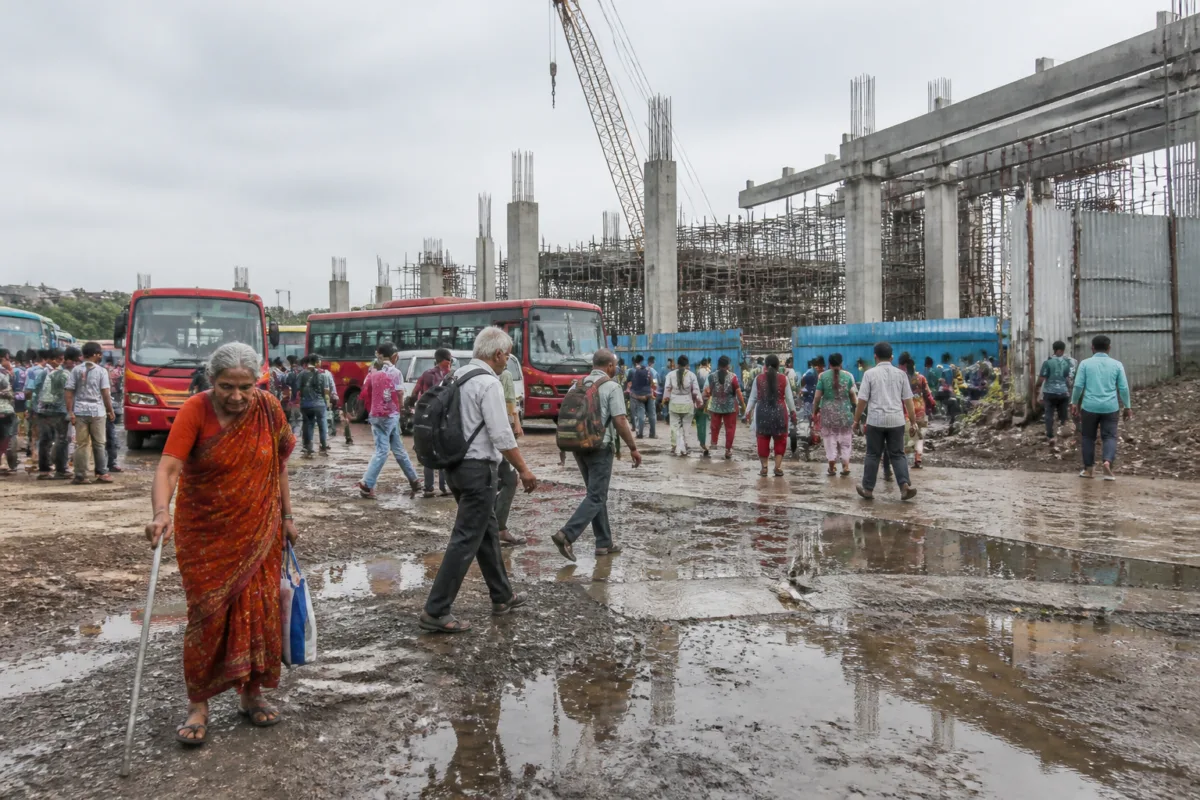
The delay in completing Avadi’s new bus terminus has turned a temporary transport arrangement into a daily test of the city’s ability to maintain basic commuter infrastructure during construction. The present facility, shifted to private land near Avadi railway station, lacks a proper paved platform and reportedly floods even after light rain, while the permanent project remains only 60% complete.
The Chennai Metropolitan Development Authority (CMDA) began construction of the new bus terminus on CTH Road in August 2025. The move was required to make way for the project, with the Metropolitan Transport Corporation (MTC), in coordination with the Avadi Corporation, transferring bus operations to the temporary site. The arrangement was intended to keep services running while construction progressed, but commuters now face uncertainty over how long the temporary facility will remain in use.
A senior MTC official said the private property had been rented until October 2026 and that the corporation was planning to renew the contract for another six months. The statement establishes a near-term continuation of the temporary arrangement, but the report does not provide a confirmed completion date for the new terminus. That gap is significant for commuters because the temporary site’s shortcomings are not limited to inconvenience: they affect access, waiting conditions and the usability of a transport interchange connected to the railway network.
The proposed permanent terminus is substantially different in scale and function. CMDA is constructing a three-storey facility at an estimated cost of ₹36.06 crore, with a built-up area of 65,000 sq. ft. The project is planned to include a food plaza, shopping area, public conveniences, a water purification plant and restrooms for bus crew. Its ground floor is designed for bus bays and is expected to accommodate 22 buses at the same time.
The plan also includes a waiting area of nearly 5,000 sq. ft., along with timekeeper and other administrative offices. These facilities indicate that the project is not merely a replacement shelter. It is intended to consolidate the operational and passenger functions of a major bus interchange and to provide the physical capacity required for more organised movement of buses and people.
That planned capacity is particularly relevant because Avadi’s location gives the terminus a role beyond the immediate neighbourhood. Its proximity to Avadi railway station makes it a transport hub for passengers travelling towards Poonamallee, Tiruvallur and Arakkonam. The bus-rail connection means that conditions at the terminus influence not only people boarding buses at Avadi but also passengers transferring between modes for longer journeys across the region.
The current site, however, appears to be operating without several basic features expected at a permanent interchange. S. Murugaian, a resident of Avadi, said commuters, especially senior citizens, faced difficulties because there was no proper paved platform. He also said the site became flooded even after light rain. These conditions expose the difference between keeping bus operations technically functional and keeping a transport facility accessible and safe for the people who depend on it.
A bus terminus is not only a place where vehicles arrive and leave. It is a public interface where passengers wait, cross between buses, handle luggage, seek information and move towards other forms of transport. The absence of a paved platform can make these simple activities more difficult, particularly for senior citizens and other passengers with limited mobility. Flooding adds another layer of disruption by reducing usable space and complicating access to buses.
The temporary site also raises a question about how construction-related relocations are managed. When a transport facility is moved to make way for a new project, the interim site becomes part of the city’s functioning infrastructure, even if it is not intended to be permanent. The MTC’s planned contract renewal suggests that the temporary location will continue to carry this responsibility for at least another six months. The report does not state whether improvements to drainage, paving or passenger facilities are planned at the rented property.
This is the central administrative issue in Avadi: the permanent project and the temporary service arrangement are being managed by different public bodies, with the Avadi Corporation also involved in the relocation. CMDA is responsible for constructing the new terminus, while MTC is responsible for operating bus services and arranging the temporary premises. The arrangement requires the construction schedule, the transport operator’s lease and the commuter’s immediate needs to remain aligned.
The reported progress of 60% shows that construction has advanced beyond the initial stage, but it also leaves 40% of the work unfinished. The supplied report does not identify which elements remain incomplete, whether the remaining work includes passenger-access facilities, or whether the project has faced a revised schedule. Without those details, the percentage alone cannot establish when the terminus will be ready for use.
The project’s design also includes parking arrangements for 500 vehicles, including cars. Commuters had specifically sought parking facilities, and CMDA has made arrangements for this capacity in the new terminus. If delivered as planned, the parking provision would address an existing demand around a facility that serves both bus users and passengers connecting to the railway station. However, the report does not clarify whether the parking will be available simultaneously with bus operations or how vehicle movement will be separated from bus bays and pedestrian areas.
The proposed 22-bus capacity and the planned waiting area suggest an effort to create a more structured interchange than the current temporary site. The terminus is also expected to include operational offices for timekeepers and other staff, which would bring passenger and service-management functions into one facility. Yet the project’s value will depend on completion and operational handover, not only on the facilities listed in its design.
The concerns raised by residents also connect the project to the question of service expansion. T. Sadagopan, a resident of Pattabhiram, said the CMDA should complete the bus terminus-cum-depot as early as possible so that Avadi could gain prominence similar to the Poonamallee bus terminus and operate more services to larger destinations in the city. This expectation links physical infrastructure to network performance: residents see the new facility not only as a building but as a possible basis for more extensive bus operations.
The source material does not establish that additional services have been sanctioned or that the completed terminus will automatically produce a specific increase in routes. It does, however, show why commuters and residents are watching the construction closely. A modern terminus can provide space for buses, passengers, parking and staff, but decisions on routes and service frequency remain part of transport operations and are not determined by the building alone.
Avadi’s experience illustrates a recurring problem in urban infrastructure delivery: the public often experiences a project first through its temporary phase. The permanent facility may be designed with improved amenities, but commuters must use the interim arrangement every day while work continues. If the temporary site is not treated as a functioning public facility, the inconvenience can persist without a clear accountability mechanism for basic improvements.
The available evidence confirms three points. First, the new Avadi bus terminus is a sizeable CMDA project with a stated cost of ₹36.06 crore, a planned built-up area of 65,000 sq. ft. and capacity for 22 buses at a time. Second, construction had reached 60% when the report was published, with no completion date specified in the supplied material. Third, the temporary terminus is expected to remain in use beyond the existing rental period, while commuters continue to report flooding and inadequate paving.
The developments that now require monitoring are the renewal of the temporary-site contract, progress on the remaining construction, the provision of basic commuter facilities during the interim period and the eventual operational plan for the bus terminus-cum-depot. Until those milestones are clarified, Avadi’s proposed transport hub will remain divided between a large promised facility under construction and a temporary stop that commuters already find difficult to use.

