


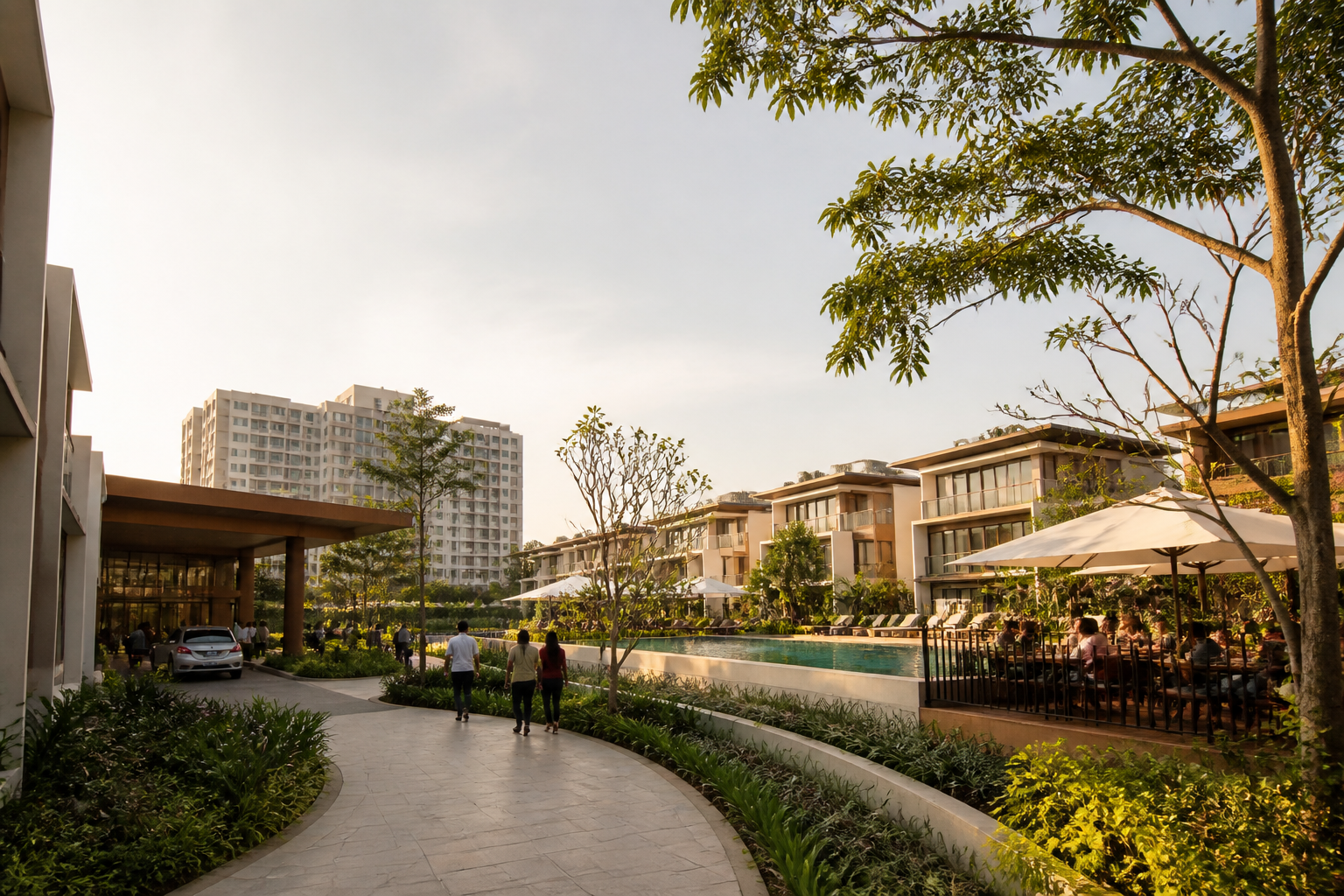
Hospitality-led real estate is moving beyond the traditional second home in India, as buyers near major cities increasingly seek managed services, resort-style environments and integrated leisure experiences. The trend is prompting developers to combine residential units with hotels, serviced apartments, dining, shopping and social spaces, while sale-and-leaseback models are creating a closer link between property ownership and hospitality operations.
The shift, reported by Economic Times, is visible in locations such as Lonavala, Jaipur, Kasauli and Coorg, as well as in projects around Bengaluru. These destinations sit within the broader orbit of major urban markets, allowing developers to position them as lifestyle extensions of metropolitan living rather than simply as standalone holiday properties. The reported demand is therefore not only for additional residential space, but for a particular way of using and managing that space.
That distinction matters for the built environment. A conventional second home is primarily sold as a private asset: a house or apartment that can be occupied by its owner, rented out or left unused for long periods. Hospitality-led projects introduce another operating layer. Owners may receive access to resort facilities and managed services, while developers or hospitality partners take responsibility for operating parts of the project and, in some cases, leasing units back into a broader resort inventory.
The sale-and-leaseback model described in the report reflects this change. A portion of a resort is sold to individual buyers, who can use their units and also place them on lease. The arrangement gives developers a way to raise capital through unit sales while retaining a hospitality-led operating model. For buyers, it offers a potential combination of personal use and participation in a managed property, although the report does not provide details on lease terms, guaranteed returns, occupancy assumptions, maintenance charges or the distribution of operating income.
Those missing details are important because a hospitality-linked property is not identical to a conventional home. Its value depends not only on location and physical construction, but also on the quality and continuity of services, the performance of the operating brand, the management agreement and the balance between owner use and commercial use. The source material establishes that the model is gaining traction, but it does not establish the financial outcomes for individual buyers or compare the model with other forms of real estate investment.
The reported buyer preference is being described in experiential terms. Ashwin Chadha, chief executive officer of India Sotheby International Realty, said buyers were seeking an elevated lifestyle, world-class design and services backed by a trusted brand. He also said the success of recent launches across Mumbai, Gurugram and Delhi showed that buyers were willing to pay a premium for exceptional experiences rather than only for physical square footage.
This is a significant change in the language of residential development. For years, the core proposition in housing has generally been built around size, location, connectivity, amenities and price. Hospitality-led projects add service quality, design identity and curated experiences to that proposition. The home is presented not merely as a private interior, but as part of a managed environment with leisure, dining and social infrastructure.
Vishal Vincent Tony, managing director of Aratt Developers, said homebuying decisions were increasingly shaped by lifestyle choices and the kind of environment buyers wanted to live in. According to him, buyers were seeking convenience, service, experiences and an environment that complemented their aspirations and everyday routines. Aratt is executing multiple resort-led projects around Bengaluru, where the report links demand to the city’s business environment, technology presence and appetite for quality experiences.
Bengaluru is an important case in this emerging model because the projects described are not limited to conventional holiday destinations. The city’s development pattern is supporting projects that combine residential, hospitality and commercial functions. This suggests that the resort-led idea is being adapted for an urban and peri-urban market, where buyers may want hotel-like services and leisure infrastructure without giving up access to a major employment centre.
The concept also changes how developers think about project programming. Raghunath Reddy Bhattagiri, co-founder and managing director of Triguna Projects, said demand was increasing for developments that combine hotels, serviced apartments, shopping and dining. His comments point to a mixed-use approach in which hospitality is not an accessory to a residential project, but one of its organising principles.
That approach can create new development possibilities. Residential, hospitality and commercial uses can share roads, public-facing spaces, service infrastructure and amenities. A project may be able to draw users at different times of the day and across different seasons. However, the report does not provide occupancy data, infrastructure assessments or project-level performance figures, so the extent to which these developments create consistently active mixed-use environments remains unestablished.
The investment side is also becoming more institutional. The report notes that ASK Curated Luxury Assets Fund-I, a co-sponsored fund, invested in the Taj Mount Kusur Resort & Villas in Lonavala, developed by Amavi in partnership with Indian Hotels Company. The investment indicates that hospitality-led real estate is attracting not only individual homebuyers but also capital structured around branded and managed assets.
The presence of an institutional investor and an established hospitality company adds credibility to the operating model, but it does not remove the need to understand the underlying arrangements. The source does not disclose the investment size, ownership structure, projected returns or the responsibilities of the participating entities. Those details would be necessary to assess how institutional capital is shaping the development pipeline and whether the model can be replicated beyond premium locations.
The policy landscape surrounding these projects is not set out in the report, but the development model raises several administrative questions. A project that combines villas or apartments with a resort, serviced accommodation, retail and dining may involve multiple land-use, construction, hospitality and local governance requirements. The way these uses are approved, serviced and taxed can affect both project viability and the experience of residents and guests.
The urban infrastructure implications are similarly material. Resort-led development depends on reliable access, water, power, waste management and road capacity. In locations near metropolitan regions, new projects can add seasonal or weekend demand that differs from the demand generated by permanent residents. The supplied report does not quantify that pressure or indicate how local authorities are planning for it. As a result, the evidence supports the existence of a development trend, but not a conclusion about its wider infrastructure impact.
The data available in the report is primarily qualitative. It identifies project activity around Bengaluru, mentions recent launches across Mumbai, Gurugram and Delhi, and names four destination markets—Jaipur, Lonavala, Kasauli and Coorg—where sale-and-leaseback models are being offered. It also records an investment in a Lonavala project and cites statements from three industry executives. However, it does not provide sales volumes, price premiums, absorption rates, project counts, buyer demographics or comparisons with conventional second-home markets.
That limitation should shape how the trend is understood. The evidence shows that developers and property advisers are observing stronger interest in lifestyle-led and hospitality-backed developments. It does not yet establish how broad the preference is across the housing market, whether it is concentrated among affluent buyers, or how many projects have reached stable operations. The language of a market shift is supported by the reported activity, but its scale remains unclear from the available material.
The bigger urban question is whether hospitality-led real estate represents a new form of integrated development or a premium branding layer applied to second homes. The answer will depend on how these projects operate after launch. If hospitality, residential and commercial uses are genuinely integrated, they could create more active environments and diversify the use of peri-urban land. If services are inconsistent or ownership and operating responsibilities are unclear, the model could instead produce expensive properties with limited everyday utility.
For buyers, the distinction between a home, a managed resort unit and a lease-backed investment will need to remain clear. For developers, the challenge is to deliver not only attractive buildings but also reliable operations. For cities and local authorities, the question is whether planning and infrastructure systems can accommodate projects whose populations and service needs fluctuate between residents, visitors and short-term guests.
The evidence currently confirms a strong commercial direction: developers are combining residential and hospitality uses, buyers are being sold experiences alongside physical space, and institutional capital is entering selected branded projects. What remains uncertain is the long-term performance of the model, its infrastructure footprint and the protections available to individual purchasers. Those factors will determine whether hospitality-led real estate becomes a durable urban development format or remains a niche segment of the premium second-home market.
