


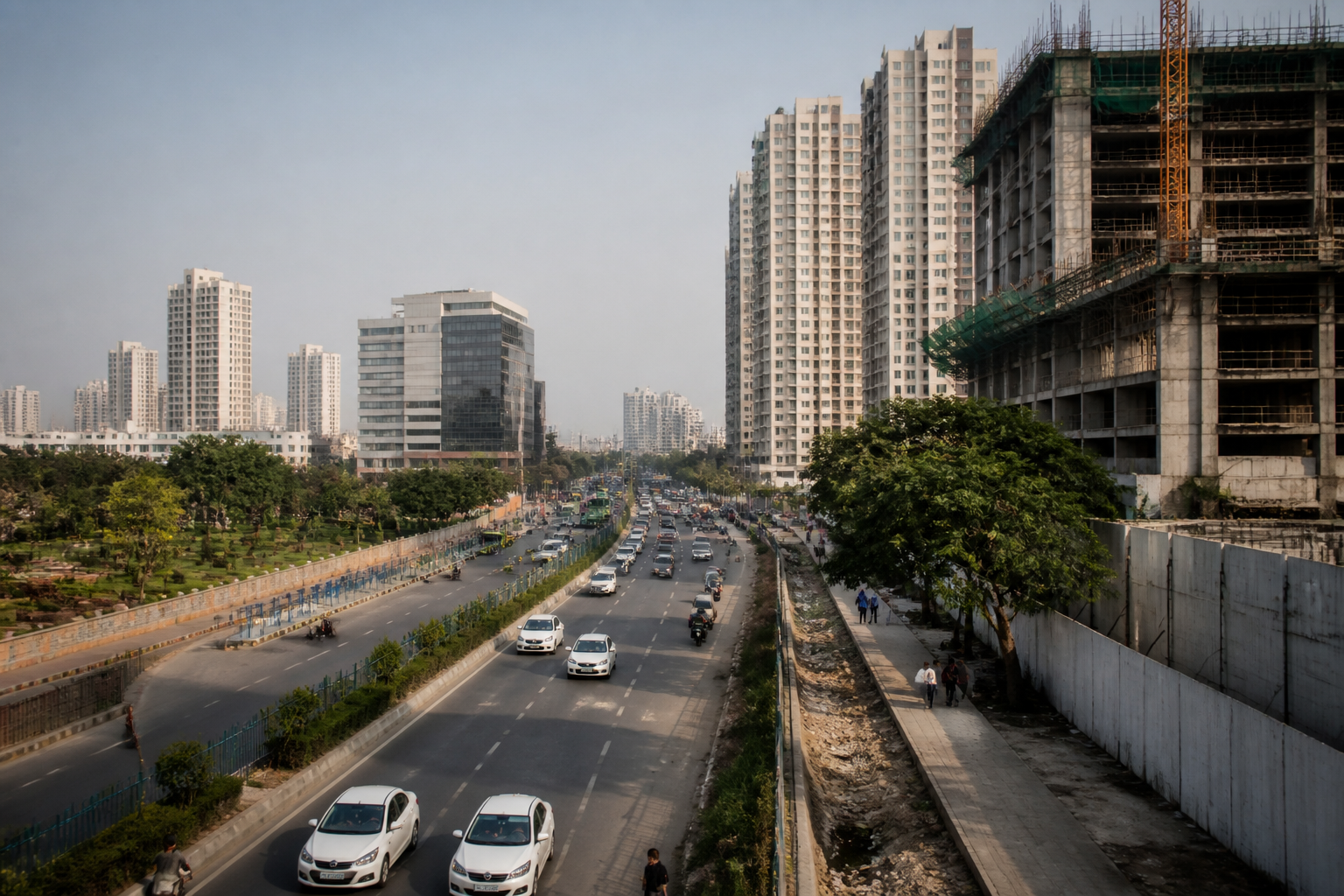
A Rs 1,850 crore bid for 12.5 acres in Noida Sector 108 has exposed a larger shift in the city’s urban economy: as older sectors reach saturation, development pressure is moving south towards the Noida-Greater Noida Expressway. The parcel, purchased by real-estate developer M3M after outbidding DLF, attracted more than twice the Noida Authority’s reserve price of Rs 835 crore.
The bid is significant not only because of its value, but because of what the site is expected to accommodate. The land has been sold for a mixed-use project allowing a maximum of 40% residential development and 60% commercial development. That combination places Sector 108 within a development model increasingly shaped by premium housing, Grade A offices, institutions, healthcare and transport infrastructure rather than by residential expansion alone.
The Noida Authority’s explanation points to a basic spatial problem. Older northern sectors, including Sectors 19, 27, 28 and 30, have become saturated, leaving limited room for new development. The Expressway-side sectors therefore offer something that established parts of the city increasingly cannot: larger parcels, room for planned mixed-use projects and proximity to newer commercial and institutional clusters.
Sector 108’s appeal is also linked to the concentration of high-value urban activity around it. An unnamed Noida Authority official cited premium residential projects between Sector 44 and the Expressway, with property rates in some locations going up to Rs 9 crore. The official said this has created demand from high-end customers for nearby commercial establishments. Schools, universities, hospitals, offices, parks and playgrounds are part of the wider ecosystem described by the authority.
This is important because the demand for the parcel is not being presented as a land-market event in isolation. The authority’s account describes a reinforcing urban cycle. Premium housing creates a customer base for retail and services. Commercial districts create demand for nearby homes. Institutions and hospitals generate regular movement and employment. Green spaces and recreational facilities improve the attractiveness of the area for residents and workers. Sector 108’s value, in this reading, comes from its position within that network rather than from its acreage alone.
The mixed-use allocation strengthens that logic. The Noida Authority official said the 40% residential and 60% commercial proportion is attractive to builders because the surrounding corridor already contains Grade A commercial developments serving information technology and IT-enabled services. Advant Navis Business Park and SkymarkOne in Sector 98 were cited as examples. Employees working in such developments could seek residences nearby, with Sector 108 positioned as one possible location.
That does not mean the corridor is already a fully integrated live-work district. The source material establishes the presence of projects, institutions, healthcare facilities and transport links, but it does not provide occupancy figures, employment numbers, traffic data or details of how the new project will be phased. The bid therefore demonstrates strong developer confidence, while the final urban performance of the site will depend on how effectively residential, commercial, public-space and mobility components are delivered together.
The Expressway is central to the land’s appeal. Sector 108 is described as 9.5 km, or about a 14-minute drive, from the Delhi Noida Direct flyway. It is also around 52 km, or a 50-minute drive, from Noida International Airport in Jewar. The airport’s opening has added another layer to the corridor’s investment narrative, with the Noida Authority suggesting that freight operations could generate demand for logistics parks and related commercial activity.
The airport connection illustrates how infrastructure expectations can influence land markets before the full economic effects of a project are visible. For travellers moving from Noida to the airport, the Expressway is currently described as the main road route. The authority also referred to e-bus services to the airport and the existing metro line from Botanical Garden to Sector 137. Proposals by the Noida Metro Rail Corporation for a line to improve connectivity from the sector were also mentioned, although the supplied material does not establish a construction timeline or approved alignment.
This distinction matters. Road access, bus services, metro connectivity and proposed rail links do not carry the same operational certainty. The current value of Sector 108 is being shaped by a combination of existing infrastructure and anticipated connectivity. For residents and businesses, the difference between an operating service and a proposal will determine actual travel times, access to jobs and the viability of high-density development.
The land bid also reveals how scarcity is changing competition among developers. Reetesh Singh, managing partner at Realistic Advisory & Consultancy, said very limited land is now available along the Expressway and that large builders do not want to lose a position there. Paras Satija, founder and chief executive officer of PlanWell Realty, described the transformation as extending beyond Sector 108 to the entire Noida Expressway corridor.
Satija said the corridor had seen the arrival of several large real-estate brands and branded residences during the previous year. He also said prices had increased drastically, in some cases by as much as four times. His example from neighbouring Sector 105 provides a more specific reference: he said land prices rose from about Rs 1,50,000 per square metre in 2016 to Rs 3,70,000 per square metre now. That is a substantial increase, although the figures cited for Sector 105 should not be treated as a direct valuation of the Sector 108 parcel.
The arrival of larger brands changes the competitive structure of the corridor. Satija cited projects and companies associated with Max Estates, Godrej, Tata, Birla and M3M, while also referring to interest from builders in Hyderabad. For established local developers, this means competing not only for land but also for visibility, financing, customers and the ability to deliver projects at the standards associated with branded developments.
The Noida Authority’s planning framework, as described in the report, is therefore producing a corridor in which land-use flexibility and location are closely connected. A site with a majority commercial allocation can benefit from nearby offices and high-income housing, while the residential component can provide a local customer base and reduce the distance between homes and workplaces. Whether this produces a balanced urban district will depend on details not available in the supplied material, including the project’s approved design, parking arrangements, public transport access, infrastructure capacity and implementation schedule.
The institutional geography around Sector 108 is already dense. Amity University in Sector 125, Lotus Valley school and private hospitals including Felix and Yatharth within a 6-km radius were cited by the authority. These facilities create a broader catchment of students, staff, patients, families and service workers. They also add daily trips that can place pressure on roads and public transport as more commercial and residential projects are built along the corridor.
That is the larger urban question raised by the bid. Noida is not simply expanding into empty land; it is assembling a new concentration of housing, offices, education, healthcare, green space and transport around the Expressway. The economic case for Sector 108 rests on the interaction of these uses. The governance challenge will be ensuring that the infrastructure supporting them grows at a comparable pace.
The available evidence confirms strong market interest, a high-value land transaction and a clear shift towards the Expressway as a preferred development location. It also shows that airport access, existing commercial projects, premium housing and limited land supply are reinforcing demand. What remains uncertain is how quickly proposed connectivity improvements will materialise, how the mixed-use project will be implemented and whether the corridor’s public infrastructure can match the scale of private development. Those will be the key indicators to monitor as Sector 108 moves from a successful land bid to a functioning urban district.

