


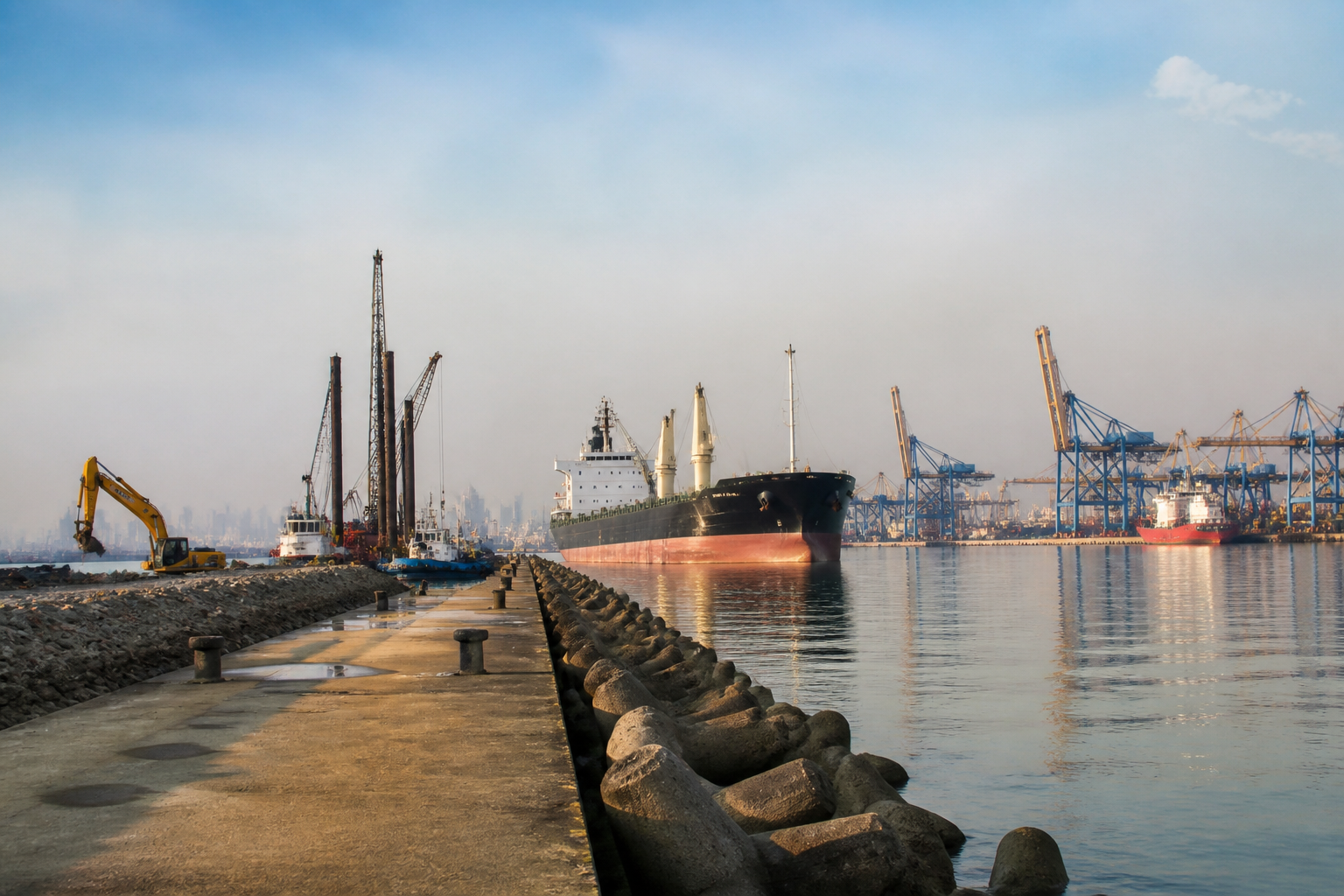
The government’s decision to double the validity of environmental clearances for ports, harbours, breakwaters and dredging projects changes more than an administrative deadline. It alters the regulatory horizon within which one of India’s most capital-intensive infrastructure sectors must plan, invest and expand. Clearances will now remain valid for 20 years instead of 10, with two further five-year extensions possible subject to safeguards.
The reform comes as the government targets a substantial increase in port capacity, from the existing 2,762 million metric tonnes per annum to 10,000 MMTPA by 2047. That target makes the duration and stability of environmental approvals an important part of the infrastructure system. Port development is not a short-cycle activity: it involves marine works, dredging, breakwaters, cargo-handling facilities and supporting assets that require long-term investment decisions. A clearance that expires halfway through an asset’s operating or expansion cycle can become a significant regulatory uncertainty.
The Economic Times reported the change, citing the government’s decision and comments from M Angamuthu, chairperson of the Mumbai Port Authority. Angamuthu said the extended validity would benefit the port sector and business stakeholders from a long-term business perspective. He added that the reform would facilitate large investments from local and global port operators.
## Why port environmental clearance validity matters
Environmental clearance is not merely a preliminary permission for a port project. In the context of the reform, its validity determines how long an approved project can operate within the terms of its environmental authorisation before it must seek renewal or extension. Moving from a 10-year period to 20 years therefore reduces the frequency at which eligible projects must revisit the validity of an existing clearance.
The change does not remove environmental safeguards. The provision for two additional extensions of five years each is explicitly subject to compliance with safeguards. This distinction is central to understanding the policy. The reform extends the regulatory duration, but it does not establish an unconditional or indefinite approval. Continued eligibility remains linked to compliance requirements.
That structure creates a two-part framework. The first part is a longer base validity period, which provides greater certainty for planning and investment. The second is a continuing compliance condition, which preserves the role of environmental safeguards during the life of the project. The source material does not specify the detailed safeguards or the process through which compliance will be assessed, so the operational effect of those conditions will depend on subsequent implementation and monitoring.
The reform also covers eligible ongoing projects with active clearances. This provision is important because the benefit is not limited to projects that receive approval after the change. Existing projects with active clearances may also be able to operate under the revised validity framework, subject to eligibility and the applicable safeguards. That gives the measure an immediate administrative dimension alongside its longer-term investment implications.
## A longer regulatory horizon for port investment
The government’s capacity target provides the clearest explanation for why clearance validity has become a policy issue. India’s existing port capacity is reported at 2,762 MMTPA, while the target for 2047 is 10,000 MMTPA. Reaching that level would require capacity to grow by more than three times from the current figure. The source does not provide a project-wise roadmap, funding split or implementation schedule, but the scale of the stated target indicates that expansion will need to be sustained over several decades.
A 10-year clearance period can create a mismatch between the life of a port asset and the period for which its environmental authorisation remains valid. Even where a project continues to function within approved conditions, the need to seek extensions or renewals can introduce additional administrative steps. For investors and operators, that may affect the assessment of long-term risk, particularly for large projects whose returns depend on extended operating periods.
The 20-year validity period addresses this issue by aligning the clearance window more closely with the long-term nature of port infrastructure. It can make the regulatory position of an approved project easier to assess over a longer investment cycle. This is the principal institutional change indicated by the reform: environmental approval becomes a more durable component of project planning rather than a permission that must be revisited at a comparatively shorter interval.
The policy is therefore relevant to both public and private infrastructure. Mumbai Port Authority is one of the dozen ports owned by the central government, according to the report. The comments from its chairperson place the reform within the operating reality of major public port institutions, while the reference to local and global port operators points to its expected relevance for private and international capital as well.
## The reform’s limits are as important as its promise
The extension should not be read as a waiver from environmental regulation. The provision for two additional five-year extensions is conditional, and the source specifically refers to safeguards. This means the long-term certainty offered by the policy is not separate from compliance; it is built around compliance.
That distinction matters because port projects interact with marine and coastal environments through activities such as dredging and the construction of breakwaters. The reform covers these activities alongside ports and harbours, but the supplied material does not identify how different project types will be treated or whether specific conditions will vary by location, scale or environmental impact. Those details will determine how predictable the new system is in practice.
The same issue applies to ongoing projects. The government has indicated that eligible projects with active clearances are covered, but the source does not state how eligibility will be determined, whether operators must file any additional documentation, or how existing conditions will be carried forward. Until those administrative details are made clear, the announcement establishes the direction of policy but not every step required for implementation.
This is where the institutional significance of the reform lies. A longer validity period can reduce repetitive approval-related uncertainty, but it also places greater importance on the quality of continuing compliance systems. If safeguards are conditions for further extensions, authorities and project operators will need a clear basis for demonstrating that those conditions have been met. The source does not provide details on monitoring arrangements, reporting requirements or enforcement procedures, so those aspects remain to be clarified.
## What the capacity numbers reveal
The movement from 2,762 MMTPA to a 10,000 MMTPA target is the central data point in the reform. It shows the distance between existing capacity and the government’s 2047 ambition. The target is not simply an operational objective for individual ports; it represents a national infrastructure expansion challenge that will involve multiple projects, operators and approval cycles.
The clearance reform addresses one part of that challenge: the duration of environmental authorisation. It does not, based on the supplied information, resolve questions about capital availability, land and coastal space, cargo demand, connectivity, construction timelines or the financial performance of individual facilities. Nor does the announcement establish how much of the targeted capacity will come from new ports, existing port expansion or improved utilisation of current assets.
That limitation is significant. Extending clearance validity may improve the investment environment, but it cannot by itself guarantee that capacity will be built or used. The policy’s immediate contribution is regulatory continuity. Whether that continuity translates into additional capacity will depend on the projects that come forward, their financing, their compliance performance and the government’s broader port development programme.
The 2047 horizon also means that the reform will operate across successive investment and administrative cycles. A 20-year validity period gives projects a longer formal window, while the possible extensions could provide additional continuity. At the same time, the conditions attached to those extensions mean that the regulatory relationship does not end when the initial clearance is granted.
## The larger urban and infrastructure question
Ports are often discussed as national economic infrastructure, but their development has direct implications for the built environment around coastal cities and industrial regions. Port expansion can shape freight movement, logistics facilities, road and rail connections, worker settlements and the use of adjoining waterfront areas. The supplied report does not detail these local effects, but the inclusion of ports, harbours, breakwaters and dredging places the reform within a wider infrastructure system rather than a single administrative category.
For cities connected to major ports, the practical significance of a longer clearance period will depend on how projects are integrated with surrounding transport and land-use systems. The reform may make long-term port investment easier to structure, but the announcement does not establish how future projects will address their connections with roads, railways, logistics parks or urban services. Those questions remain outside the evidence supplied for this report.
The policy nevertheless marks a clear shift in the balance between approval duration and project life. The government is seeking faster and more durable conditions for port investment while retaining safeguards as a condition for further extensions. That balance will be tested through implementation: how eligibility is defined, how active clearances are transferred into the revised framework, and how compliance is assessed over the longer period.
The evidence currently confirms three points. Environmental clearances for the specified port-related projects have been extended from 10 years to 20 years; two further five-year extensions are possible subject to safeguards; and eligible ongoing projects with active clearances are included. The reform is linked to a national capacity ambition of 10,000 MMTPA by 2047, compared with 2,762 MMTPA at present. The next significant developments will be the detailed administrative process for existing projects and the compliance framework governing future extensions.
