


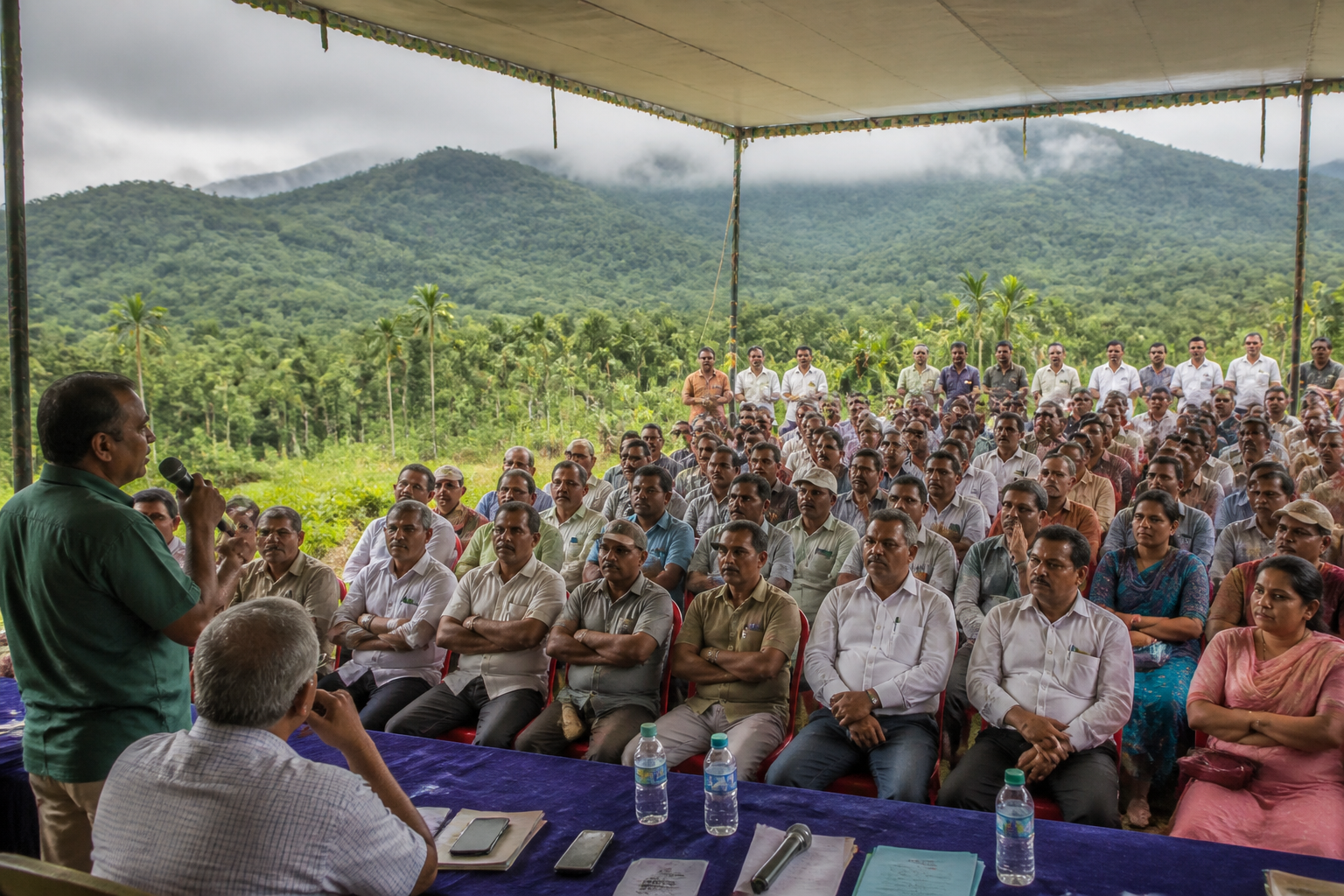
A public meeting in Karnataka’s Thirthahalli has revived a conflict that has shaped the Western Ghats for more than a decade: how to protect an ecologically fragile landscape without pushing its residents into legal and economic insecurity. The renewed discussion around the Kasturirangan report brought ministers, officials, elected representatives, farmer organisations and local residents together, but it also showed that the state’s position remains fundamentally opposed to implementing the report in its present form.
The meeting, titled “Kasturirangan Report and Malnad Problems”, was held in Thirthahalli on Saturday. Karnataka minister S. Madhu Bangarappa said residents affected by the Sharavathi project had not yet received justice and argued that renewed references to the Kasturirangan report were creating repeated difficulties for forest-dwelling communities. He said the state government had not accepted the report.
The immediate political language at the meeting was opposition. The deeper issue, however, is administrative: the proposed environmental restrictions cover inhabited and cultivated landscapes where residents seek secure land rights, access to construction and development permissions, and protection from further displacement. At the same time, the Western Ghats contain ecologically sensitive slopes, forests and watersheds where unregulated construction, land-use change and infrastructure expansion can increase environmental risk.
The Kasturirangan report has remained in this contested space for 13 years, according to Srinivasalu, the state’s principal chief conservator of forests, who presented an overview of the proposal at the meeting. He said a seventh draft notification had now been issued. Of the 1,449 villages in the state covered by the proposal, 447 villages in Shivamogga district fall within the environmentally sensitive area, according to the official figures reported by Prajavani.
Those numbers explain why the debate is not confined to forests in the narrow administrative sense. A designation covering hundreds of villages affects the regulatory environment in which homes are built, farms are expanded, roads are improved and public facilities are planned. For residents, the question is whether environmental safeguards will be designed around the realities of inhabited settlements or imposed in a way that treats established communities as an obstacle to conservation.
The report’s long history has also produced distrust. Bangarappa said the state government was resisting the proposal because local farmers had helped preserve the region’s forests. The district areca growers’ association president, B.A. Ramesh Hegde, argued that successive forest laws had made life difficult for Western Ghats residents and said the Kasturirangan process threatened their ability to live securely in the region.
These claims reflect the central political challenge of environmental governance in settled landscapes. Restrictions are more likely to be resisted when residents believe that the state is protecting the landscape without recognising the costs imposed on people who already live there. The conflict becomes sharper where land records, forest boundaries and settlement histories are complicated, and where families depend on agriculture rather than on formal urban employment.
The meeting also linked the report to the unresolved problems of Sharavathi project-affected people and residents displaced by landslides. Bangarappa requested that the Chief Minister provide alternative sites to people left without secure shelter after hill collapses in Thirthahalli. That demand illustrates how environmental regulation and disaster vulnerability overlap. A community may face restrictions on where it can build, while also needing relocation because its existing settlement has become unsafe.
For local governments, this creates a difficult sequence of decisions. They must identify land that is legally available, physically safe and connected to roads and services. They must also ensure that relocation does not create a new environmental risk or separate residents from farms, markets, schools and social networks. The supplied report does not establish whether a detailed relocation plan has been approved, how many families would be covered or what funding would be available.
The debate over the Kasturirangan report is therefore not only about whether a notification should be issued. It is also about which institution should decide what happens inside a sensitive landscape. The meeting featured the state forest administration, ministers, members of Parliament, legislators, farmer representatives and local communities. Their presence showed that the issue cuts across departmental and party boundaries, even as political disagreements remain visible.
B.Y. Raghavendra, the Shivamogga member of Parliament, said the Kasturirangan report should not become a subject for political conflict and that opposing its implementation in the interests of Malnad residents was a shared responsibility. He said the report had originated after a complaint by an environmental organisation in Goa and a direction from the Supreme Court, and that the Kasturirangan committee had been constituted during the United Progressive Alliance government under then Prime Minister Manmohan Singh.
Raghavendra also said that former chief ministers Siddaramaiah, B.S. Yediyurappa and Basavaraj Bommai had earlier communicated to the Union government that the report could not be implemented in Karnataka. His remarks place the state’s opposition within a longer political continuity rather than presenting it as a new position created by the current meeting.
Former minister Kimmane Ratnakar argued that Parliament could legislate differently from directions of the Supreme Court’s green tribunal and said the Union government should not rely on the courts to push the report through. He also called for changes to forest law that would give the state government fuller authority to sanction land. These are political and legal positions expressed at the meeting; the report does not provide details of any pending legislative proposal or court order that would determine the issue.
The event’s scale indicated the depth of local concern. Organisers placed 8,000 chairs before the main stage, and the hall was reported to be full, with people watching from outside after seats ran out. Residents arrived from Thirthahalli, Sagara, Hosanagara and Soraba taluks in special buses. The crowd remained present through bright sunshine and heavy rain, while a meal was arranged at the neighbouring junior college ground.
Large attendance does not settle the environmental question, but it does establish that the matter has a broad local constituency. The participation of women and residents from several taluks suggests that the debate is connected to household security and community life, not only to the interests of a single farmer group or political organisation. It also indicates that any future notification will face intense scrutiny from communities that believe their homes and livelihoods may be affected.
The policy problem is made harder by the absence of a simple division between “forest” and “settlement”. The report’s proposed coverage includes villages, while the region’s residents depend on agriculture and local infrastructure. At the same time, the presence of settlements does not remove ecological risk. Roads, buildings, slope cutting, drainage changes and land conversion can affect landslide vulnerability and water systems. A framework that ignores either side is likely to produce resistance or environmental damage.
The supplied report provides no final map, detailed restriction schedule, compensation framework or implementation timetable for the latest draft notification. It also does not state what changes, if any, have been made in the seventh draft compared with earlier versions. Those omissions matter because the practical impact on a village depends less on the name of the report than on the exact boundaries, prohibited activities, permission procedures and exemptions eventually notified.
The next stage will therefore be determined by documentation rather than speeches alone. Residents and elected representatives will want clarity on the status of the latest draft, the villages included, the activities regulated and the safeguards available to households affected by land or construction restrictions. The administration will need to reconcile environmental objectives with the demand for secure housing, agricultural livelihoods and safe relocation for landslide-affected families.
The Thirthahalli meeting confirms that Karnataka’s Kasturirangan dispute remains unresolved because it combines three different questions: how the Western Ghats should be conserved, how established communities should retain secure rights, and how governments should respond when settlements become unsafe. Until the regulatory details and rehabilitation arrangements are made clear, each new reference to the report is likely to reopen the same conflict between ecological protection and the right to remain in, build on and sustain life in the Malnad region.
