


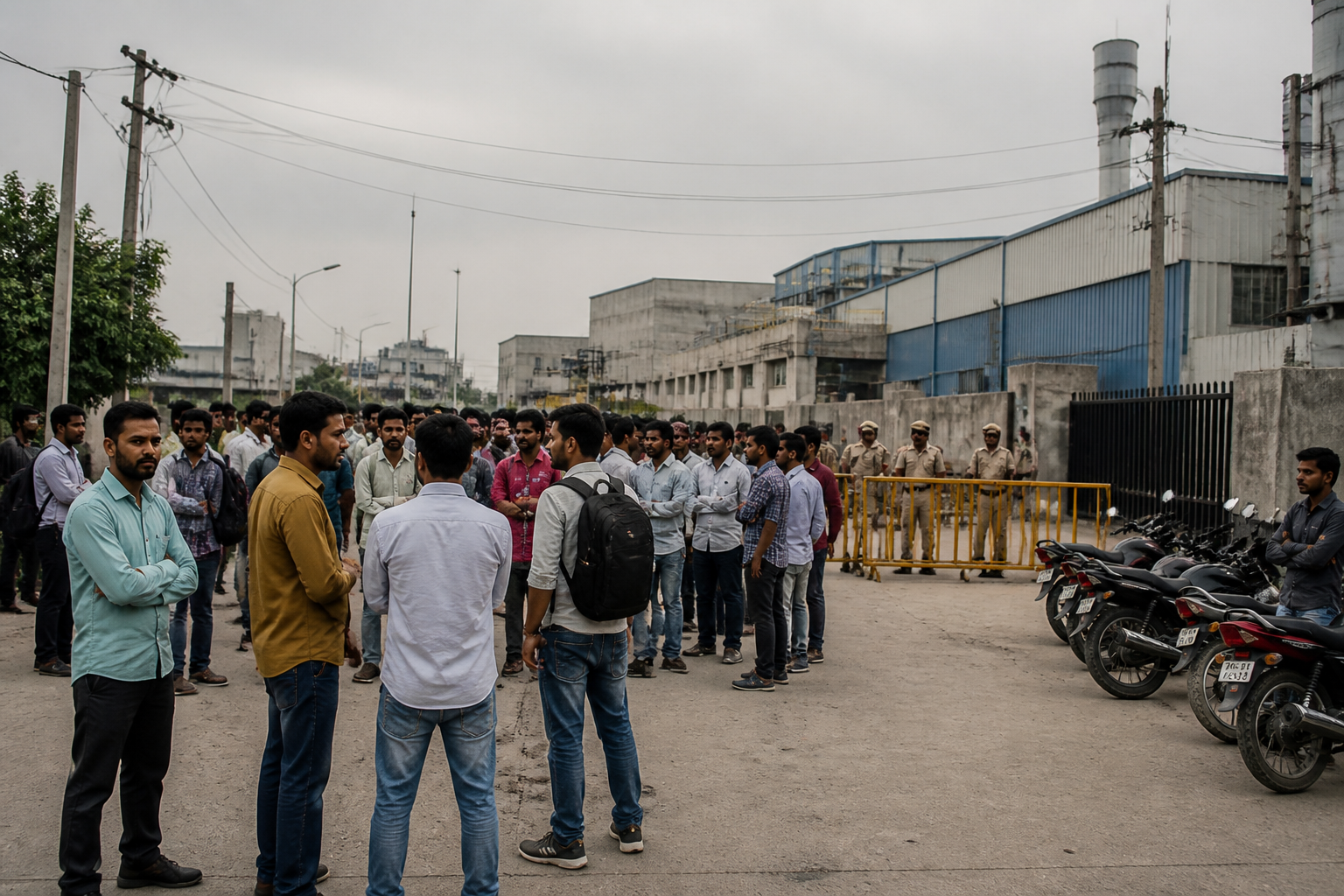
A Gurugram sessions court’s decision to grant bail to engineer Aditya Anand in the Manesar labour protest case has drawn an important legal distinction: demanding higher wages and mobilising workers through democratic means is not, by itself, a criminal offence. The order does not decide whether violence occurred or whether any individual will ultimately be convicted. It does, however, question whether the evidence presented against Anand was sufficient to keep him in custody while the trial continues.
That distinction matters in Manesar, an industrial area where disputes over wages, working conditions and worker representation can quickly become matters of policing and criminal prosecution. The case arising from violence during a workers’ protest at Richa Global Exports combines two separate questions that are often merged in public debate: whether violence or damage took place, and whether a person who supports wage demands can be treated as a participant in that alleged criminal conduct.
The court’s order, as reported by The Indian Express, addressed the second question while leaving the first for trial. Additional Sessions Judge Dr Gagan Geet Kaur granted bail to 28-year-old Anand, an NIT Jamshedpur engineering graduate who worked as a Java developer at Genpact. He was already in judicial custody in Uttar Pradesh in connection with a separate labour agitation case in Noida when Gurugram Police arrested him in the Manesar matter on June 5 through a production warrant.
The Manesar case relates to violence during a workers’ protest on April 9. An FIR registered at the Industrial Sector 7 Manesar police station invoked multiple provisions of the Bharatiya Nyaya Sanhita, including attempt to murder, rioting, assault and criminal conspiracy. It also invoked Section 3 of the Prevention of Damage to Public Property Act. The charges therefore concern serious alleged offences, not merely the organisation of a wage campaign.
The court’s reasoning focused on the evidence specifically linking Anand to those alleged offences. The prosecution said his mobile phone had been traced near the protest site between April 7 and 9. However, the investigating officer conceded that there was no CCTV footage or photograph showing Anand at the location, according to the report. Police also acknowledged that Anand was not part of any WhatsApp group used by the protesting workers, had not sent incriminating messages to any co-accused, and that his mobile phone had not been seized during the investigation.
The judge observed that tower-location data in call detail records, without independent corroboration, could not establish complicity. This is a significant procedural point. Location data may indicate that a phone was within a particular area, but it does not by itself establish what its user did there, whom the person met, or whether the person participated in a criminal act. The court therefore treated the available material as insufficient, at the bail stage, to justify continued incarceration.
The order also examined the nature of the activity attributed to Anand. The judge wrote that even if he had been creating awareness among workers about their rights and encouraging them to raise their wages through a democratic protest, that conduct would not itself constitute an offence. The court similarly stated that raising wage demands because of rising prices and the cost of daily living, and persuading workers to do so, was not an offence in itself.
This is not a finding that the April 9 incident was peaceful or that no conspiracy existed. The order expressly said that whether the incident resulted from an alleged conspiracy or from other forces would be a matter for trial. The court’s conclusion was narrower: the material placed before it did not show a sufficient prima facie basis to keep Anand behind bars, particularly when there was nothing left to recover from him and he had no criminal background.
The case consequently exposes the institutional difficulty of handling industrial unrest. Police and prosecutors must investigate alleged violence, threats, damage and conspiracy. At the same time, wage negotiations and collective mobilisation are part of the ordinary social and economic life of an industrial city. When these activities are investigated through the same criminal framework, the central challenge is to separate lawful advocacy from evidence of specific criminal acts.
That separation becomes especially important when the evidence consists largely of association, proximity or prior participation in labour activity. The Indian Express report said Gurgaon Police had earlier submitted an affidavit before the Supreme Court alleging that Anand played an active role in conspiring to incite workers to attack company management and police with an intention to kill. Anand strongly denied the allegations in a statement annexed to that status report, saying investigating agencies had framed him because of his association with the labour advocacy group Mazdoor Bigul.
These competing accounts show why the court’s emphasis on corroboration matters. The police allegation describes a direct role in incitement and conspiracy. The evidence recorded in the bail order, as reported, did not include images placing Anand at the site, messages linking him to co-accused workers, membership of the relevant WhatsApp group or seizure of his phone. The difference between an allegation and evidence capable of supporting custody is at the centre of the order.
The ruling also forms part of a sequence of bail orders in cases arising from the Manesar labour unrest. The same judge had, in an order dated May 18 granting bail to accused Ajit Singh, similarly observed that demanding higher wages was not an offence. The repeated appearance of this reasoning suggests that the court is treating the legal status of wage advocacy as a recurring issue in the cases, even while the alleged violence remains subject to trial.
For industrial administration, the implications are practical. A factory dispute can involve employers, workers, contractors, labour representatives, police and the local administration. Each institution operates under a different responsibility: employers manage employment and wages, workers seek representation and improved conditions, labour authorities address industrial disputes, and police investigate offences. When these roles are not clearly separated, a wage dispute can become primarily a criminal case before the underlying employment issues are resolved.
The supplied material does not establish whether the wage dispute at Richa Global Exports was settled, whether labour authorities conducted separate proceedings, or what specific events led to the April 9 violence. It also does not establish whether the prosecution has additional evidence beyond the material discussed in the bail hearing. Those questions remain relevant because bail orders assess the need for custody and the prima facie record; they do not replace a full trial or determine final guilt.
The case therefore raises a larger question about how industrial cities govern disagreement. Manesar is not only a manufacturing location; it is also a workplace and residential ecosystem in which wage levels, living costs, worker mobility and collective organisation intersect. The court’s order does not resolve those structural issues. It does clarify that the legal response must identify conduct that amounts to a specific offence rather than treating the act of asking for better wages as criminal by itself.
The immediate legal consequence is Anand’s release on bail in the Manesar case. The broader consequence will depend on the trial, the evidence eventually presented and the handling of the other cases arising from the labour unrest. For now, the order confirms a boundary that will remain central to the proceedings: allegations of violence and conspiracy must be tested separately from the protected act of making and democratically pursuing wage demands.
