


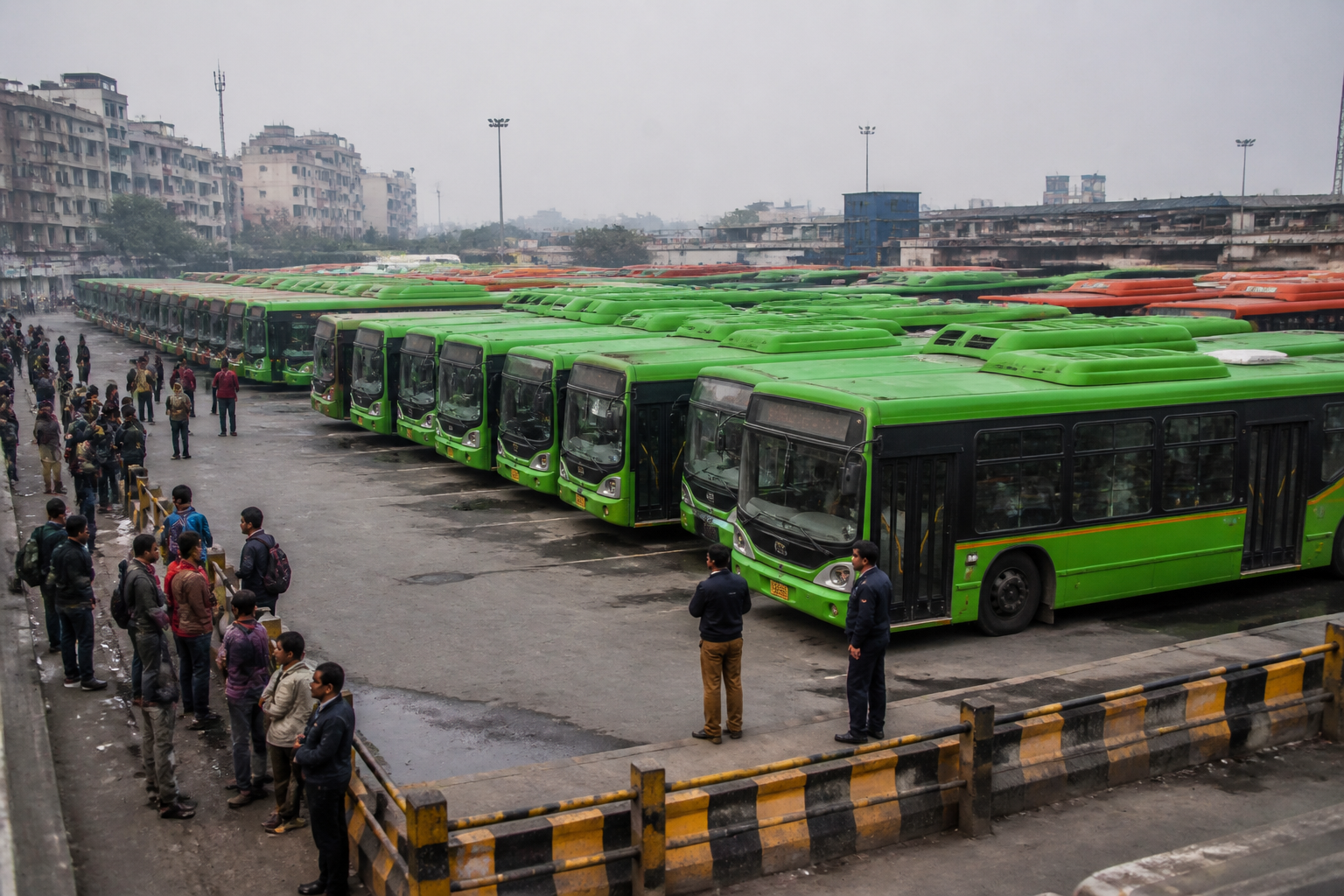
The sixth day of the Delhi bus drivers’ strike has done more than reduce the number of buses on the road. It has exposed how the city’s public transport system depends on a large contracted workforce whose wages, working hours, training and employment protections are separated from the public authority whose buses they operate. The disruption has also shown how quickly a labour dispute inside the bus system becomes a city-wide mobility problem.
The Delhi Transport Corporation drivers’ protest began on Tuesday, with drivers hired by private agencies refusing to operate buses and, in some cases, stopping vehicles that were already running. The Delhi police subsequently arrested 12 drivers in Rohini district for allegedly damaging public property. Four arrests were made in Begumpur and eight in Khanjawala, according to a police officer cited in the report. The police said the arrests related to damage to bus windows. A driver alleged that a WhatsApp group had been used to instigate vandalism, but the officer denied that the arrests were based on that allegation and said they were connected to damage to public property.
The dispute continued despite Transport Minister Pankaj Kumar Singh’s assurance on Thursday that the matter would be discussed with the private operators who employ the drivers. Some services resumed on Sunday after the Transport Department brought in more than 2,000 former DTC drivers, along with drivers who had been promoted and deployed to other services. The Delhi Metro Rail Corporation also added trains and operated extra trips to absorb passengers displaced by the strike. Even so, the disruption produced traffic jams and higher fares on ride-hailing platforms and auto-rickshaws.
The immediate transport response is important, but it does not resolve the underlying institutional question: who is responsible for the conditions under which a public bus service is delivered when the drivers are employed by private agencies? The drivers’ accounts suggest that the contracting arrangement has created a division between operational responsibility and employment responsibility. DTC services are being performed for a public transport system, but the drivers say their wages and basic protections are determined by private vendors.
### Delhi bus drivers’ strike and the contracted workforce
The scale of the workforce makes the issue significant. Government data from 2024 put the number of contractual drivers in Delhi at about 4,564. The DTC Karamchari Ekta Union says the number has since increased to around 6,000. The figures indicate that contractual drivers are not a marginal supplement to the city’s bus network. They represent a substantial labour force whose availability directly affects the reliability of public transport.
The drivers say increasing privatisation of bus operations has kept salaries low, while private operators have also avoided responsibility for bus maintenance. One driver from the Burari depot said the workday could begin at 4 a.m., requiring employees who live far away to wake at 2 a.m. and travel to the depot before completing an eight-hour shift for ₹862 a day. The same driver said overtime could extend the working day until 10 p.m., raising questions about rest and family time.
Another driver from the Shadipur depot alleged that drivers were sometimes made to work 16 hours for slightly more than ₹1,000. He also said they had no paid holidays and had to work when ill. These are allegations made by drivers and should be distinguished from independently established findings. However, the consistency of the complaints points to the central concern behind the strike: the drivers are seeking a more predictable and protected employment structure rather than only a one-time increase in daily wages.
Their principal demand is a basic-plus-dearness-allowance salary structure similar to that of government employees. They want daily wages to rise to at least ₹2,000 and are also seeking medical insurance, financial assistance in the event of accidents and paid leave. These demands link wages to the wider conditions required to operate a safe and dependable bus network.
### Safety is also an accountability problem
The dispute is not limited to compensation. The drivers say they are held responsible for failures over which they have limited control. Sandeep Kumar, a driver from the Shadipur depot, said private vendors often did not take an active role in checking buses before they left the depot. According to him, inadequate inspection contributed to breakdowns during routes, after which passengers confronted the drivers.
The Transport Minister has directed private vendors to ensure passenger safety and oversee bus maintenance. The drivers, however, argue that responsibility ultimately falls on them when a vehicle breaks down or passengers face problems. This gap matters because a bus service requires several connected functions to work together: vehicle inspection, maintenance, route allocation, driver training, passenger communication and emergency response. If one agency controls employment, another authority manages the public service, and drivers face passengers directly, accountability can become fragmented.
The training system described by the drivers raises a related concern. Sandeep Kumar said drivers receive six days of training before being assigned DTC services. The training covers the daily routine, passenger handling and operational protocols, but he said it does not include disaster management or emergency situations. He also claimed that some drivers struggle to communicate with passengers.
The report does not establish whether the six-day training period meets a formal regulatory standard or whether all drivers receive identical instruction. It does, however, show that the drivers themselves see training as part of the employment and safety problem. A transport system cannot treat driving as only a vehicle-control function when drivers are also the first point of contact during breakdowns, emergencies and disputes with passengers.
### Public transport disruption travels across the city
The strike demonstrates the dependence between different modes of Delhi’s transport system. When bus services fell, the Delhi Metro added trains and extra trips. Road congestion increased, while ride-hailing and auto-rickshaw fares rose. This chain of effects shows that buses are not interchangeable with metro services for all passengers, even in a city with an extensive rail network.
Buses provide route coverage and street-level access that rail systems cannot replicate. They connect neighbourhoods to workplaces, markets and metro stations, and they serve passengers whose journeys do not align with metro corridors. When buses are withdrawn, commuters must either use more expensive modes, make longer journeys or absorb delays. The impact is therefore uneven: passengers with fewer transport choices face a greater burden than those able to shift to the metro or private vehicles.
The use of more than 2,000 former DTC drivers and drivers assigned to other services helped restore some operations. But that emergency measure also illustrates the fragility of normal staffing arrangements. A public transport system that needs to draw on former or redeployed workers during a strike may have limited resilience when its contracted workforce is unavailable.
The report does not provide the total number of DTC buses affected, the number of routes suspended or the precise decline in daily service. Those gaps prevent a complete measurement of the strike’s operational cost. The available evidence nevertheless establishes that the disruption affected buses, metro demand, road traffic and the price of alternative modes.
### The wage question is tied to the governance model
The demand for daily wages of at least ₹2,000, medical insurance, accident assistance and paid leave is also a demand for clarity over the public authority’s obligations. The drivers say the government has not provided an assurance on a wage hike. The Aam Aadmi Party has criticised the BJP-led Delhi government, while its Delhi president, Saurabh Bharadwaj, said salaries should be increased to ₹32,000 a month. He also said a previous AAP government had sent such a proposal to the Lieutenant-Governor but that it was not approved.
That political claim is presented in the report as the statement of an opposition leader; the article does not independently establish the status or details of the earlier proposal. The broader issue, however, is clear from the dispute itself. Wage decisions are being negotiated within a system where the public authority depends on private operators but remains accountable to passengers when service fails.
The drivers also say the absence of an educated and organised union has weakened their position. This adds another layer to the dispute. A workforce may be large enough to be essential to a city but still lack the institutional capacity to negotiate effectively with employers and government agencies. The strike has therefore brought labour representation into the same conversation as transport planning and public accountability.
The immediate question is whether the government, DTC and private operators can reach an agreement that restores services while addressing the drivers’ demands. The longer-term question is whether contracting arrangements can deliver a reliable public service without weakening the employment conditions of the workers who operate it. The supplied evidence does not establish the outcome of negotiations, the final number of affected services or whether the arrests will lead to further legal action.
What it does establish is that Delhi’s bus network is not only a fleet of vehicles and routes. It is a labour system, a maintenance system and a public accountability system. When those parts are separated, the consequences appear on the street: buses stop, metro trains carry additional pressure, traffic worsens and passengers pay more. The next significant measure of the government’s response will be whether it treats the strike only as a temporary service disruption or addresses the employment, training, maintenance and responsibility gaps that allowed it to spread across the city.

