


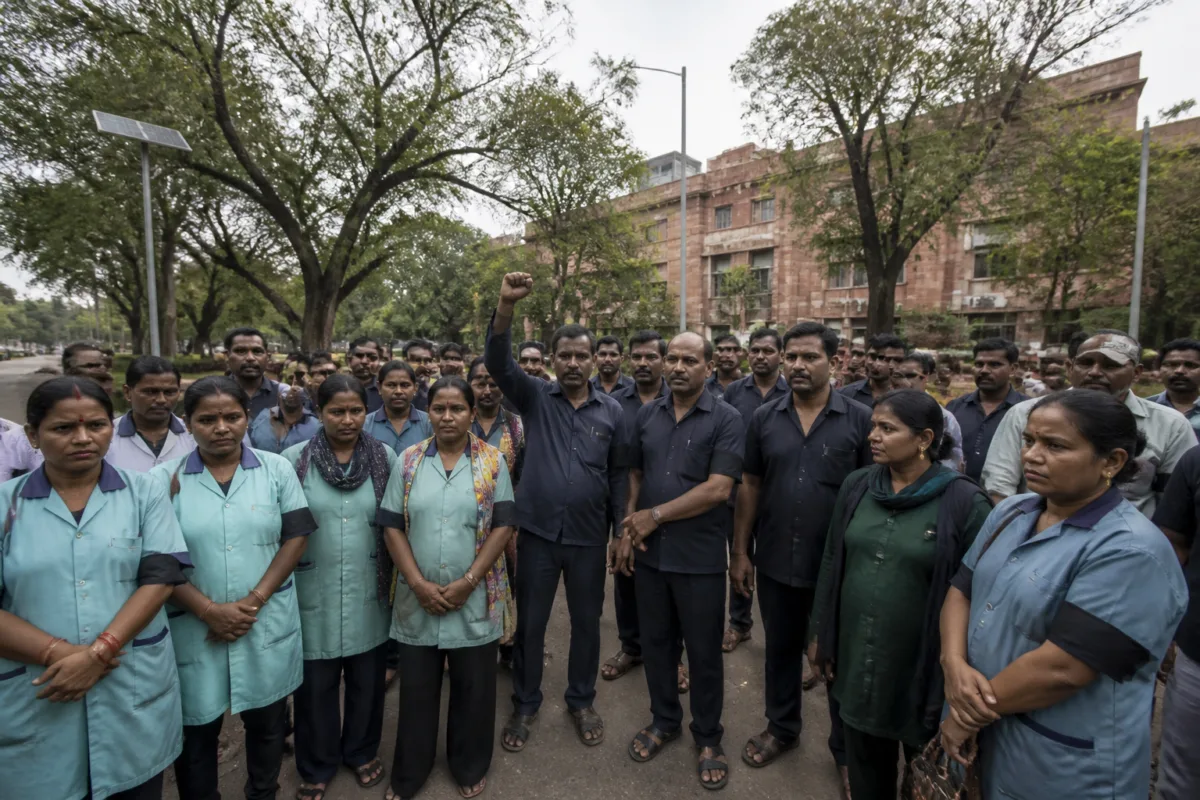
The strike by contract workers at Jawaharlal Nehru University is more than a dispute over wages and workplace benefits. It has exposed how the daily functioning of a large public institution depends on workers whose employment conditions, according to their union and an account published by Millennium Post, remain outside the protections that are supposed to govern contracted labour.
Hundreds of sanitation workers, mess attendants, security guards, horticulturists and maintenance workers began a strike at the university on Tuesday. Sanitation workers withdrew their labour, while mess staff reported for duty wearing black armbands. The different forms of protest point to the same institutional problem: the services that make the campus usable are being delivered by a workforce that says it has been denied basic statutory rights and adequate administrative recognition.
The account, based on statements from the All India Central Council of Trade Unions and the workers, says more than 500 people are facing severe hardships. Their complaints include alleged illegal wage deductions, arbitrary retrenchments, non-payment of statutory bonuses, the absence of salary slips and identity cards, and the failure to establish a functioning grievance redressal committee. Female workers have also alleged that maternity benefits were denied. The workers further say that earned leave, casual leave and equal pay for equal work have not been implemented.
These are not separate administrative irritants. Together, they describe a system in which responsibility for essential work may be distributed across contractors and university authorities while accountability remains difficult for workers to locate. The report says an Assistant Labour Commissioner issued directions in late September requiring university management to halt arbitrary retrenchments, issue salary slips and identity cards, constitute a grievance redressal committee and audit missing statutory bonuses. The workers allege that these directions have not been implemented.
That alleged gap between an official labour direction and conditions on the ground is the central institutional question raised by the strike. A direction has value only when an authority is able to monitor compliance, identify the responsible employer or administrative unit, and provide a remedy when the direction is ignored. The material supplied in the report does not establish why compliance has allegedly failed or which specific agency is responsible for each lapse. It does, however, show that the workers say formal intervention has not resolved their grievances.
The case also illustrates the operational dependence of campuses on work that is often treated as peripheral. Sanitation, food preparation, security, horticulture and maintenance are not decorative additions to a university. They are the systems through which classrooms, hostels, roads, public spaces and residential facilities remain functional. When staffing is inadequate or workers withdraw their labour, the effect is felt across the institution even when the dispute began as an employment matter.
In their appeal to students, the workers said severe staff shortages had left single individuals carrying the workload of ten people. This claim is presented by the workers and has not been independently quantified in the supplied material, but it identifies a measurable operational concern: whether contracted staffing levels are sufficient for the scale of work assigned. The workers also linked shortages to campus sanitation and food quality. That connection matters because service quality cannot be separated from the number of workers available, the hours they work and the conditions under which they are employed.
The wage question adds another layer. The workers said they receive one-fourth the wages of permanent employees while performing the same tasks. The report does not provide wage records, job classifications or details of the applicable contracts, so the comparison cannot be independently assessed from the material available. But the allegation goes to the unresolved issue of how public institutions define equivalent work when services are delivered through contractual arrangements. If the same task is split between permanent and contracted workforces, the contractual structure may determine not only pay but also access to leave, benefits, identity documents and channels for complaint.
The absence of salary slips and identity cards, as alleged by the workers, is especially significant because documents are the basic infrastructure of employment. A salary slip records deductions and earnings. An identity card establishes a worker’s connection to the workplace. A grievance mechanism creates a route through which a dispute can be formally heard. Without these, an employee may find it difficult to prove service, challenge a deduction, claim a benefit or determine which institution must respond.
The complaint regarding statutory bonuses similarly raises a question of administrative record-keeping. The workers have called for an audit of missing bonuses, while the Assistant Labour Commissioner’s directions reportedly required such an audit. The supplied report does not state the amount allegedly withheld, the period involved or the outcome of any prior review. Those details will be necessary to determine the scale of the dispute. At this stage, the evidence establishes that the issue has been formally raised and that workers say it remains unresolved.
Maternity benefits and leave entitlements show how labour conditions affect the wider social infrastructure of a campus. A university may present itself as a community organised around education and research, but its workforce also includes people who depend on regular wages, leave and social protection. The workers’ appeal to students framed this relationship directly, asking the campus community to recognise them as part of JNU rather than as an invisible service layer outside its institutional identity.
The protest’s location at Sabarmati T-Point and the call for support from the JNU Teachers’ Association and students also reveal the dispute’s social geography. The workers are not seeking visibility in an abstract space; they are gathering at a campus point where the university community can encounter the conflict. Mess workers’ decision to report for duty with black armbands, as described in the report, indicates an attempt to register dissent while limiting disruption to students. Sanitation workers, by contrast, withdrew their labour entirely, making the dependence of campus life on their work more immediately visible.
The immediate institutional challenge is therefore twofold. The university must address the specific claims about wages, deductions, benefits, staffing, retrenchment and statutory payments. It must also clarify how its contracting system works: who employs the workers, who supervises them, who maintains employment records, who receives complaints and who is responsible for enforcing labour directions. The supplied report does not provide the university’s response, the names of the contractors involved or the terms of the relevant contracts. Those gaps prevent a complete assessment of responsibility.
The dispute also shows why labour administration is part of urban infrastructure. Public institutions are often analysed through their buildings, roads, utilities and capital projects, while the people who operate and maintain those systems receive less attention. Yet a campus cannot remain clean, secure, landscaped or adequately fed through physical assets alone. Its functionality depends on a continuing workforce. When employment arrangements weaken that workforce, the operational consequences become visible in the spaces used by students, teachers and staff.
There is a further accountability issue in the reported contrast between the university’s public mission and the workers’ experience. The workers’ appeal referred to JNU’s commitments to democracy and social justice, arguing that those principles should extend to the people performing essential work. That is not a claim that can be resolved through institutional language alone. It requires records of wages, attendance, staffing, benefits, contractor obligations, complaints and compliance with labour authorities’ directions.
The evidence currently available confirms the existence of a strike and a set of serious, attributable allegations. It does not establish the final legal responsibility for each alleged violation, whether the Assistant Labour Commissioner’s directions were formally served on all relevant parties, or whether any corrective action has since been taken. The next decisive developments will therefore be the university’s response, the outcome of the workers’ engagement with the labour authorities, and whether the promised records and grievance mechanisms are put in place. Until then, the JNU dispute remains a test of whether a major public campus can make the workforce behind its everyday operations visible in its governance system.

