


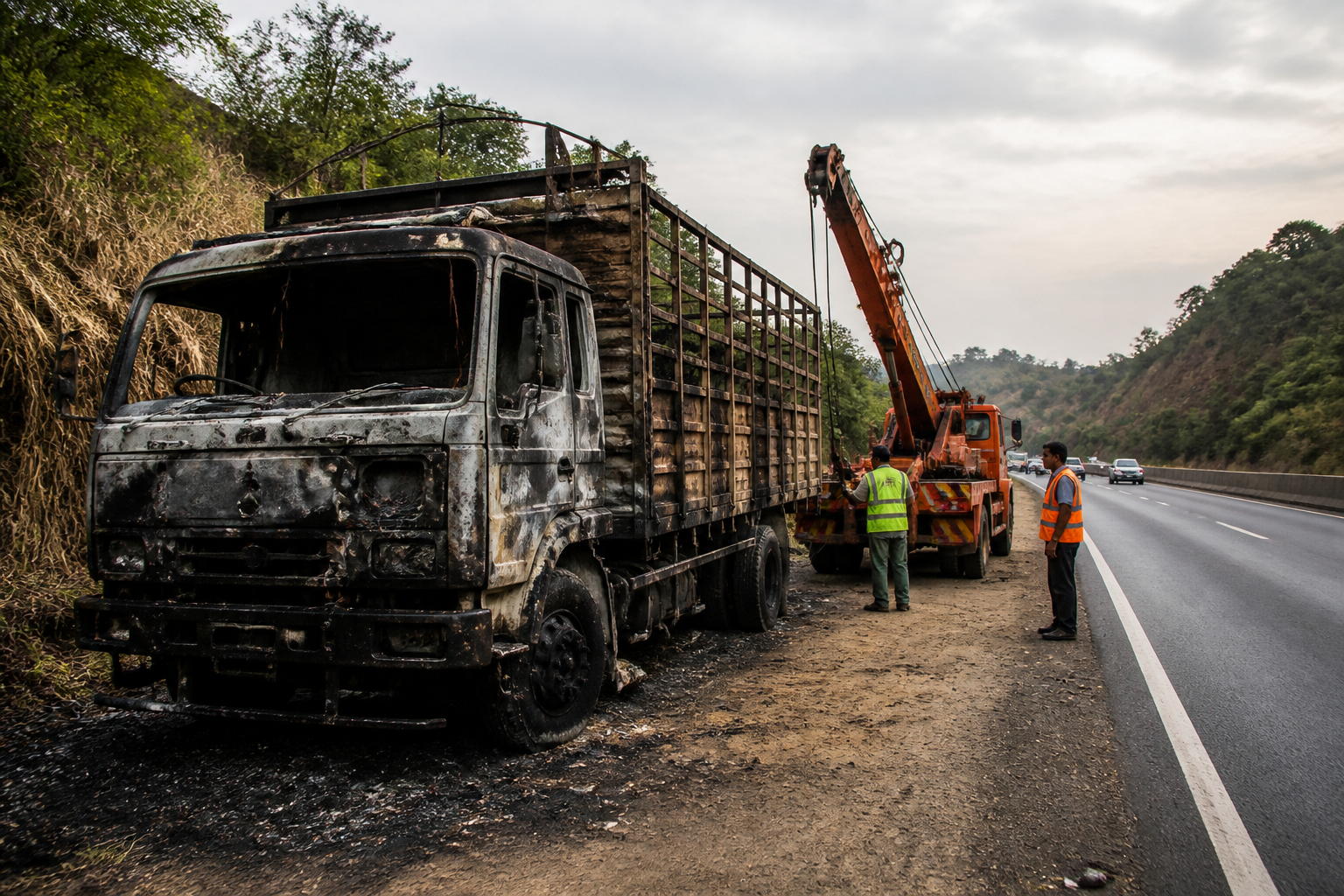
Five people were killed after a car collided with a burnt truck lying beside the Mumbai-Nashik Highway at Atgaon in Shahapur, according to a report by Loksatta. The truck was removed by the administration after the crash, despite having remained in a dangerous condition along the highway for nearly two years. The sequence has turned a fatal road accident into a larger question about how highway hazards are identified, assigned and removed before they cause harm.
The available report does not establish that the burnt truck alone caused the collision. It states that a car hit the vehicle and that all five occupants died at the spot. What it does establish is that the truck had remained beside the highway since March 2024, when it caught fire while allegedly carrying illegal foreign liquor. A criminal case was registered against unidentified persons, but the report says several questions about the vehicle and the incident remained unanswered.
The truck’s continued presence is significant because a stationary wreck on a highway is not only evidence of an old incident. It can become a permanent roadside obstruction, particularly when it is burnt, damaged or positioned close to the carriageway. Its condition can affect visibility, vehicle movement and the usable width of the road. The Loksatta report describes the truck as having remained in a dangerous state for two years and says that the potential risk of an accident had existed during that period.
The administration’s immediate removal of the truck after the deaths creates the central institutional issue. If the vehicle was considered sufficiently hazardous to be removed after the crash, the question is why the same action did not take place earlier. The supplied report does not identify the specific agency responsible for monitoring, securing or removing the wreck. That gap itself points to a recurring governance problem in road safety: physical hazards may be visible to several authorities while remaining the clear responsibility of none.
## The road hazard that became permanent
Highway safety is often discussed through speed, driver behaviour and vehicle condition. Those factors may be relevant to an individual crash, but the Atgaon case highlights another category: hazards created by the road environment and left unresolved. A burnt truck beside a major highway is an easily recognisable object. It does not require sophisticated technology to detect. The administrative challenge lies in acting on the information, documenting responsibility and completing removal through a defined process.
The report says the truck remained in the same condition for about two years. During that period, it was reportedly linked to an unresolved case involving illegal foreign liquor. The criminal investigation and the road-safety response may have involved different responsibilities. Preserving a vehicle as evidence, identifying its owner and removing a dangerous obstruction are not necessarily the same administrative task. However, the available account does not say whether any temporary safety measures were installed while the vehicle remained beside the highway.
That distinction matters. Even when a vehicle is part of an investigation, the surrounding road cannot simply be treated as frozen until the case is resolved. A damaged vehicle can be documented, moved to a secure location or protected with appropriate warning measures, subject to the procedure followed by the authorities. The report does not state whether such options were considered or rejected in this case. It records only that the truck stayed beside the highway and was removed after a fatal collision.
## What the unanswered questions reveal
The Loksatta report lists several unanswered questions: who was driving the truck, who owned it, whose foreign liquor was being transported, where the truck came from, where it was headed and what caused the fire. These questions belong primarily to the criminal investigation. They also matter to the public because the absence of a clear account appears to have coincided with the vehicle remaining at the roadside for an extended period.
The report says a case was filed against unidentified persons. It does not provide the present status of that case, identify the investigating agency or state whether the truck was formally seized. Those details would be necessary to determine why the vehicle was not removed earlier and whether legal or procedural constraints prevented action. Without them, it would be inaccurate to assign responsibility to a particular department or official.
What can be examined from the reported sequence is the timing of administrative action. The truck was present for approximately two years. A crash then killed five people on Wednesday. The administration removed the wreck immediately afterwards. The contrast between prolonged inaction and rapid post-crash response is the strongest evidence in the report. It suggests that the system was capable of removing the obstruction, but that the trigger for action came only after the risk materialised as loss of life.
This is the difference between reactive and preventive road management. Reactive action follows an accident, a complaint or public attention. Preventive management treats a visible obstruction as a risk before it becomes part of a crash investigation. The supplied report does not show whether the Atgaon truck had previously been reported by motorists, residents or road-maintenance personnel. It also does not state whether highway inspections had recorded it. Those are important gaps for any official review.
## The institutional problem on the highway
A highway is not managed only through construction and traffic enforcement. Its safety also depends on roadside maintenance, removal of abandoned vehicles, lighting and signage, emergency response, policing and the handling of seized property. When an incident involves suspected illegal transport, law-enforcement procedures may overlap with the responsibilities of the road authority and highway operator.
The report does not name the authority that removed the truck. It therefore cannot establish whether the delay resulted from police procedure, ownership disputes, road-agency inaction, contractor responsibility or coordination failure. Yet the case demonstrates why such responsibilities need to be clear at the operating level. A hazard can remain in place when each agency sees only one part of the problem: the police see evidence, the road agency sees an abandoned vehicle, and the highway operator sees an obstruction awaiting instruction.
A functioning system would need a record of the incident, a risk assessment, temporary protection and a deadline for final removal. It would also need escalation when the deadline is missed. None of these steps is documented in the supplied report. Their absence from the account does not prove that no action was taken, but it does mean that the public cannot tell what process governed the truck’s two-year presence.
## The larger road-safety question
The Atgaon crash raises a question broader than the fate of one burnt truck: how many road hazards are tracked until closure, rather than merely noticed? The answer cannot be established from this report. There are no figures on abandoned vehicles, roadside obstructions, highway inspections or similar crashes on the Mumbai-Nashik route in the supplied material. The case should therefore not be presented as proof of a wider statistical trend.
It can, however, be read as a test of institutional visibility. The truck was a fixed and persistent object beside a major highway. Its long presence meant that the risk, if properly recorded, should have been easier to identify than a temporary obstruction. The reported removal after five deaths makes the case relevant to the design of inspection and escalation systems, even though the precise chain of responsibility remains unconfirmed.
For road users, the immediate impact is practical. A damaged vehicle beside a fast-moving corridor can reduce the margin for error, especially at night or in poor visibility. The report does not provide details of lighting, warning signs, lane position, weather or the speed of the vehicles involved, so no conclusion can be drawn about their role in the collision. The established fact is narrower but serious: five people died after a car struck the burnt truck, and the truck was removed only afterwards.
The next stage should be an official account of the truck’s status between March 2024 and its removal, including which authority had custody or responsibility, whether warnings or barricades were installed, and whether the vehicle had been identified during highway inspections. The status of the criminal case and the findings of the accident investigation would also clarify the distinction between the unresolved illegal-transport case and the road-safety failure highlighted by the crash.
The evidence currently confirms a fatal collision, a burnt truck that had remained beside the Mumbai-Nashik Highway for about two years, and its removal after the deaths. It does not yet establish why the obstruction remained, which agency was responsible or whether the truck directly caused the crash. Those unresolved facts are precisely what will determine whether Atgaon was an isolated failure or a sign of a broader weakness in managing roadside hazards.

