


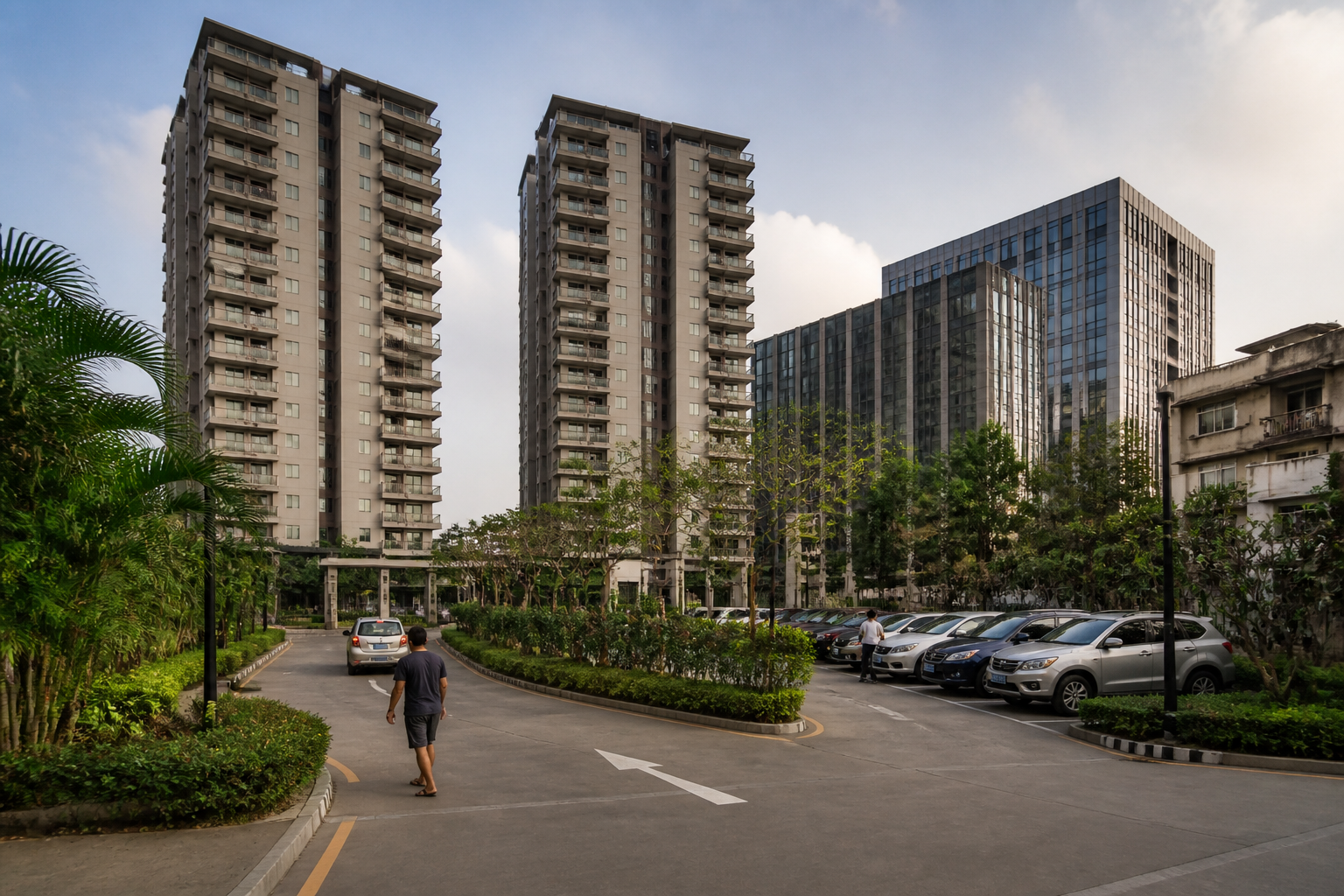
The Maharashtra Real Estate Appellate Tribunal’s ruling in the RA Residences case places a sharper boundary around how Mumbai developers can use additional FSI and TDR after buyers have agreed to a sanctioned plan. The order also links that issue to a second, persistent housing problem: the delay in transferring control of completed buildings and their common areas to residents’ societies.
The dispute concerns RA Residences in Dadar East, a project comprising two residential buildings and an IT commercial building. The tribunal directed the promoters to deposit a penalty equal to 2% of the project cost, execute a conveyance deed for the residential building in favour of the society, apportion among allottees the sale proceeds from commercial units built with additional FSI or TDR beyond the 2017 plan, and demarcate and hand over 64 remaining guest-parking spaces.
Taken together, the directions address three connected questions in urban housing: what buyers are entitled to rely on when they sign agreements, who controls development potential that remains on a project site, and when a residents’ society should receive legal control over a completed building and its shared spaces.
The society first approached MahaRERA alleging encroachment on mandatory guest-parking and recreational-ground areas, unauthorised use of additional FSI, and construction and sale of ground-floor offices by encroaching on common areas. It later approached MREAT, arguing that the 2017 sanctioned plan formed the basis of the agreements for sale but was substantially altered in 2021 without prior consent from the society or the allottees.
The project’s planning history was central to the tribunal’s reasoning. The plan shown to allottees in July 2017 was revised and approved in January 2021. The residential building’s built-up area or FSI increased from 30,540.77 square metres to 31,769.76 square metres. The commercial building, however, increased from 3,231.63 square metres to 7,473.74 square metres through additional premium FSI.
The contrast matters because the tribunal treated the commercial expansion as a substantial deviation rather than a routine technical adjustment. According to the ruling as reported, the promoters were required to obtain the allottees’ prior informed consent. That consent, the tribunal held, had to be specific and based on full disclosure. The agreements, it found, did not provide sufficient details about the proposed use of TDR or FSI from other land.
This finding places disclosure at the centre of the FSI dispute. In a dense city such as Mumbai, additional development potential can change the physical and commercial character of a project. It can affect the scale of structures, the use of common areas, parking arrangements and the value generated from commercial premises. The tribunal’s reasoning, as reported, indicates that buyers cannot be treated as having consented to major changes merely because a contract contains broad or general language about future development.
The case also shows why sanctioned plans are more than regulatory documents. They are part of the information framework on which housing purchases are made. The society’s position was that the 2017 plan formed the basis of the sale agreements. The tribunal’s response, as reported, was that a later and substantially different plan required a more specific form of informed consent, particularly where additional development potential was used for a commercial building.
The direction to apportion commercial sale proceeds among allottees adds a financial dimension to the ruling. The reported order links the proceeds from units created through additional FSI or TDR beyond the 2017 plan to the allottees of the project. This means the dispute was not limited to whether an alteration was physically permissible. It also concerned who should benefit from the value generated by development beyond what buyers had originally been shown.
That issue is especially important in projects where residential and commercial components share land, permissions, amenities or development potential. The RA Residences project contains both residential buildings and an IT building. The tribunal’s direction suggests that the commercial component cannot be assessed in isolation when its expansion uses development potential connected to the wider project and its buyers.
The ruling’s conveyance findings address another structural weakness in apartment ownership. The society alleged that the promoters had not executed conveyance or handed over building and common-area documents. MREAT held that conveyance cannot be deferred indefinitely. Once a building is complete, an occupation certificate is obtained, possession is handed over and the society is registered, the obligation under Section 11 arises, according to the reported decision.
The tribunal also held that this obligation cannot be overridden by a contractual clause linking conveyance to completion of the entire project. That distinction is consequential for phased or mixed-use developments. A completed residential building may remain without effective control over its land, common areas and documentation if conveyance is tied to the delivery of another building or a later phase. The ruling rejects that indefinite linkage once the conditions for conveyance have been met.
The project’s changing completion schedule forms part of that background. It was originally scheduled for completion in June 2018. The deadline was later extended to 2019 and then to March 2025. The reported case does not establish all reasons for those extensions, but the sequence illustrates the long period over which questions of control, development rights and common areas remained unresolved.
MREAT further held that once the development potential disclosed to allottees has been exhausted and the obligation to convey has arisen, subsequently available additional FSI or TDR cannot be used for additional structures or floors. This connects the timing of conveyance with the future use of a site’s development capacity. The tribunal’s position, as reported, is that a promoter cannot keep control of the development potential indefinitely by postponing conveyance.
For residents’ societies, the practical significance lies in the relationship between physical possession and legal control. A society may occupy a building while still lacking the conveyance deed, complete building documents or control over shared spaces. The reported directions on the 64 guest-parking spaces, common areas and conveyance address different aspects of the same institutional problem: the gap between a project being occupied and residents having enforceable control over the assets they collectively use.
For regulators and project authorities, the case highlights the importance of tracking changes between the plan presented to buyers and the plan ultimately approved. The source report does not state that the tribunal has created a general procedure for every future FSI or TDR change. It does, however, record a clear emphasis on specific consent, full disclosure and the consequences of substantial deviations from the plan underlying the agreements for sale.
The ruling also distinguishes between additional development potential and the promoter’s continuing ability to alter a project after sale. The reported reasoning does not treat every modification as prohibited. Instead, it focuses on the scale of the deviation, the information provided to buyers, the consent obtained and whether the promoter’s obligation to convey has already arisen. Those distinctions will matter in applying the decision to other mixed-use or phased projects.
The financial and spatial directions are therefore linked. Additional commercial area produced through premium FSI generated sale proceeds; the society alleged that development encroached on common areas and parking; and the tribunal ordered both financial apportionment and physical handover of remaining guest-parking spaces. The case demonstrates how a plan revision can affect not only building size but also revenue, access, amenities and collective ownership.
The RA Residences ruling confirms that a project’s approved plan, the disclosures made to buyers and the timing of conveyance are interconnected parts of urban housing governance. It also leaves implementation as the next important stage: the promoters must deposit the 2% penalty, apportion the relevant commercial sale proceeds, hand over the 64 parking spaces and execute conveyance for the residential building in accordance with the tribunal’s directions.
