


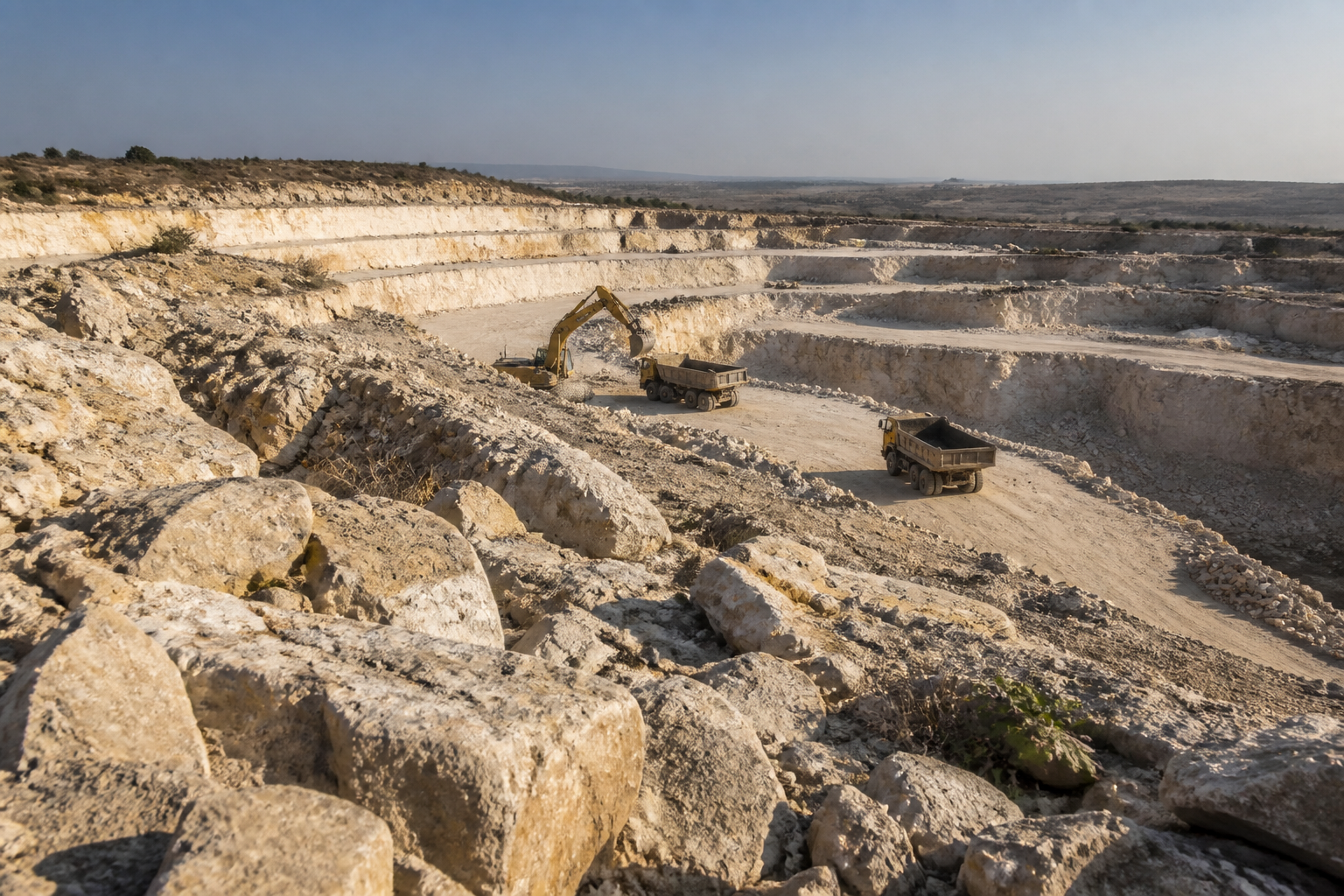
The Karnataka High Court’s decision to cancel a ₹482.69 crore demand against ACC Limited over limestone mining in Kalaburagi has done more than settle a dispute between a cement company and the state mining department. It has placed the mechanics of mineral leasing, royalty assessment and digital contract administration at the centre of a case with direct implications for the construction materials that support India’s urban growth.
The division bench headed by Chief Justice Vibhu Bakhru quashed the demand notice issued by the Department of Mines and Geology against ACC Private Limited, a company belonging to the Adani Group. The dispute concerns open-cast limestone mining in the villages of Ingalki and Ravoor in Kalaburagi district. The department had alleged that the company continued mining without signing a supplementary lease deed after the original lease period ended.
The court’s ruling, pronounced on September 8, said that the lease period had already been extended by law. It directed the state government not to insist that ACC obtain a ‘no dues’ certificate, not to prevent the company from accessing the Integrated Lease Management System, and to refund the amount deposited by ACC. The court also said the state had used its own hypothetical formula instead of relying on the actual basis for calculating the amount demanded.
The decision therefore turns on two linked questions: whether ACC’s mining lease continued beyond February 2023, and how the state should calculate the royalty payable for the period under dispute. ACC argued that the 2015 amendment law automatically extended its lease until the end of March 2030. The company also sought protection from urgent action based on the ₹482 crore demand issued after 2023.
The state’s position, as described in the case, was connected to ACC’s failure to sign a supplementary lease agreement. The company asked the court to direct the government to implement the extended lease period up to March 31, 2030, in accordance with a state government order dated August 25, 2022. The court’s conclusion accepts the significance of the statutory extension and limits the department’s ability to use the absence of a supplementary document as the basis for the demand and related administrative restrictions.
That distinction matters because a mining lease is not only a commercial contract. It is also an administrative permission that determines whether extraction is legally authorised, what payments are due to the state, and which digital systems a company can use to manage the lease. When those elements become disconnected, a dispute over paperwork can quickly become a dispute over production, public revenue and the operation of a major industrial supply chain.
The ruling also gives unusual importance to the method used to calculate royalty. The bench directed the state to consider the report of the National Council for Cement and Building Materials, described in the report as an autonomous research institution, as the basis for determining royalty. The court said the state had relied on a ‘hypothetical formula’ rather than the actual measure. This part of the judgment is significant because it shifts the question from the amount claimed to the evidence and technical basis used to arrive at that amount.
For the cement industry, limestone is not a peripheral input. ACC had obtained the lease in 1963 for limestone mining for cement manufacturing. The long duration of the arrangement, and the company’s reliance on a statutory extension up to 2030, show how mineral leases can outlast several administrative and legal frameworks. The dispute illustrates the difficulty of managing legacy leases when legislation changes and when older contracts must be aligned with new procedures.
The case also shows why the supplementary lease deed became central. ACC’s argument was not that it could ignore regulation, but that the lease had been automatically extended under the 2015 amendment and that the lack of a supplementary deed could not invalidate that extension. The state department’s demand, according to the report, was based on the allegation that mining after the earlier period had occurred without the required document. The court’s order makes the legal status of the extension more important than the mere existence of an unsigned supplementary instrument.
The administrative consequences were immediate. The court directed the government not to require a no-dues certificate from ACC in these circumstances and not to block the company’s entry into the Integrated Lease Management System. Access to such a platform is not a technical detail alone. It is part of how a leaseholder interacts with the state, submits or receives information and continues the administrative process around the mining contract. Restricting access can affect the practical ability of a company to operate even before the underlying legal dispute is finally resolved.
The direction to refund the deposited amount adds another layer. The company had placed money with the state in connection with the demand, and the court ordered that it be repaid. This demonstrates how a disputed assessment can impose a financial burden even when the underlying demand has not been conclusively established. For the government, it also underlines the importance of ensuring that large demands are based on a legally sustainable calculation before enforcement begins.
The numbers in the case show the scale of the dispute. The demand was ₹482.69 crore. The lease was originally granted in 1963. The earlier lease period was treated by the dispute as ending in February 2023, while ACC claimed an automatic extension until March 31, 2030. The state government order relied upon by the company was dated August 25, 2022. These dates are not merely background details: they define the period for which the department sought payment and the period during which the company claimed continuing legal authority to mine.
The case also connects mineral governance with urban construction. Cement and building materials depend on a chain that begins well outside city limits, often in rural mining areas, but ends in housing, roads and infrastructure projects. A dispute over limestone extraction can therefore affect how the state regulates a basic construction input, although the supplied material does not establish any interruption to cement production or a direct effect on prices. What it does establish is that the legal and financial conditions governing the input remain contested when lease rights and royalty calculations are interpreted differently.
The institutional division of responsibility is visible in the judgment. The Department of Mines and Geology issued the demand notice. The state government was directed to implement the court’s instructions, refund the deposited amount and maintain the company’s access to the lease-management platform. The court also identified an external technical institution whose report should guide the royalty assessment. The arrangement indicates that the dispute cannot be resolved through departmental calculation alone; it requires legal interpretation, administrative implementation and a technically grounded assessment.
For regulators, the ruling places emphasis on consistency between statutory extensions, government orders, lease documents and digital records. A company may hold a legal claim to an extended lease while the administrative system continues to reflect an earlier expiry date. That gap can create enforcement action, demands and operational restrictions. The judgment’s directions address precisely those points by recognising the extension, restoring system access and rejecting the demand based on the formula criticised by the bench.
For companies, the decision clarifies the importance of documenting the relationship between a statutory extension and the supplementary deed intended to record it. For the state, it highlights the risks of treating the absence of a later document as decisive without first resolving whether the law had already extended the lease. The ruling does not eliminate the state’s authority to assess royalty or regulate mining; it directs that the assessment be based on the appropriate report and that enforcement follow the legal status of the lease.
The larger urban question is how India can secure construction materials while maintaining credible mineral governance. Cities require cement and other building inputs, but those inputs are governed through leases, royalties, environmental and administrative controls outside the urban boundary. When the rules for extraction, payment and contract renewal are unclear, the uncertainty travels through the supply chain and can become a dispute involving hundreds of crores.
The High Court’s ruling confirms that ACC’s ₹482.69 crore demand, as issued by the mining department, cannot stand in its existing form. It also establishes that the state must account for the statutory extension claimed by the company and use the National Council for Cement and Building Materials’ report as the basis for royalty assessment. The next points to monitor are the government’s implementation of the order, the refund of the deposited amount, restoration of administrative access and any fresh royalty determination based on the specified report.
