


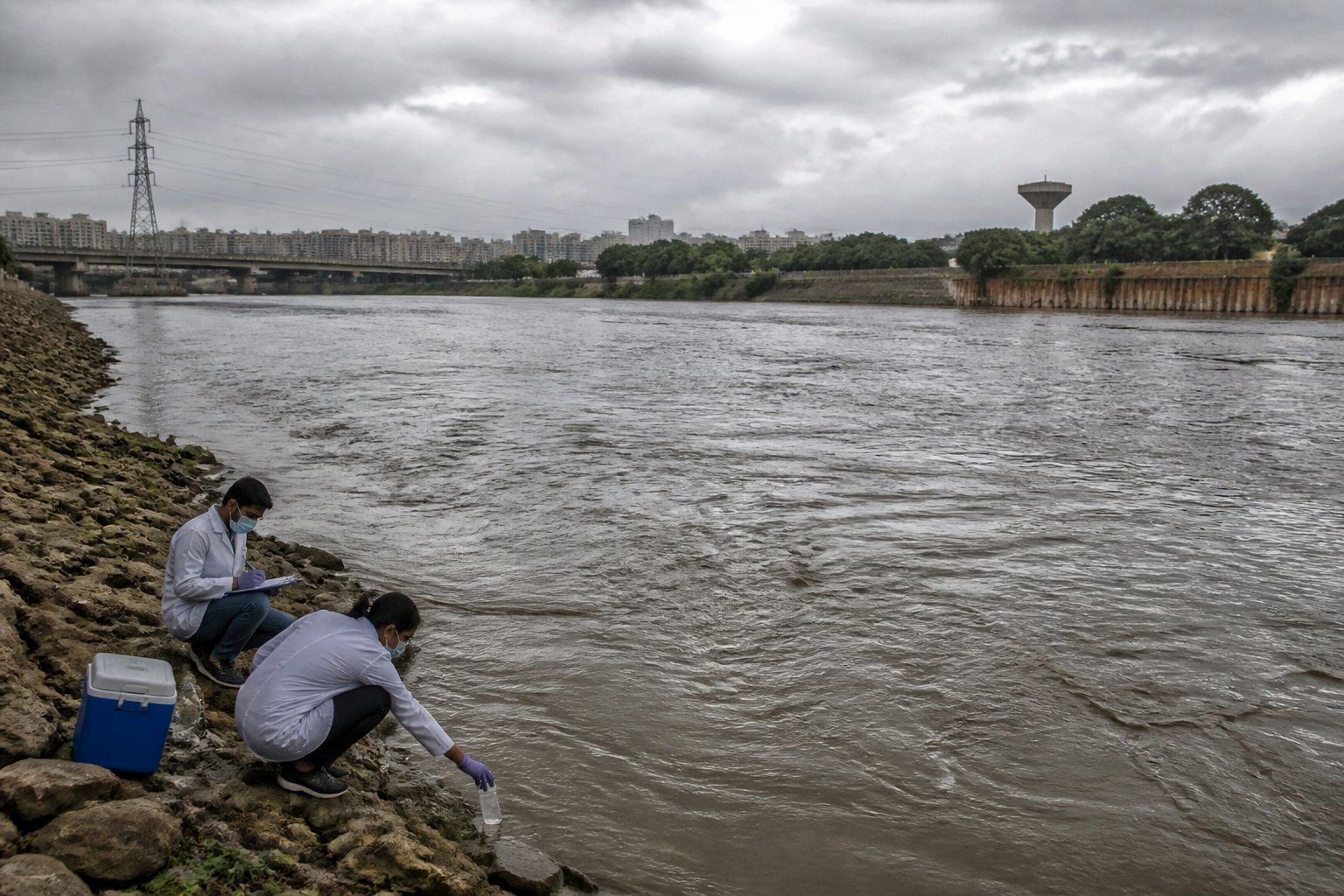
The latest Delhi Pollution Control Committee assessment presents a familiar contradiction in the Yamuna: water-quality indicators improved sharply during August, yet pollution remained above prescribed limits at most monitoring points. The change was driven largely by increased monsoon flow, which diluted pollutants, while the continued presence of high faecal coliform and biochemical oxygen demand shows that the underlying sewage burden has not disappeared.
The DPCC report, dated September 9, measured water quality at eight locations between Palla and Asgarpur. Its findings show that the river responded positively to greater flow during the monsoon, particularly on indicators linked to sewage contamination and oxygen availability. But the data also shows why a cleaner-looking river during a high-flow month cannot by itself be treated as evidence of a permanent improvement in the Yamuna’s condition.
Faecal coliform is one of the clearest indicators of contamination by sewage. At Asgarpur, downstream of Delhi, the level fell from 3.2 lakh MPN/100ml in July to 3,600 MPN/100ml in August. At Okhla Barrage, it declined from 1.1 lakh to 23,000 MPN/100ml. These reductions are substantial, but both August readings remained well above the Central Pollution Control Board benchmark of below 2,500 MPN/100ml.
The prescribed limit was met at only two monitoring points: Palla and Wazirabad. Faecal coliform at the two locations was recorded at 1,400 and 1,100 MPN/100ml, respectively. Wazirabad had recorded 3,500 MPN/100ml in July, making its August reading an improvement, but the broader pattern remained uneven across the river’s Delhi stretch.
The location-wise variation is important because it shows that the Yamuna is not experiencing a uniform recovery. Palla and Wazirabad, located upstream in the monitored stretch, recorded levels within the prescribed benchmark. Downstream locations, including Okhla and Asgarpur, continued to carry much higher contamination loads. Asgarpur recorded the highest levels of biochemical oxygen demand, chemical oxygen demand, phosphate and faecal coliform among the monitoring points.
The dissolved oxygen readings provide another measure of the change. In July, oxygen had fallen to zero between ISBT Kashmere Gate and Asgarpur. In August, oxygen was detected throughout the monitored stretch. The highest readings were recorded at Palla and Wazirabad, at 6.8mg/L and 5.7mg/L. The level was 3mg/L at ISBT, 5mg/L at ITO, 4.6mg/L at Nizamuddin, 4mg/L at Okhla and 2.6mg/L at Asgarpur.
This improvement matters because dissolved oxygen indicates whether the river can support aquatic life and sustain natural processes. The return of measurable oxygen across the stretch suggests that increased monsoon flow changed the immediate chemical conditions in the river. However, the sharply lower reading at Asgarpur compared with Palla and Wazirabad also indicates that the downstream stretch remained under greater stress.
The data on biochemical oxygen demand is less encouraging. BOD measures the oxygen required for the decomposition of organic matter in water. A higher BOD therefore points to a greater load of organic pollutants. Palla was the only monitoring point where BOD remained within the acceptable range, at 3mg/L. It stayed elevated at most other locations, with Asgarpur recording the highest level among the sites assessed.
Taken together, the indicators suggest that August brought a change in the river’s immediate condition rather than a complete resolution of its pollution problem. Faecal coliform dropped, dissolved oxygen returned and some locations met the prescribed benchmark. At the same time, high BOD and continuing exceedances at key downstream stations show that organic pollution and sewage contamination remained embedded in the monitored stretch.
The year-on-year comparison reinforces this mixed picture. At Okhla, faecal coliform fell from 54,000 MPN/100ml in August 2025 to 23,000 MPN/100ml in August 2026. That is a significant reduction, but the latest reading was still more than nine times the CPCB benchmark cited in the assessment. Improvement, in other words, is not the same as compliance.
The role of monsoon flow is central to interpreting the numbers. The DPCC attributed the improvement in several water-quality parameters to increased flow that helped dilute pollutants. Dilution can reduce measured concentrations and improve oxygen conditions over a particular period, but it does not necessarily indicate that the quantity of sewage entering the river has been reduced. The August readings themselves support that distinction: contamination declined at several locations, yet remained above the prescribed limit at most of them.
This creates a governance challenge for the agencies responsible for river pollution control. Monthly monitoring can show whether conditions are improving or worsening, but the location-wise results also reveal where the pollution burden remains concentrated. The downstream readings at Okhla and Asgarpur, along with the high BOD at Asgarpur, make the river’s movement through Delhi especially significant. Water quality changes as the river passes through the city, and the downstream condition records the cumulative effect of that urban stretch.
The DPCC’s monitoring system relies on manual sample collection from eight locations between Palla and Asgarpur. That network provides a consistent set of points for comparing conditions across months and years. It also makes it possible to identify differences between upstream and downstream locations. In the August assessment, the contrast between Palla and Asgarpur was particularly clear: Palla met the faecal coliform benchmark and recorded acceptable BOD, while Asgarpur recorded the highest levels of several pollution indicators.
The institutional question is therefore not simply whether the Yamuna improved in August. It is whether the improvement can be sustained when monsoon flows recede. The supplied assessment does not establish that outcome. It records a period in which increased water flow improved several parameters, while contamination remained above limits at most locations. The next sets of readings will be important because they can show whether the August improvement persists beyond the conditions that helped produce it.
The data also cautions against relying on a single indicator. A fall in faecal coliform is significant, but it cannot be read in isolation from BOD, chemical oxygen demand, phosphate and dissolved oxygen. At Asgarpur, several indicators remained the worst among the monitored locations even as faecal coliform fell sharply. Similarly, the return of dissolved oxygen throughout the stretch does not mean that all locations reached the same level of river health.
For Delhi’s urban system, the Yamuna’s condition remains closely tied to the management of sewage and organic waste across the city. The August report does not provide a complete account of the sources of contamination or the performance of individual treatment facilities, so those conclusions cannot be drawn from the available evidence. It does, however, show the measurable result at different points in the river: improvement during higher flow, persistent excess contamination downstream and continued stress reflected in elevated BOD.
The clearest conclusion from the DPCC assessment is that the Yamuna improved, but not enough to move most of Delhi’s monitoring points within prescribed limits. The monsoon reduced pollution concentrations and restored measurable dissolved oxygen across the stretch, while the continued high BOD and downstream contamination showed the limits of that improvement. Future monitoring after the period of increased flow will determine whether August marked sustained progress or a temporary seasonal reprieve.
