


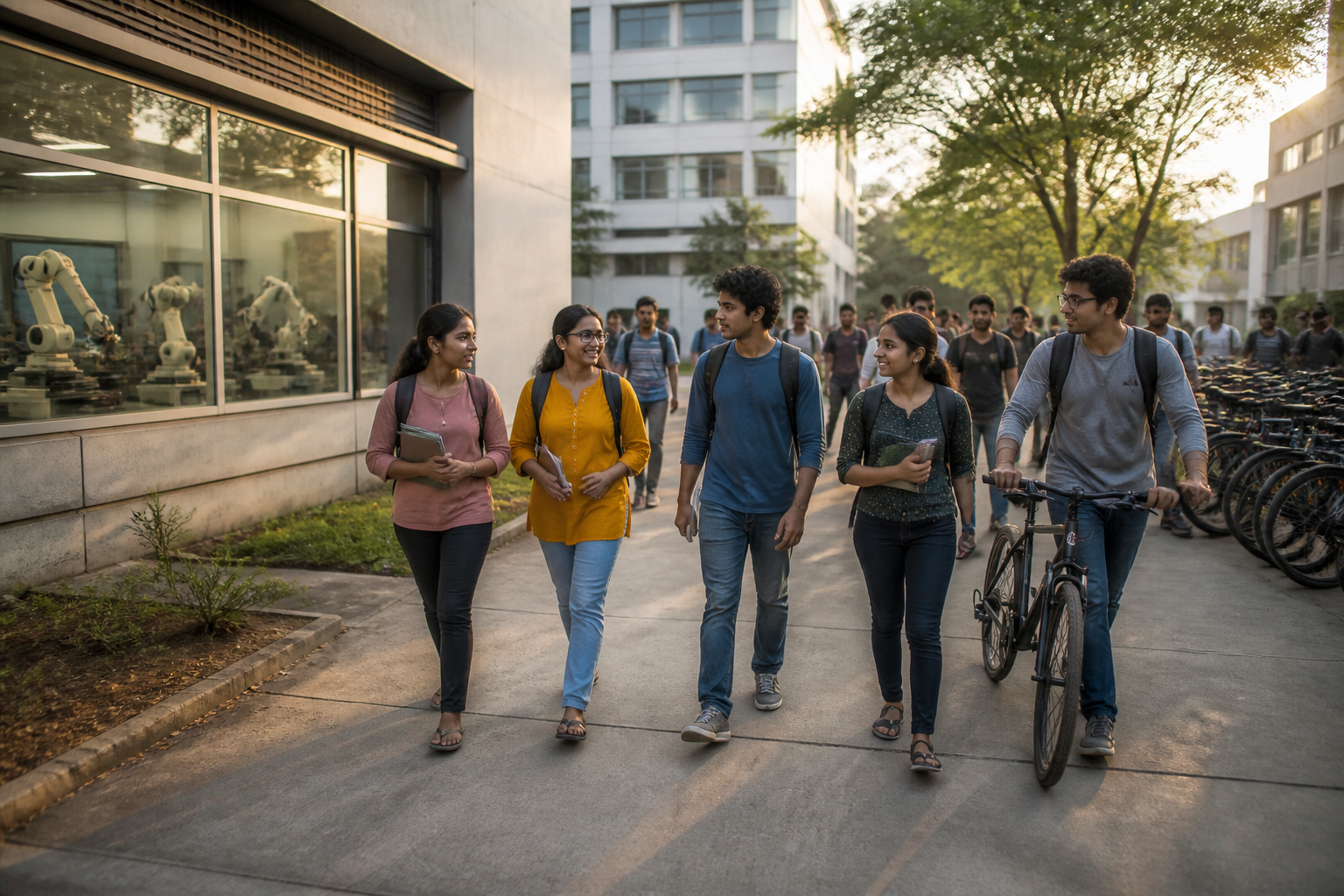
Maharashtra’s engineering enrolment has expanded sharply over four years, with the number of female students rising 75% to 67,806 in 2026-27. But the figures also expose a continuing imbalance: women now account for 37.3% of the state’s 1.82 lakh engineering students, leaving participation well below parity even as the overall intake grows.
The change is not only a story about admissions. It shows how Maharashtra’s higher-education geography is being shaped by the interaction of gender, affordability, institutional capacity, course demand and the perceived advantages of particular cities. Pune has emerged as the state’s strongest engineering hub, while Mumbai, despite having prominent institutions and better infrastructure in some respects, attracts fewer students partly because of hostel costs and established perceptions about proximity and affordability.
The latest figures, shared by the state’s CET cell and reported by the Times of India, show that female engineering enrolment increased from 38,626 students in 2023-24 to 52,751 in 2024-25, 62,195 in 2025-26 and 67,806 in 2026-27. During the same period, total engineering enrolment rose from 1.18 lakh to 1.82 lakh. Women’s share therefore moved from 32.7% to 35.3%, then 37.3% in each of the last two years.
That distinction matters. A 75% increase in the number of women entering engineering is substantial, but the percentage share has risen by about five percentage points because the entire system has expanded. The data indicates improved participation without establishing that the underlying gender gap has been closed. The growth in female enrolment is therefore both a positive shift and a measure of how much further the state’s engineering institutions have to go.
The distribution of students across universities adds a second layer to the story. Savitribai Phule Pune University recorded the highest enrolment among engineering colleges affiliated to public universities, with 64,822 students. Dr Babasaheb Ambedkar Technological University at Lonere followed with 34,385, while the University of Mumbai recorded 32,126. Nagpur University had 17,084 students and Shivaji University 9,921.
These numbers should not be read simply as a ranking of academic quality. They also reflect the scale and spread of affiliated colleges, the availability of seats and the choices made by students who must balance course availability with the cost of living. Pune city alone recorded nearly 50,000 engineering students, the highest concentration in Maharashtra. That concentration creates an education ecosystem in which colleges, hostels, transport links and private services reinforce one another.
Counsellor Sachin Bangad, speaking to the Times of India, attributed Pune’s appeal partly to a perception that it is closer to the rest of Maharashtra and more affordable than Mumbai for hostel accommodation. He also said that Mumbai has better colleges and infrastructure in some respects, but that Pune has developed a stronger reputation and probably has a larger number of colleges. The comments point to a city-choice decision driven not only by institutional reputation, but also by the practical cost of sustaining a student in the city.
For families, the location of a college is part of the education decision. Tuition fees are only one component of the total cost. Accommodation, food, daily travel and the ease of reaching home can determine whether a student accepts a seat. Pune’s position as a major educational centre may therefore be strengthened by cumulative advantages rather than by a single policy intervention: more colleges attract more students, which supports hostels and other services, which in turn makes the city more recognisable and convenient to future applicants.
Mumbai’s lower position in the university-level distribution does not mean that its engineering institutions are marginal. The city recorded the third-highest enrolment among colleges affiliated to public universities, with more than 32,000 students. But Mumbai’s housing and accommodation costs can influence access even when academic infrastructure is strong. The comparison between Mumbai and Pune consequently raises a wider urban question: how much educational opportunity is determined by the cost and functioning of the city around a campus?
The admission process itself also reveals an institutional issue. The highest number of seats was filled during the institutional round, according to the CET cell data. Seats remained vacant through the earlier rounds and were then taken in the institutional round, a pattern that Bangad said occurs in almost every admission season. He also said that many students continue to block seats across all three rounds.
This suggests that published seat capacity and actual student demand do not always align smoothly. Vacancies in the first rounds can reflect uncertainty among applicants, multiple applications, course preferences, changing decisions or the timing of admissions. The available information does not establish the precise reason for every vacant seat, but it does show that the formal sequence of counselling rounds does not immediately produce a stable allocation of students to institutions.
The pattern has consequences for how colleges and cities plan capacity. Institutions may have seats on paper but still face uneven demand between courses, locations and admission stages. Students, meanwhile, may delay commitment while comparing colleges and programmes. The result is a system in which enrolment totals become clear only after the institutional round, making early-round vacancy figures an incomplete measure of the actual demand for engineering education.
Course choices show where that demand is concentrated. Computer engineering had the highest enrolment, with 28,170 students, followed by mechanical engineering with 19,702 and electronics and telecommunication engineering with 18,895. Computer science and engineering accounted for 18,277 students, while information technology recorded 15,219.
Taken together, the figures show the strength of computer and IT-related education. More than half of the students secured admission in computer- and IT-related courses, according to the report. At the same time, educationists said that seats in computer engineering are not increasing because the field has reached a level of saturation, while newer courses in artificial intelligence, data science and machine learning are expanding.
This is a shift in the structure of technical education rather than simply an increase in the popularity of one course. Students are responding to perceived opportunities in digital and technology-linked sectors, while institutions are adjusting their offerings through newer specialisations. The enrolment figures therefore capture both demand from students and the supply decisions of colleges.
The data does not, however, establish whether the growth of these courses will translate into comparable employment outcomes. It shows what students are choosing and what programmes are available, but not the quality of instruction, graduate placement, earnings, retention or the distribution of jobs across cities. Those questions remain important for assessing whether rising enrolment represents a durable expansion of opportunity or a concentration of students around courses perceived to offer better prospects.
The gender figures also require a more detailed institutional reading. The supplied data identifies the number and share of female students, but it does not break enrolment down by university, course, district or type of institution. It is therefore not possible from these figures to determine whether women are enrolling evenly across Maharashtra or whether participation is concentrated in particular cities and disciplines. Nor does the data show how many women continue through graduation or enter engineering-related employment.
What is clear is that the state’s engineering system is expanding while remaining uneven in three ways. First, women’s participation is rising but remains below half of total enrolment. Second, students are concentrated in a small number of large educational centres, especially Pune. Third, demand is heavily tilted towards computer and technology-related courses, while admissions are completed late in the counselling cycle.
These are not separate trends. They can reinforce one another. A city with a large college base can offer more course choices, but it may also face pressure on hostels, transport and everyday affordability. A strong technology-course cluster can attract students and institutions, but it can also leave other disciplines with weaker demand. A rise in women’s enrolment can widen access, but the urban conditions around colleges will influence whether that access is practical and sustainable for students from different parts of the state.
Maharashtra’s latest engineering numbers therefore point to a system that is growing faster than its old categories can explain. The central fact is encouraging: female enrolment has risen from 38,626 to 67,806 in four years. The unresolved questions concern distribution and durability—whether more women are entering a broad range of programmes, whether cities can provide affordable support infrastructure, why so many seats are filled only at the institutional stage, and whether the expansion of technology-focused courses will match future educational and employment outcomes. The next useful layer of evidence will need to connect enrolment with course-level gender data, institutional capacity and student outcomes.
