


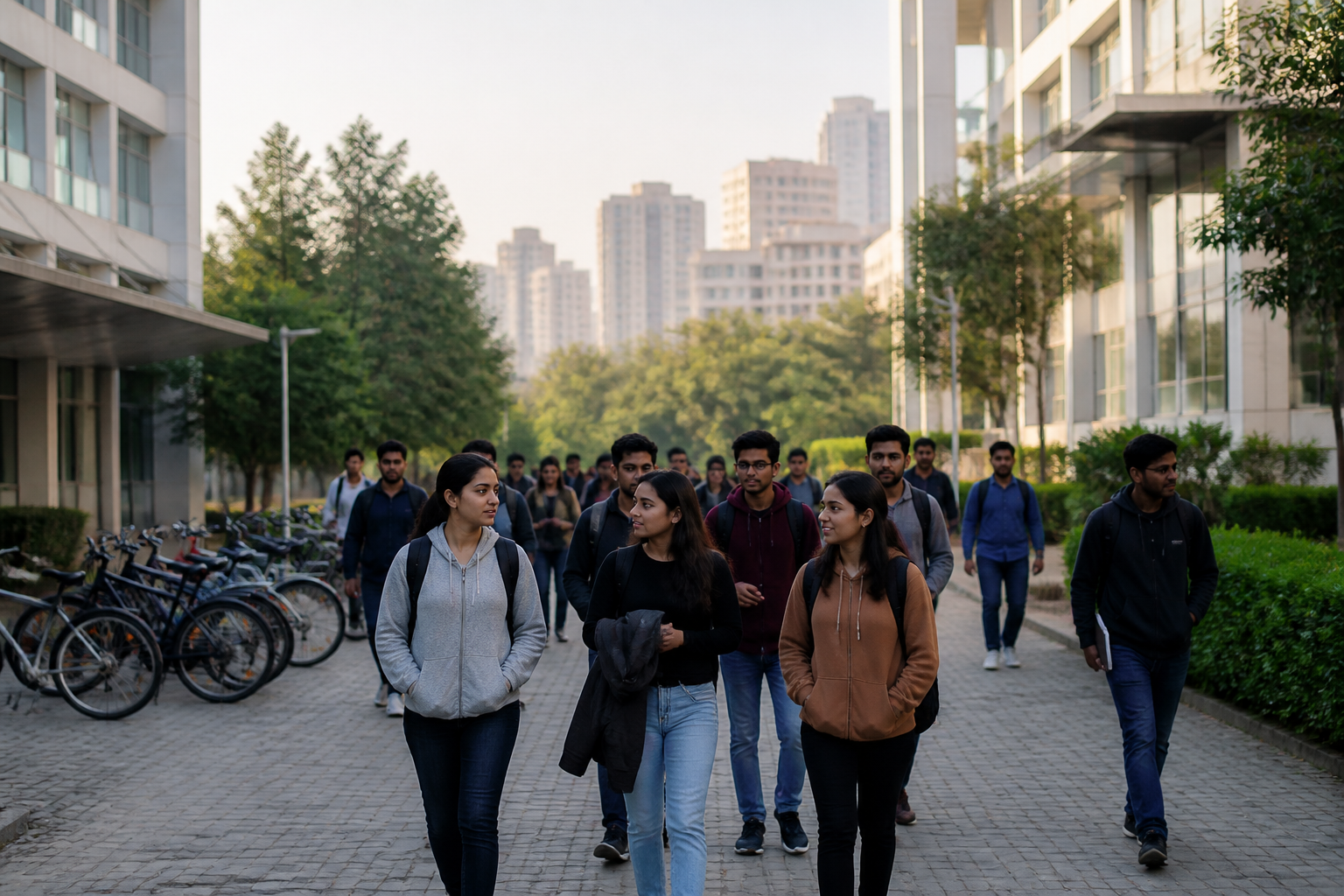
Maharashtra’s engineering admissions are expanding, but the growth is not being distributed evenly across the state. Female enrolment has risen from 38,626 students in 2023-24 to 67,806 in 2026-27, a 75% increase, while Pune has emerged as the state’s dominant education hub with nearly 50,000 engineering students. The numbers point to a larger urban pattern: access to professional education is being shaped not only by the number of seats available, but also by perceived institutional quality, hostel costs, proximity and the concentration of colleges in particular cities.
The increase in female enrolment is the clearest change in the data. Girls accounted for 32.7% of Maharashtra’s 1.18 lakh engineering students in 2023-24. Their share rose to 35.3% in 2024-25 and 37.3% in both 2025-26 and 2026-27. In absolute terms, however, the increase has been sharper: female enrolment reached 52,751 in 2024-25, 62,195 in 2025-26 and 67,806 this academic year.
That rise changes the scale of the question facing engineering institutions. The issue is no longer only whether more women are entering engineering, but whether campuses, hostels, transport links and surrounding urban services are equipped to support a larger and more geographically mobile student population. The supplied data does not establish how many students relocate for admission or what facilities are available to them, but the distribution of enrolment and the comments on hostel affordability show that the urban environment is already part of the admission decision.
The gender share has improved even as total engineering enrolment has grown from 1.18 lakh students in 2023-24 to 1.82 lakh in 2026-27. This means that the increase in women’s participation is not simply the result of a shrinking overall pool. More women are enrolling in absolute numbers, while their representation has also risen by nearly five percentage points over four years. Yet women still account for only a little over one-third of engineering students, leaving a substantial gap between participation and parity.
The geographic distribution is equally important. Savitribai Phule Pune University recorded 64,822 engineering students, followed by Dr Babasaheb Ambedkar Technological University, Lonere, with 34,385. Mumbai University recorded 32,126 students, placing it third among the public universities listed in the report. Nagpur University had 17,084 students, while Shivaji University recorded 9,921.
These figures show how strongly engineering education is concentrated within a small number of institutional clusters. Pune’s university figure is almost twice Mumbai University’s, while the city itself recorded nearly 50,000 engineering students, the highest in the state. The data does not imply that Pune has the state’s best colleges across every discipline. It does show that the city has accumulated a large enough combination of institutions, accommodation and student networks to become the preferred destination for engineering aspirants.
Counsellor Sachin Bangad, speaking from Latur, attributed Pune’s appeal partly to proximity and affordability. He said students from elsewhere in Maharashtra perceive Pune as closer to the rest of the state and consider its hostels more affordable than those in Mumbai. He also said Mumbai has better colleges and infrastructure in some respects, but that Pune has developed a strong perception advantage and probably has a higher number of colleges.
That observation is significant because it places student movement within the same urban systems that shape housing and mobility. A city that attracts tens of thousands of students requires more than classroom capacity. It requires affordable rental accommodation, hostels, public transport, food services and neighbourhoods that can absorb a large temporary population. The report does not provide hostel or rental data, so it cannot establish the scale of the housing pressure. It does, however, identify affordability as one factor influencing the location of demand.
The admissions process also reveals a mismatch between formal seat availability and actual student behaviour. The highest number of seats was filled during the institutional round, according to data shared by the state’s CET cell. Bangad said seats remain vacant through all three regular rounds and are then filled during the institutional round, while some students continue to block seats across the earlier rounds.
This pattern complicates the usual interpretation of vacant seats. A seat that remains unfilled during an early round is not necessarily evidence of a lack of demand. It may reflect the way applicants manage multiple options, wait for preferred institutions or courses, and use successive rounds before making a final decision. At the same time, repeated vacancies can indicate that the location, course, institution or cost of a seat does not match student preferences.
The concentration in Pune may therefore be understood as both a demand signal and an institutional planning signal. Students are not choosing only an engineering discipline. They are also choosing an urban setting with a particular reputation, cost structure and supply of colleges. Public universities and affiliated colleges in cities with fewer institutions may continue to see lower enrolment even when seats are available, while established education hubs can attract students from across the state.
Course preferences provide another layer to the story. Computer engineering recorded the highest enrolment at 28,170 students, followed by mechanical engineering at 19,702 and electronics and telecommunication engineering at 18,895. Computer science and engineering accounted for 18,277 students, while information technology recorded 15,219.
More than half of the students secured admission in computer and IT-related courses, according to the report. This concentration reflects the continuing appeal of technology-linked education, but it also raises questions about how institutions are adapting their course portfolios. Educationists cited in the report said seats in computer engineering are not increasing because the discipline has reached saturation, while newer programmes in artificial intelligence, data science and machine learning are expanding.
The distinction matters for campus planning. If demand is moving from established computer engineering programmes towards newer technology specialisations, universities may need to reorganise teaching capacity, laboratories and faculty requirements rather than simply add more seats under familiar course names. The source material does not provide a statewide breakdown of seats in artificial intelligence, data science or machine learning, so the scale of that shift cannot be quantified here. It does establish that the growth in computer-related enrolment is extending beyond traditional computer engineering.
Mechanical and electronics and telecommunication engineering remain significant, with 19,702 and 18,895 students respectively. Their enrolment shows that the state’s engineering demand has not entirely narrowed to software-oriented courses. However, the combined weight of computer engineering, computer science and information technology indicates that technology-linked courses dominate student choices.
The institutional distribution also exposes a possible capacity imbalance. While the top five universities account for large enrolments, the report notes that some universities, including public ones, have enrolments only in the hundreds. The supplied material does not explain whether this is due to fewer affiliated colleges, lower demand, course availability, location, infrastructure or institutional reputation. Those unanswered questions are important because a state-wide admission system can produce very different outcomes for institutions operating in different urban and regional environments.
The rise in female enrolment makes that imbalance more consequential. If more women are entering engineering but the strongest institutional clusters are concentrated in a few cities, families and students may face a choice between relocating to a larger education hub and accepting a local institution with fewer perceived options. The source does not provide gender-disaggregated data by city, university, course or hostel access, so it is not possible to determine whether women are disproportionately concentrated in particular institutions or locations.
The report also records a smaller but related trend in management education. Nearly 45,000 students secured admission to MBA and MMS courses across Maharashtra, 2,111 more than the previous year and 20% higher than in 2023-24. Even so, 22% of the 56,931 available seats across 412 colleges remained vacant. This parallel suggests that growth in professional education does not automatically translate into full utilisation of institutional capacity.
For policymakers, the combined engineering and management figures point towards a planning challenge rather than a simple expansion target. Adding seats can respond to demand in popular courses, but it does not guarantee that students will choose every institution or location. The timing of admissions, the institutional round, affordability, course reputation and urban accessibility all influence how capacity is used.
The Maharashtra data therefore describes a higher-education geography built around concentrated urban hubs. Pune’s lead is linked in the report to its perceived proximity, hostel affordability, college density and established reputation. Mumbai remains a major centre, but higher accommodation costs may affect its ability to attract students from other parts of the state despite its institutional strengths.
What the evidence confirms is a three-part shift: engineering enrolment is expanding, female participation is rising, and student demand is concentrating around particular cities and technology-related courses. What remains uncertain is how much of this growth reflects long-term course preference, how much is driven by the availability of seats, and whether the state’s less-populated institutions can attract students through improved infrastructure or more relevant programmes. Those questions will determine whether the current increase represents a broadening of engineering access or a deeper concentration of opportunity in Maharashtra’s established education hubs.
