


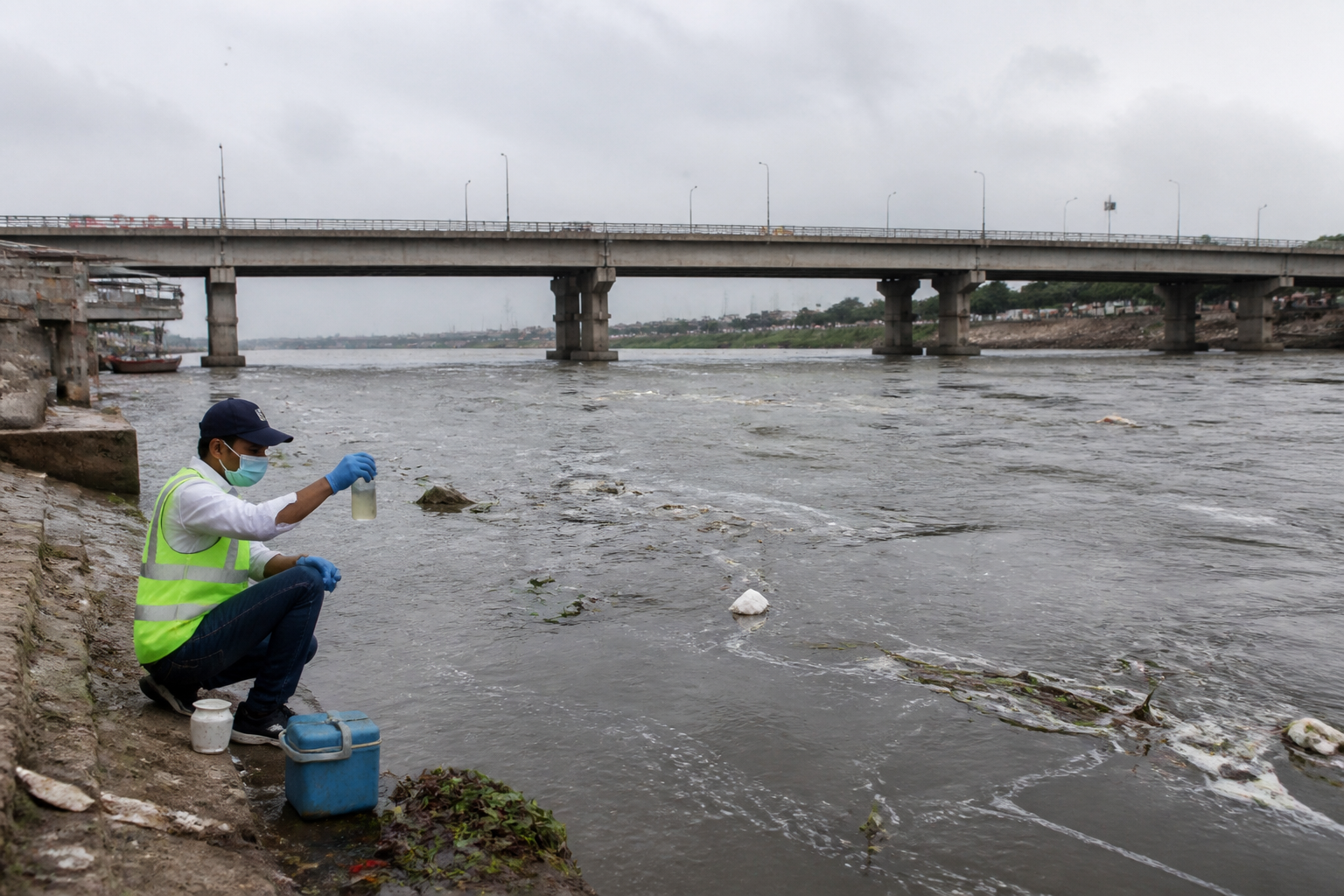
The Yamuna’s pollution indicators improved at several Delhi locations after monsoon flows reached the river, but the latest DPCC data shows that the change is largely a dilution effect rather than evidence of recovery. Faecal coliform levels fell at some downstream points, yet biochemical oxygen demand remained high and dissolved oxygen stayed below the bathing standard at the locations cited, leaving a large stretch of the river unfit for bathing.
The contrast is clearest in the August readings. A Delhi Pollution Control Committee sample collected on August 5 recorded faecal coliform at 17,000 most probable numbers (MPN) per 100 ml at ITO Bridge, down from 54,000 a year earlier. At Okhla Barrage, the reading was 23,000, compared with 30,000 in August 2025. Nizamuddin Bridge recorded almost no change, at 13,000, while Asgarpur recorded 36,000 against 35,000 a year earlier.
These figures remain far above the limits cited in the report: a desirable limit of 500 MPN/10 ml and a standard of 200 MPN/100 ml. The reduction therefore does not indicate that the river has become clean. It indicates that the volume and movement of water have altered the concentration of sewage-related contamination at particular points and at a particular time.
That distinction matters because the Yamuna’s condition in Delhi is closely tied to the quantity of water moving through the river. In early July, when adequate monsoon flows had not arrived, pollution levels remained broadly comparable with June. Additional routine monsoon flow began reaching the river from July 9, increasing the volume available to dilute and move accumulated pollutants.
The August dissolved oxygen readings offer a second, partial sign of improvement. At ISBT Bridge, dissolved oxygen rose from 2 mg/l in August 2025 to 3 mg/l this year. At Nizamuddin, it increased from 4 mg/l to 4.6 mg/l, and at Okhla from 3.2 mg/l to 4 mg/l. Asgarpur recorded a smaller rise, from 2.3 mg/l to 2.6 mg/l.
But all four readings remained below 5 mg/l, the standard required for bathing cited in the report. Dissolved oxygen is important because aquatic life and the natural breakdown of organic matter depend on oxygen being present in the water. A rise from severely depleted levels can show that conditions have temporarily improved without demonstrating that the river can sustain a healthier ecological state.
The most important warning in the data comes from biochemical oxygen demand, or BOD. BOD measures the oxygen required to break down organic matter in water. Higher BOD means that more oxygen is being consumed by the decomposition of pollutants, leaving less available for the river’s aquatic environment.
At most downstream locations, BOD was higher than in August last year. It rose from 24 to 28 mg/l at ISBT, 14 to 18 mg/l at ITO, 7.2 to 12 mg/l at Nizamuddin, 7 to 10 mg/l at Okhla and 11 to 16 mg/l at Asgarpur. Palla was the exception, improving from 3.7 to 3 mg/l. The combination of lower faecal coliform at some points and higher BOD at most downstream locations shows why a single pollution indicator cannot describe the river’s health.
The evidence points to a river responding to changing flows while continuing to receive a substantial organic pollution load. Monsoon water can dilute contaminants and transport them downstream, but it does not remove the sources that put untreated or inadequately treated sewage into the river. As a result, one indicator can improve temporarily even as another worsens.
The timing of the DPCC sample adds another layer to the interpretation. Bhim Singh Rawat of the South Asia Network on Dams, Rivers and People said the August 5 sample was collected shortly after the season’s maximum discharge from the Hathnikund barrage. The discharge reached 63,109 cusecs on August 4, a day before the sampling. This means the readings captured the river soon after a notable increase in upstream water movement, rather than representing a stable seasonal condition.
Rawat also said the floods were erratic and that the river did not cross the warning level during the season. The maximum level recorded this year was 204.09 metres on August 8. The warning level cited in the report is 204.50 metres. Since 2014, the river had crossed warning levels each year except 2024, when it reached 204.38 metres, according to the report. The 2026 peak was described as the lowest since August 2004, when the river reached 203.73 metres, and July 2014, when it reached 204 metres.
The significance of these numbers is institutional as much as hydrological. The river’s cleansing capacity in Delhi depends not only on rainfall but also on how upstream water is managed. The report points to increased diversion into the East and West Uttar Pradesh canals at Hathnikund. During the 2023 Delhi floods, canal diversions were stopped once upstream inflow crossed 50,000 cusecs, allowing all water to move into the main river.
According to Rawat, the threshold for releasing water into the main river was later raised from 60,000 cusecs to 70,000 cusecs and then to 1 lakh cusecs from 2024. With flows crossing 60,000 cusecs only once or twice this season, he said, canal operations were not meaningfully curtailed. The result, in his assessment, was a delay in the additional water that could have provided the Yamuna with a stronger monsoon flush.
This does not establish that upstream diversion alone caused the pollution readings. The DPCC data shows conditions at selected monitoring points, while the comments on Hathnikund describe the management of upstream flows. Together, however, they reveal that river pollution is shaped by an interaction between sewage discharge, seasonal water availability and operating decisions across jurisdictions.
Delhi’s river-cleaning challenge is therefore not simply a treatment-capacity problem. It is also a flow-management problem. When the river has little water, the same sewage load occupies a smaller natural flow and pollution concentrations can rise. When monsoon water arrives, concentrations may fall or move downstream, but high BOD can persist if the organic load remains in the system.
The institutional structure makes this difficult to resolve through a single intervention. DPCC monitoring records the condition of the water at specific locations. Upstream barrage and canal operations influence how much water enters the main river. Sewage collection and treatment determine how much organic and faecal contamination reaches the river from the city. These functions are connected in the river, but they are managed through different administrative decisions and operating systems.
The August readings also show why annual comparisons can be misleading if they are not read alongside flow conditions. ITO and Okhla recorded lower faecal coliform than a year earlier, while Nizamuddin and Asgarpur were nearly unchanged. Dissolved oxygen improved at the four locations mentioned, but remained below the cited bathing standard. BOD increased at five locations and improved at one. The direction of change varied by indicator and monitoring point.
For residents, this means that a visibly fuller or faster-flowing river should not be treated as proof of improved water quality. Nor should a fall in faecal coliform at selected points be read as evidence that the river is ready for bathing. The data supports a narrower conclusion: additional monsoon flows changed some pollution measurements, but did not overcome the broader water-quality failure.
The central urban question is whether Delhi’s river policy measures pollution reduction independently of seasonal hydrology or treats river flow as part of the pollution-control system. The evidence supplied here suggests that both are necessary. Sewage contamination must be reduced at source, while upstream water-management decisions determine whether the river has enough flow to dilute and carry pollutants during the monsoon.
What the latest data confirms is a temporary and uneven improvement in some indicators, not a clean Yamuna. What remains unresolved is the extent to which the readings reflect short-lived post-discharge conditions and how much of the river’s organic pollution load continues to enter during low-flow periods. Future monitoring will need to be read alongside barrage discharge, canal diversion and sewage-flow conditions if the city is to distinguish seasonal dilution from sustained pollution control.
