


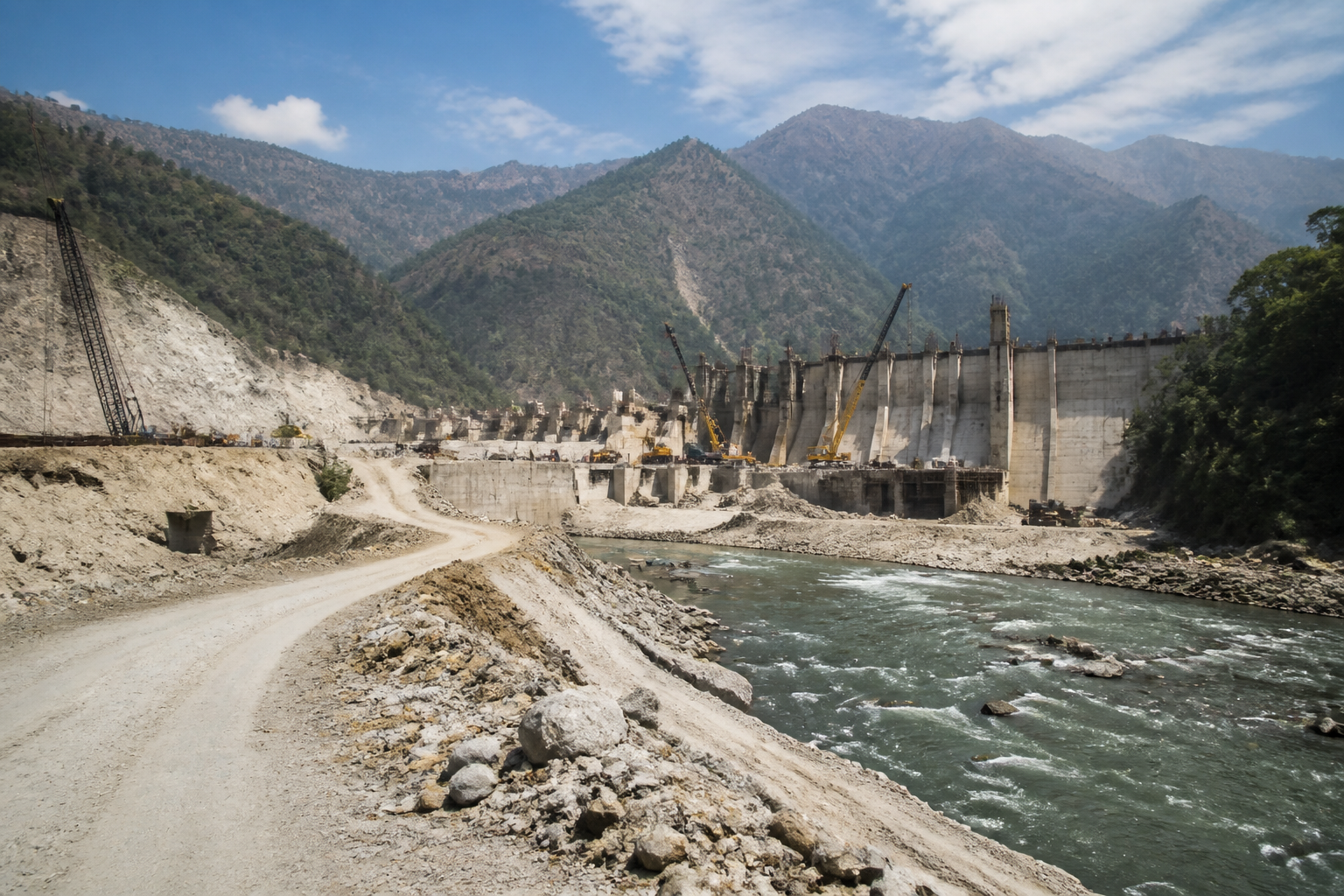
Delhi’s next major additions to its water supply are moving further into the future. The Lakhwar and Renukaji dam projects, identified as important sources for the capital, are now expected to provide water only around 2033-34, after both projects recorded limited physical progress and missed earlier completion expectations.
The delay matters because these are not standalone local works. They are inter-state projects involving the Yamuna basin, multiple implementing agencies and a formal water-sharing arrangement among northern states. Their progress therefore depends not only on construction activity at the dam sites but also on institutional coordination, financing, approvals and the eventual systems required to bring the allocated water to Delhi.
According to a report presented during a meeting of the chief ministers of several states on Yamuna cleaning, Lakhwar dam’s construction was earlier expected to be completed in 2031. The latest assessment places completion in 2034. Renukaji dam, previously expected to be completed in 2032, is now projected to be ready by 2033-34. The report was cited by Navbharat Times, which also quoted Delhi Jal Board officials on the projects and Delhi’s expected shares.
The available progress figures show why the timelines have shifted. Civil work at Lakhwar dam is reported to be about 14-15 per cent complete, while approximately 13 per cent of Renukaji dam’s work has been completed. Among the three dam projects being considered as future sources for Delhi, Lakhwar is expected to be completed first, although the revised schedule still places it several years away.
Lakhwar dam is being constructed on the Yamuna in Uttarakhand’s Tehri Garhwal district by the Uttarakhand Jal Vidyut Nigam Limited. Under the water allocation agreed through the Upper Yamuna River Board, Delhi’s share is linked to the dam’s total storage capacity. The report puts Delhi’s share at 6.08-6.3 per cent of the storage capacity, translating into an expected supply of about 130-135 million gallons per day.
Renukaji dam is being constructed in Himachal Pradesh’s Sirmaur district by the Himachal Pradesh Power Corporation Limited. Its importance for Delhi is greater in volume terms. The report states that Delhi is entitled to 47.82 per cent of the project’s allocated water, equivalent to 440 million gallons per day. Haryana’s share is listed at 33.65 per cent, followed by Himachal Pradesh at 9.34 per cent, Rajasthan at 6.04 per cent and Uttarakhand at 3.15 per cent.
Taken together, the two projects represent a potential addition of roughly 570-575 million gallons per day for Delhi, based on the quantities cited in the report. That figure does not mean the city will receive the water immediately after the dams are structurally completed. It indicates the allocation associated with the projects; the report does not provide details of the downstream treatment, transmission or distribution infrastructure needed to deliver that allocation to consumers.
This distinction is central to understanding the urban significance of the delay. A dam is only one part of a metropolitan water system. Water must be stored, released, conveyed, treated and distributed through institutions that operate across administrative boundaries. Any slippage at the storage project stage pushes back the point at which the rest of the system can become operational. It can also complicate planning for treatment capacity, transmission links and city-level distribution assets, although the supplied report does not establish the status of those components.
The projects also illustrate how Delhi’s water security is tied to decisions outside the city. Lakhwar is located in Uttarakhand and Renukaji in Himachal Pradesh, while the water-sharing arrangements include several other states. Delhi’s future supply is therefore connected to construction schedules and administrative decisions in other jurisdictions. The implementing agencies named in the report are state-level corporations, while the allocation framework operates through the Upper Yamuna River Board.
The Union Home Ministry meeting referenced in the report adds another layer of institutional oversight. The meeting focused on Yamuna cleaning and involved chief ministers from several states. The project status was presented in that setting, linking water augmentation to the wider governance of the Yamuna basin. However, the supplied material does not identify the specific causes of delay, the revised construction milestones beyond the broad completion years, or the funding position of either project.
That absence is important. The available figures establish that construction is progressing slowly and that earlier completion targets have moved. They do not establish whether the principal constraints are land, clearances, financing, contracting, technical issues, inter-state coordination or other factors. A responsible assessment must therefore separate what is known from what remains unclear. The known facts are the low reported completion levels, the revised timelines and the water shares. The reasons for the slippage require further documentation from the project authorities or the relevant government agencies.
The timeline also shows the difference between announcing a water source and securing additional water for a city. Earlier completion expectations of 2031 for Lakhwar and 2032 for Renukaji created a basis for future planning. The revised projections extend that horizon to 2033-34. For Delhi, the change is not merely a construction update; it alters the time available for planning around a future source and keeps the benefits of the projects several years away.
Renukaji’s allocation makes the project particularly consequential. At 440 million gallons per day, it is expected to provide the largest share among the projects mentioned in the report. Yet its reported physical progress is about 13 per cent and its expected completion has moved to 2033-34. The combination of high intended capacity and low progress means that the project’s importance to Delhi is not matched by near-term availability.
Lakhwar is expected to come online before Renukaji, according to the report, but its contribution to Delhi would be smaller at about 130-135 million gallons per day. Its revised 2034 completion date means that even the first of the two named projects is not expected to provide relief before the next decade. The report also refers to a third dam project, but it does not provide its name, progress or allocation details, making a complete assessment of the three-project programme impossible from the available information.
The broader urban question is how Delhi should plan when major supply additions are delivered through long-duration, multi-state infrastructure projects. The answer cannot be inferred from the reported figures alone, but the institutional structure is clear: Delhi’s water planning is partly dependent on projects outside its boundaries, state implementing agencies and basin-level allocation mechanisms. Delays in any one of these layers can affect the city’s projected supply timetable.
The current evidence confirms that Delhi’s anticipated water additions from Lakhwar and Renukaji will not arrive on the earlier schedules reported for the projects. Lakhwar is now associated with a 2034 completion target, while Renukaji is expected around 2033-34. The next developments to monitor are updated construction progress, official explanations for the delays, confirmation of financing and implementation milestones, and the downstream infrastructure required before the allocated water can reach Delhi.
