


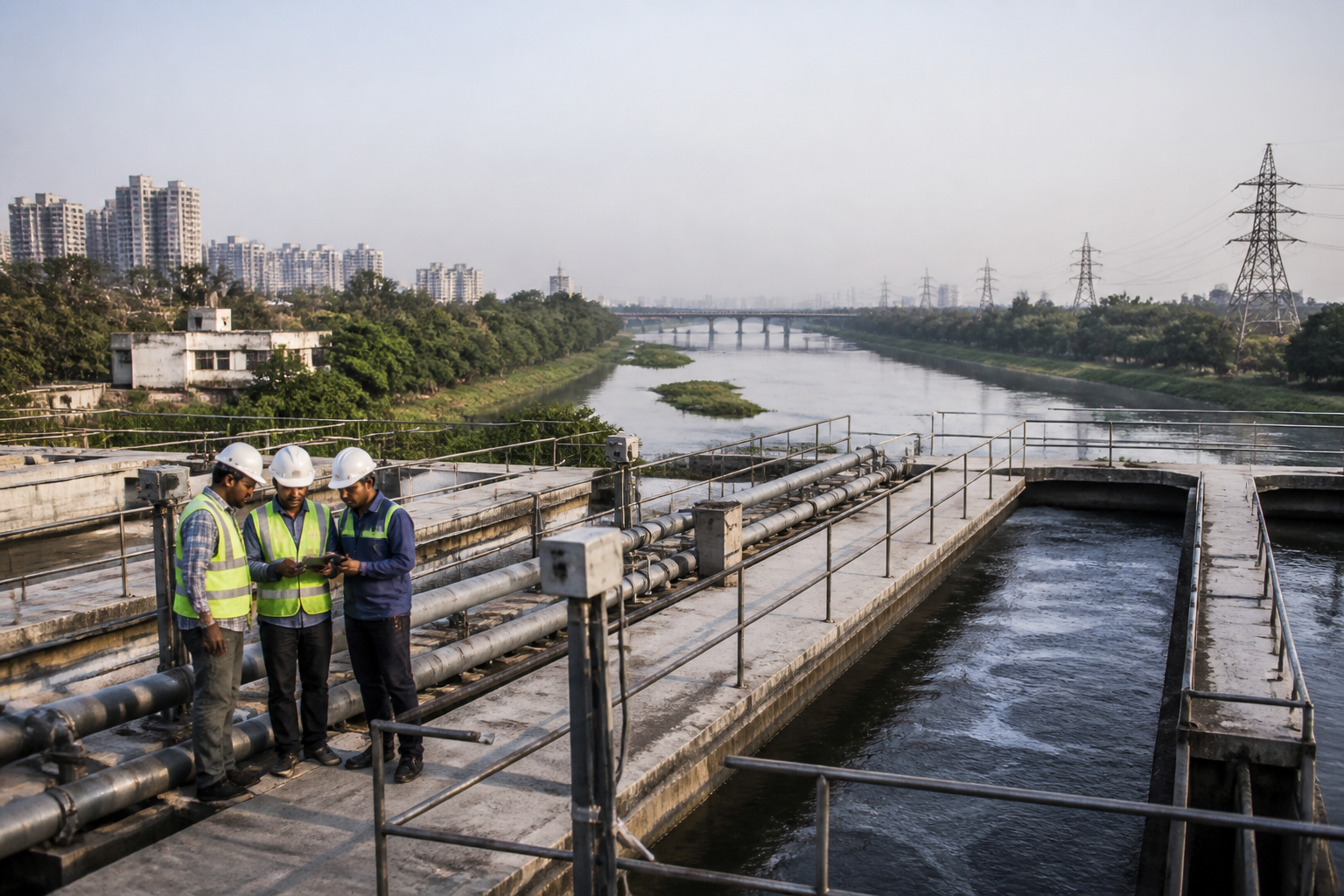
The Delhi Jal Board’s Jal Manthan 2026 has placed a familiar problem in a more useful frame: the health of the Yamuna cannot be separated from the way Delhi supplies, distributes, collects, treats and reuses water. The conference brought together water experts, international specialists, multilateral institutions and senior officials to discuss improvements ranging from treated wastewater reuse and sewerage networks to smart metering, leakage detection and artificial intelligence-based decision systems.
That framing matters because river-cleaning efforts often become visible through isolated projects, while the conditions affecting a river are produced across an entire urban service chain. In Delhi, the chain described at the conference begins with water supply and distribution and extends through sewage collection, treatment, drain management, reuse and pollution prevention. A weakness at any point can affect the quality and quantity of water reaching the river.
The central proposition emerging from Jal Manthan is that the Yamuna should not be treated as a standalone environmental project. It is also an outcome of the city’s water utility, sewerage infrastructure and monitoring systems. The experts cited in the report argued that improvement cannot come from scattered interventions or from work limited to a few areas. It requires continuous improvement across all systems that influence river health.
This shifts the administrative question. Instead of asking only how to clean the river, the more consequential question is how Delhi manages water before it reaches the river. That includes whether sewage is collected, whether treatment capacity and treatment quality are adequate, whether drains are managed effectively and whether treated wastewater can be used for purposes that do not require fresh water.
The conference placed wastewater reuse at the centre of this approach. Experts said treated wastewater should be managed as a resource that can be treated, reused and recovered, rather than being viewed only as waste. The stated logic is straightforward: expanding the use of treated wastewater can reduce pressure on fresh water and lower the volume of polluted water entering the river.
However, the report does not provide figures on the present scale of wastewater generation, treatment, reuse or leakage in Delhi. It also does not specify capacity additions, project costs, deadlines or measurable targets emerging from the conference. That absence is important. Jal Manthan has established a policy direction, but the supplied material does not yet show whether the direction has been converted into an implementation programme.
The distinction between an idea and an operating system is particularly significant for wastewater. Reuse requires more than treatment plants. It requires collection networks that carry sewage to treatment facilities, reliable treatment performance, distribution arrangements for the treated water and users who can safely and consistently consume it for approved purposes. The experts’ emphasis on the entire wastewater network indicates that these links are being considered together, but the report does not identify specific schemes or locations where the model will first be implemented.
Sewerage networks are another critical part of the proposed system. The conference called for stronger sewage networks, better drain management and stronger monitoring across the wastewater chain. These are not merely engineering concerns. They also involve the responsibilities of utilities, local administration and other agencies that manage roads, drains, land and public services. The effectiveness of river restoration therefore depends on coordination beyond a single department or a single project.
The Delhi Jal Board’s stated priorities reflect that wider responsibility. Delhi’s water minister, Parvesh Verma, said the purpose of Jal Manthan was to adapt the best ideas, technologies and experiences from India and abroad to the city’s requirements. He said the objectives were to provide quality water to every household, use every drop responsibly and move the Yamuna towards revival. He also said the event’s real success would depend on whether the ideas discussed produced actual improvement in water supply and river health.
That statement provides an important test for the conference. International participation can widen the pool of technical options, but imported solutions cannot substitute for local implementation capacity. The report says experts from Israel, the United Kingdom, the Netherlands and France participated, along with water professionals and representatives of the World Bank and Asian Development Bank. Their presence signals the breadth of expertise being brought into the discussion. It does not, by itself, establish which technologies or financing models Delhi will adopt.
The list of subjects discussed shows the scale of the proposed transformation. They included new technology for water utilities, treated-water reuse, leakage detection, measures to reduce water wastage, smart metering, water conservation, supervisory control and data acquisition, smart operations, resource recovery from sludge, artificial intelligence-based decision systems and citizen-focused digital services.
Taken together, these subjects point towards a utility that is expected to become more measurable and responsive. Smart meters can help utilities understand consumption and identify irregularities. Leakage detection can improve the management of water that is produced but does not reach users. SCADA and smart operations can support closer monitoring of infrastructure. Digital services can change how residents report problems and interact with the utility. But the supplied report gives no data on current metering coverage, leakage levels, response times, digital adoption or the operational performance of existing systems.
That gap between technological ambition and measurable baseline is one of the main issues to watch. Without a clear starting point, it becomes difficult to determine whether a new system is improving supply reliability, reducing losses, increasing reuse or preventing pollution. The minister’s own formulation—that the conference will succeed only when its ideas create real improvements—makes outcomes more important than the event itself.
Sludge management also broadens the discussion beyond conventional sewage treatment. The conference included resource recovery from sludge, suggesting that treatment systems are being considered not only as pollution-control facilities but also as places where useful resources may be recovered. The report does not state which resources, technologies or facilities are under consideration. It does, however, show that the discussion is moving towards a more integrated view of urban wastewater.
For citizens, the effects of this system are experienced in practical ways: the reliability and quality of household water, the condition of drains, the handling of sewage and the visible health of the river. A city can announce advanced monitoring systems while residents continue to experience uneven supply or untreated discharge if the basic network remains incomplete. Conversely, improvements in less visible parts of the system—collection, treatment quality, monitoring and reuse—may have greater long-term value than a single highly visible riverfront intervention.
The governance challenge is therefore one of continuity. River health is affected by daily operations, not only by periodic campaigns or conferences. Treatment plants must operate consistently, networks must be maintained, drains must be monitored and data must inform decisions. The experts’ call for continuous improvement across all systems highlights this operational dimension.
Jal Manthan 2026 has consequently identified a potentially stronger framework for Delhi’s water policy: connect household supply, distribution losses, sewage collection, treatment, reuse, drain management and river pollution within one urban water system. The evidence supplied so far confirms a shared policy direction and a wide range of proposed tools. It does not yet confirm implementation schedules, funding commitments, agency-wise responsibilities or performance results.
The next test will be whether the Delhi Jal Board and the Delhi government translate the conference’s discussions into defined programmes with measurable baselines and public accountability. Until that happens, Jal Manthan remains an important statement of intent. Its larger significance lies in whether Delhi can move from treating the Yamuna as the endpoint of pollution to managing the full urban water system that determines what reaches the river.
