


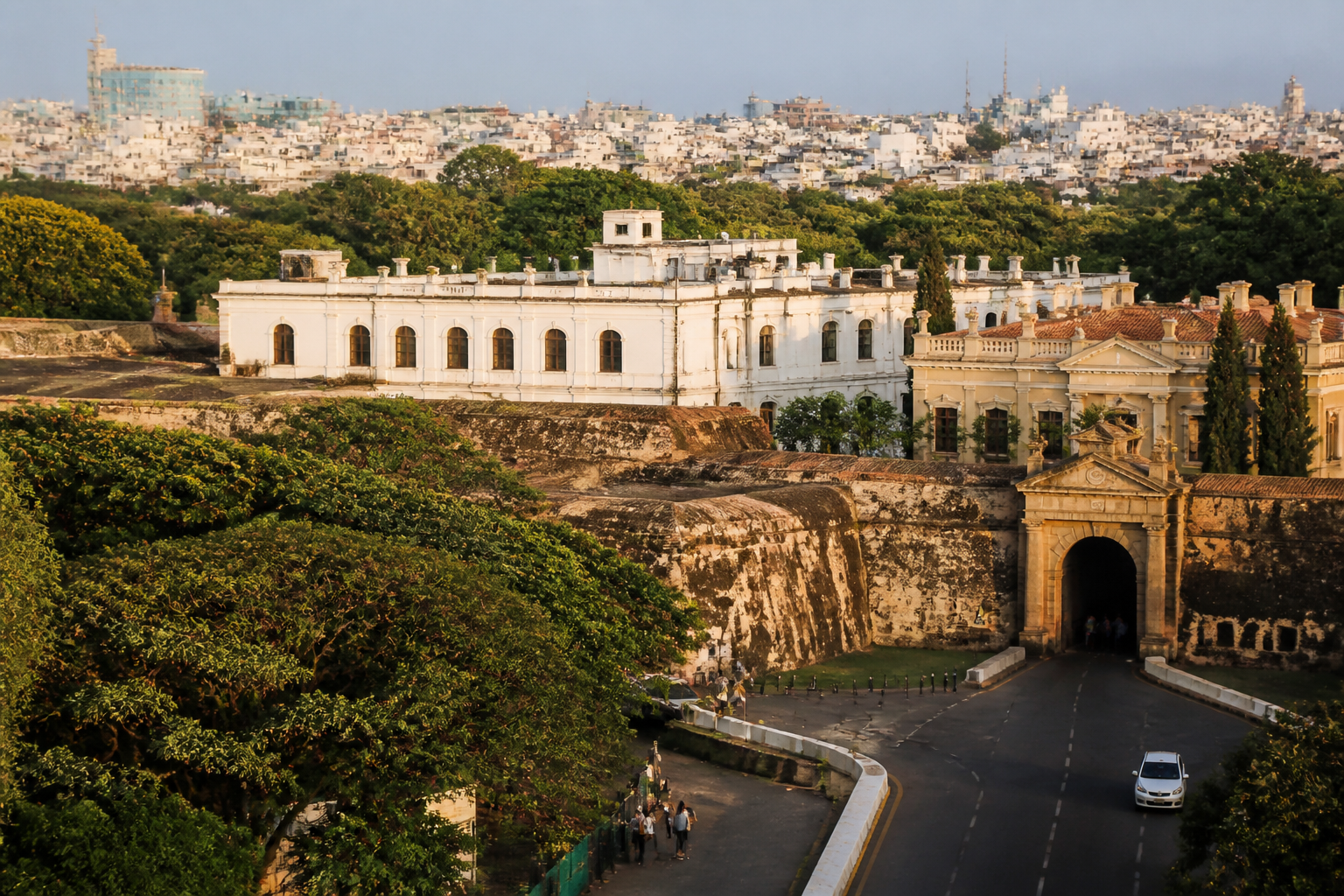
Chennai’s history began not with a master-planned capital but with a piece of land granted for trade. In 1639, Damarla Venkatapathy Nayak, an influential Nayak under the Vijayanagara rulers, granted the English land between the Cooum river and the Egmore river. The English established Fort St George there, completing its construction in 1644. From that commercial foothold emerged a settlement, an administrative centre and eventually the city now known as Chennai.
The significance of Fort St George lies in the way its role changed over time. It was not initially designed as the centre of a major city. Its primary purpose was business. Yet the fort’s location, security and growing importance to the English created the conditions for houses, trading activity and new settlements to develop around it. The urban story of Chennai therefore began as an incremental process in which commerce generated permanence and permanence produced administration.
This pattern is important because it shows that cities do not always emerge from a single act of planning. They can grow around institutions that were established for narrower purposes. Fort St George was built to support English trade, but its presence gradually reorganised the surrounding settlement. The fort became a fixed point around which economic activity, political authority and civic administration accumulated.
The settlement did not grow in isolation. An older settlement known as Madraspatnam lay to the north of the fort. As houses and other settlements appeared in the area between the two, the separate clusters gradually became one town. Fort St George remained the official centre of the English settlement, while Madras Patnam was used for the combined town. The settlement was also associated with the name Chennapatanam, in memory of Chennappa Nayak, the father of Venkatapathy Nayak.
This merging of settlements offers an early example of urban continuity being created through expansion rather than replacement. The fort did not erase the older settlement. Instead, development between the two gradually connected them. The resulting town acquired multiple names and overlapping identities, reflecting the different political and social forces that shaped it.
The distinction between the fort and the wider town also reveals how early urban power was organised. Fort St George served as the official centre of the English settlement, while the larger urban area continued to develop around it. The fort was therefore both a physical enclosure and an administrative anchor. Its walls defined a protected centre, but its economic and political significance extended beyond them.
The settlement’s position changed as control over the region shifted. In 1646, Golkonda forces under General Mir Jumla captured Madras and brought the city and surrounding areas under their control. After the fall of Golkonda in 1687, the region came under the Mughal Empire. The English later received permissions that allowed their activities in Chennai to continue.
These changes show that the growth of the settlement depended not only on trade but also on political permissions and changing systems of authority. Commercial activity required an institutional environment in which the English could continue operating. The fort could provide a physical base, but the wider settlement remained connected to the political powers that controlled the region.
By the late 17th century, the English settlement was expanding through trade and the acquisition of surrounding areas. The process was no longer limited to the original piece of land. As the English presence grew, the area under their control expanded and the fort assumed a wider role. What had begun as a trading post was becoming the centre of a larger territorial and administrative system.
An important civic development took place during the tenure of Governor Elihu Yale from 1687 to 1692, when a mayor and corporation were established for Chennai. This marked a shift in the character of the settlement. The creation of a mayor and corporation indicated that the town required formal civic administration as its population, commercial activity and territorial reach increased.
The institutional change matters because urban growth creates administrative demands that a trading post alone does not need to manage. A commercial outpost can operate through a limited chain of authority. A growing town requires structures for civic decision-making and municipal oversight. The establishment of a mayor and corporation reflected the settlement’s transition into a more complex urban entity.
In the decades that followed, several surrounding areas were added to the English company’s holdings. The town’s growth was therefore linked to the expansion of the company’s territorial control. This was not simply a story of buildings accumulating around a fort. It was also a story of boundaries changing, surrounding areas being incorporated and administrative authority extending outward from the original centre.
Fort St George subsequently became the centre of political and administrative power in the region. Its role was strengthened by the conflicts of the 18th century. The fort withstood several assaults and was briefly captured by the French between 1746 and 1749 before being restored to British control under the Treaty of Aix-la-Chapelle.
The fort’s military history reinforced its administrative importance. A fortified location offered protection, but it also became a symbol and mechanism of authority. Control over the fort was connected to control over the settlement around it. Its capture and restoration demonstrated that the site was not merely a commercial property; it had become an important political centre.
Over time, Fort St George moved further away from its original function. Its identity shifted from a trading post to a major administrative centre. It later became closely associated with the government of Madras and eventually with the administration of Tamil Nadu. This institutional continuity helps explain why the fort remains significant even though the city around it has changed dramatically.
The transformation also illustrates how historic urban assets can survive by acquiring new functions. Fort St George was first associated with English trade, then with territorial and political authority, and later with government administration. Its continued relevance did not depend on preserving only its original purpose. Instead, the site remained active because successive systems of power used it as an administrative centre.
The wider city followed a similar pattern of adaptation. The settlement that grew between the fort and Madraspatnam developed over nearly four centuries into modern Chennai. Its expansion was gradual and layered. Commercial activity, settlement growth, territorial acquisition, civic administration and political control each added a new dimension to the urban structure.
This history complicates the idea that a city has a single point of origin. Chennai’s development can be traced to the 1639 land grant, but the city itself emerged through a sequence of connections. The fort provided an institutional centre. Madraspatnam provided an older settlement context. New houses and settlements joined the two. Later administrative and territorial changes expanded the urban system.
The available account also highlights the importance of civic institutions in shaping the built environment. The mayor and corporation established during Yale’s tenure were not incidental additions to the history of the settlement. They signalled the moment when the growing town required a formal civic structure. Urban identity was being produced not only through buildings and trade but also through institutions capable of governing an expanding population and territory.
Today, the Fort St George complex remains an important historic site in Chennai. It houses government offices and a museum containing objects and relics from the colonial period. The fort is maintained as a protected monument. Its present use combines administration, heritage and public memory within the same urban site.
That combination captures the broader meaning of Fort St George. The site is not only evidence of colonial-era construction or military history. It is also a record of how economic activity can generate urban concentration, how settlements can merge through incremental growth and how political authority can become embedded in a physical landmark.
The evidence confirms a clear sequence: land was granted for English trade in 1639; Fort St George was completed in 1644; settlements developed around it; Madraspatnam and the area around the fort gradually became one town; civic institutions were established by the late 17th century; and the fort later became a major administrative centre. What remains visible today is the accumulated result of those changes. Chennai’s modern urban identity grew from that layered relationship between commerce, settlement and government.

