


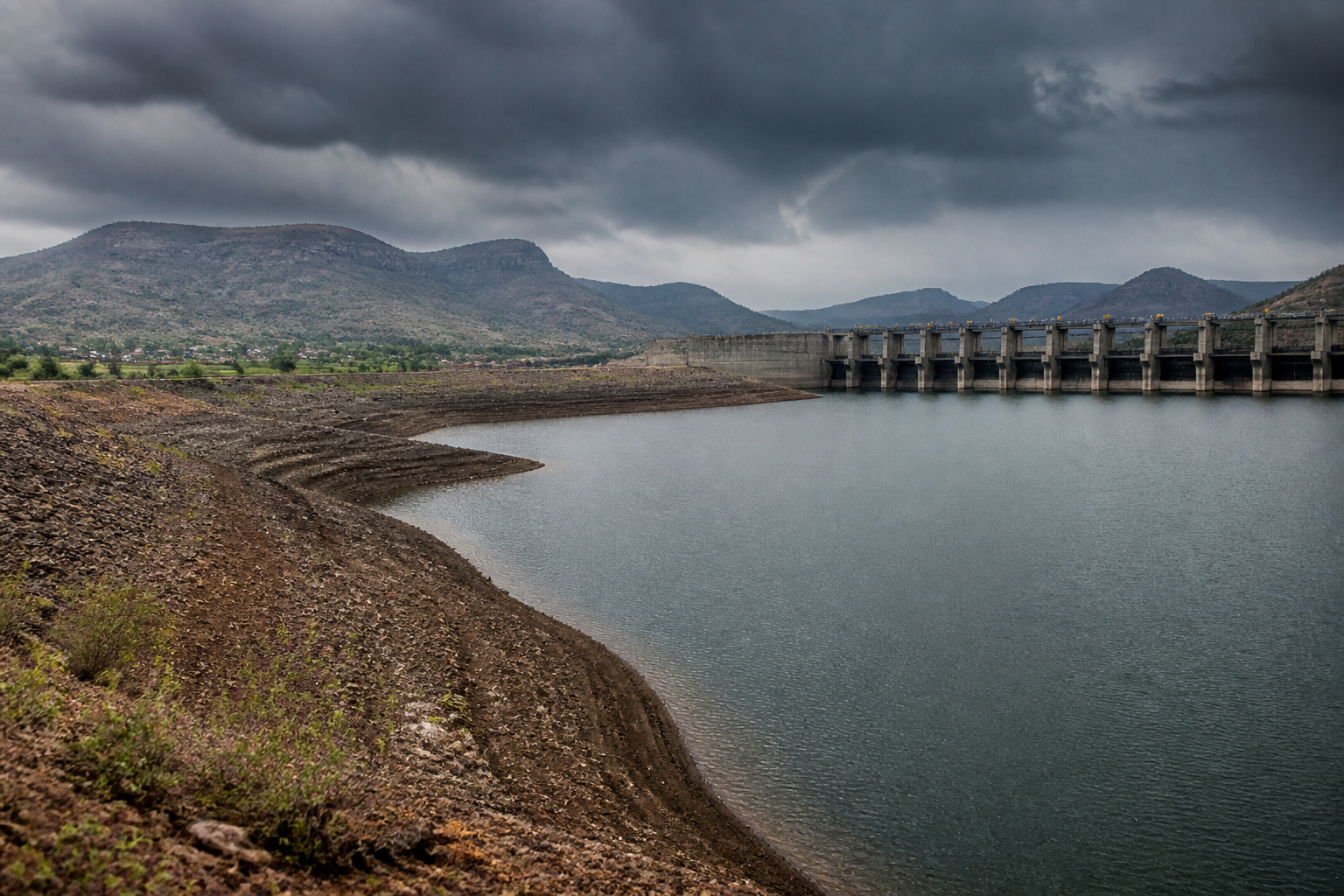
Maharashtra’s water storage position appears reassuring at the state level, but the latest rainfall pattern exposes a more difficult reality: 76 per cent storage in dams does not necessarily mean water security for every district. With rainfall 17 per cent below the September average in the first 11 days of the month, the state is entering the final phase of the monsoon with sharply uneven conditions across regions.
That distinction between an aggregate number and local availability is central to understanding Maharashtra’s water risk. The report by Loksatta states that several parts of the state have received significantly less rainfall even as some locations recorded heavy showers. The result is a divided water picture in which the state-wide average can appear manageable while districts facing rainfall deficits deal with stressed reservoirs, depleted local water bodies and weaker groundwater replenishment.
The immediate concern is not limited to the remaining days of the monsoon. The rainfall deficit affects three connected planning questions: how much water will remain available for crops, whether irrigation can support the rabi season, and how drinking-water arrangements will be managed through the next summer. These questions are particularly important in drought-prone and rainfall-deficit areas, including parts of Marathwada identified in the report.
The reported 17 per cent shortfall refers to the first 11 days of September compared with the average for that period. It does not, by itself, establish the full-season rainfall position for every district. Nor does the reported 76 per cent dam storage figure show how water is distributed between individual reservoirs, river basins or administrative regions. Those limitations matter because water planning is ultimately carried out at local and regional levels, where the physical location of storage determines whether it can serve farms, towns and cities.
The report provides a clear indication of that unevenness. In 13 districts, rainfall during the opening part of September was between 50 and 75 per cent of the average. In 17 districts, it was between 75 and 100 per cent. Three districts received more than 100 per cent of the average, while Nandurbar recorded less than 50 per cent. These figures show why a single state-wide rainfall number can conceal sharply different conditions on the ground.
For urban water systems, the distinction is significant. Cities and towns depend on a combination of surface reservoirs, local water bodies, groundwater and distribution networks. A state-level storage percentage cannot confirm the security of a particular city’s supply unless the reservoirs serving that city, their usable storage and the expected demand are separately assessed. The supplied report does not identify those city-level reservoirs or provide municipal supply forecasts. It does, however, establish the planning risk created when rainfall is uneven across the areas that feed local water systems.
The same issue applies to rural settlements. Where rainfall has been deficient, water availability may be affected at several levels at once. Dam inflows can be weaker, smaller tanks may not fill adequately and groundwater recharge may remain limited. The report specifically notes that the condition of dams, ponds and groundwater in deficit areas may be more serious than the state-wide storage figure suggests. This is an important institutional distinction: water security cannot be measured through major dams alone when communities also depend on decentralised sources.
Agriculture is the first pressure point identified in the report. In parts of Marathwada, the break in rainfall has already created a need for water for standing crops. If adequate rain does not arrive before the monsoon ends, kharif production could be affected. The implications then extend into the rabi season, when limited irrigation water could constrain the area or reliability of cultivation. The report does not provide crop-wise estimates or quantify potential losses, so the scale of the agricultural impact remains unestablished.
The sequence is important for water administration. A rainfall shortfall during the late monsoon is not simply a weather event; it changes the decisions that authorities must make about reservoir operations, irrigation releases and drinking-water reserves. Water allocated to one use can reduce flexibility for another. Yet the supplied report does not provide reservoir-wise operating rules, allocation orders or release schedules. Those documents would be necessary to establish how the reported storage position is being translated into actual water planning.
The state’s 76 per cent dam storage is therefore best understood as a broad indicator, not a complete assessment of water security. The figure may offer some immediate reassurance at the aggregate level, but it does not answer whether storage is concentrated in basins that have received heavier rain, whether deficit districts have adequate local reserves or how much of the stored water is practically available for different uses. The report makes this limitation explicit by noting that the state-wide figure does not fully describe the water position across Maharashtra.
This is also a data and governance challenge. Rainfall is recorded across districts, while water is stored and managed through reservoirs, tanks and groundwater systems that do not follow identical administrative boundaries. Agricultural demand, municipal demand and drinking-water requirements are assessed through different institutional channels. A state-wide number can support broad communication, but operational decisions require more granular information: reservoir-wise live storage, inflows, basin conditions, groundwater levels, crop demand and the status of local water bodies.
The report does not cite a government notification, reservoir bulletin or official district-wise dataset in the supplied material. As a result, the figures should be treated as reported information requiring comparison with official rainfall and storage records before being used for detailed forecasts. The broader pattern, however, is clear within the evidence available: Maharashtra’s water position is uneven, and the areas with the greatest deficit may not be protected by the state-wide average.
That matters for the coming summer because drinking-water planning begins before a crisis becomes visible. If the remaining monsoon rainfall is inadequate in deficit regions, authorities may need to assess the reliability of local sources, identify settlements dependent on tankers or supplementary supply, and determine whether reservoirs can support demand through the dry months. The supplied report does not say that such measures have been ordered or that a state-wide shortage has been declared. It points instead to a risk that must be incorporated into forward planning.
The central lesson from the current figures is that storage volume and water security are related but not interchangeable. A dam may hold water, but the location of that storage, the communities it serves, competing demands and the condition of smaller sources determine how secure a settlement actually is. For Maharashtra’s cities, towns and villages, the relevant question is therefore not only how much water the state has, but where it is, how it is replenished and who depends on it.
The available evidence confirms a September rainfall deficit, uneven district-level rainfall and 76 per cent dam storage across the state. It also establishes concerns for kharif crops, rabi irrigation and future drinking-water planning, particularly in rainfall-deficit areas. What remains uncertain is the reservoir-wise position, groundwater status, municipal supply outlook and the extent of any production or drinking-water impact. Those are the next data points that will determine whether the current warning develops into a wider water-management problem.
