


Telangana’s MBBS capacity has crossed 10,000 seats for the first time, but the expansion is being driven overwhelmingly by private medical colleges. The National Medical Commission’s latest seat matrix, as reported by the Times of India, shows that the state added 1,010 seats for 2026-27, of which 900 came from private institutions and only 110 from government colleges. The numbers mark a rapid increase in supply, but they also expose a central question for Telangana’s urban and public-health systems: does a larger medical education network automatically create wider access to doctors and better healthcare capacity?
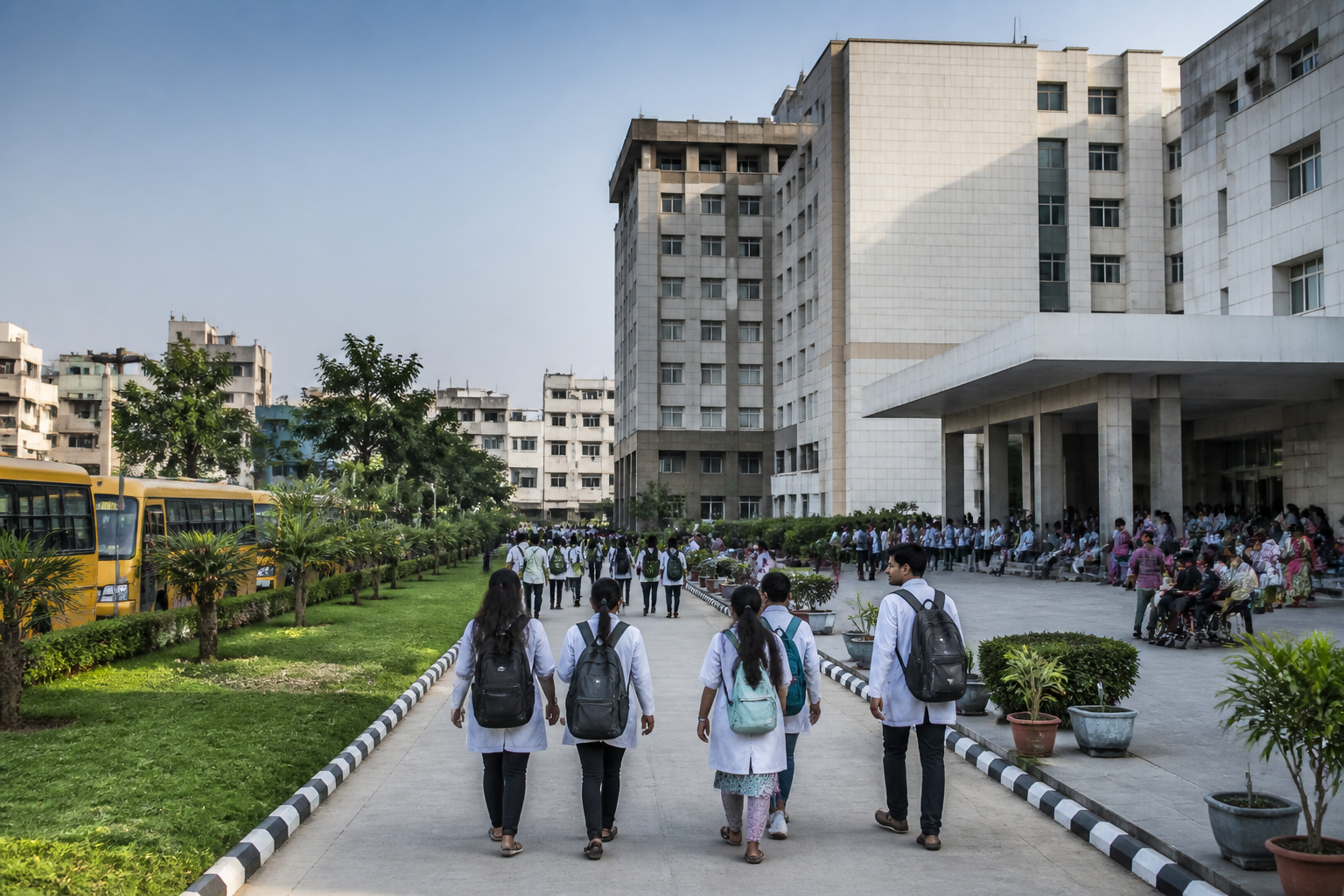
The latest matrix places Telangana’s total MBBS capacity at 10,450 seats across 66 medical colleges. Government institutions account for 4,400 seats, while private colleges account for 6,050. This means that private institutions now provide nearly three-fifths of the state’s undergraduate medical seats. The distribution is significant because the expansion of medical education is not only an academic issue. Medical colleges are major urban institutions, supporting hospitals, laboratories, hostels, transport demand, faculty employment and specialised healthcare services around them.
The growth has been steady rather than limited to a single annual jump. Telangana had 8,415 MBBS seats in 2023-24, followed by 8,965 in 2024-25 and 9,440 in 2025-26. The latest increase of 1,010 seats takes the state to 10,450 in 2026-27. Over this four-year period, capacity has grown by 2,035 seats. The new total also places Telangana fifth among the states listed in the matrix, behind Karnataka, Uttar Pradesh, Tamil Nadu and Maharashtra.
Karnataka leads with 15,745 seats across 76 colleges, followed by Uttar Pradesh with 14,400 seats across 92 colleges, Tamil Nadu with 14,299 seats across 78 colleges and Maharashtra with 13,249 seats across 87 colleges. Telangana’s 10,450 seats represent about 7.5% of the 1,40,214 MBBS seats available nationally, excluding institutes of national importance. The comparison shows that Telangana has built one of the country’s larger medical education systems despite having fewer colleges than several states ranked above it.
The more important feature of the comparison, however, is not only the total number of seats but the institutional pattern behind the increase. Telangana has 66 medical colleges, compared with 76 in Karnataka and 92 in Uttar Pradesh. Yet the latest addition is concentrated in existing private institutions and a new private college. The Raja Rajeshwari Institute of Medical Sciences-Girls has received approval for an intake of 150 MBBS students, while several existing private colleges have received increases of between 50 and 100 seats each.
Four government medical colleges — in Mahabubnagar, Nizamabad, Siddipet and Adilabad — together received 110 additional seats. Their expansion is important because government colleges generally form part of the public healthcare network and are linked to hospitals that serve wider patient populations. But the scale of the increase is much smaller than the private-sector addition. For every new government seat approved in this cycle, more than eight private seats were added.
That imbalance changes the meaning of the headline capacity number. A rise in seats indicates that more students can, in principle, enter medical education. It does not by itself establish that the new capacity is equally accessible across income groups, regions or social categories. The source report cites the Indian Medical Association raising concerns about affordability and the quality of medical education, particularly as private institutions account for most of the growth.
Dr Sanjeev Yadav, vice-president of IMA Telangana and former honorary secretary of the IMA Academy of Medical Specialists headquarters, said the focus should shift from simply increasing the number of colleges to the quality of medical education. He also pointed to concerns over faculty availability and the affordability of private medical education. These concerns are directly connected to the institutional structure visible in the seat matrix: expansion is proceeding faster in private colleges than in government institutions.
Faculty capacity is a particularly important part of the expansion question. Adding approved seats requires more than classrooms and admission permissions. Medical education depends on teaching staff, clinical departments, laboratories, hospital beds, patient exposure and supervision. The supplied figures establish the scale of seat growth, but they do not establish whether every institution has expanded these supporting capacities at the same pace. That gap is where the difference between approved capacity and effective educational quality can emerge.
The same issue applies to the relationship between medical colleges and urban healthcare. A medical college is usually anchored to a teaching hospital, and its students’ training depends on the volume and diversity of patients available for clinical learning. At the same time, attached hospitals can increase local access to specialised services. The seat matrix confirms the number and distribution of seats, but the supplied material does not provide hospital-bed figures, patient-load data, faculty-student ratios or inspection findings. Those indicators will be necessary to assess whether the numerical expansion is translating into stronger healthcare institutions.
The government-private split also has implications for the geography of opportunity. The four government colleges receiving additional seats are located in Mahabubnagar, Nizamabad, Siddipet and Adilabad, rather than being concentrated only in Hyderabad. Their expansion could strengthen medical education and public healthcare capacity in different parts of the state. At the same time, the supplied information does not provide a complete district-wise distribution of all 66 colleges, so it is not possible to determine from the matrix alone whether the overall growth is evenly distributed across Telangana.
The policy landscape is therefore defined by two parallel objectives. The first is to increase the number of doctors being trained, a goal reflected in the rise from 8,415 seats to 10,450 in four academic years. The second is to ensure that the institutions providing those seats have the academic, clinical and financial capacity required for quality training. The latest figures show clear progress on the first objective. They do not, by themselves, resolve the second.
For students and families, the private-sector share makes affordability a central part of the expansion story. More seats may reduce scarcity in aggregate, but access depends on the cost structure attached to those seats and the availability of lower-cost government options. The source material does not provide fee levels, scholarship numbers or admission-category details, so the financial impact cannot be quantified here. The IMA’s warning nevertheless identifies affordability as a structural concern rather than a minor consequence of the expansion.
For Telangana’s public administration, the figures create a monitoring challenge. The state must track not only how many seats are approved but also whether colleges have sufficient faculty, functioning departments and adequate clinical exposure. The NMC matrix provides the official capacity count, while professional bodies such as the IMA are raising questions about the conditions behind that count. Together, the two signals suggest that the next phase of medical education policy will be judged less by the number of approvals and more by the quality of institutions supporting them.
Telangana’s rise to 10,450 MBBS seats is therefore both a capacity milestone and a test of the state’s education and healthcare model. The evidence confirms a sustained expansion, a fifth-place national position among the states listed and a strong private-sector role in the latest increase. What remains unestablished in the supplied material is whether faculty, hospitals, clinical training and affordability have kept pace. Those are the indicators that will determine whether crossing the 10,000-seat mark becomes a durable public-health gain or mainly a larger admissions pipeline.
