


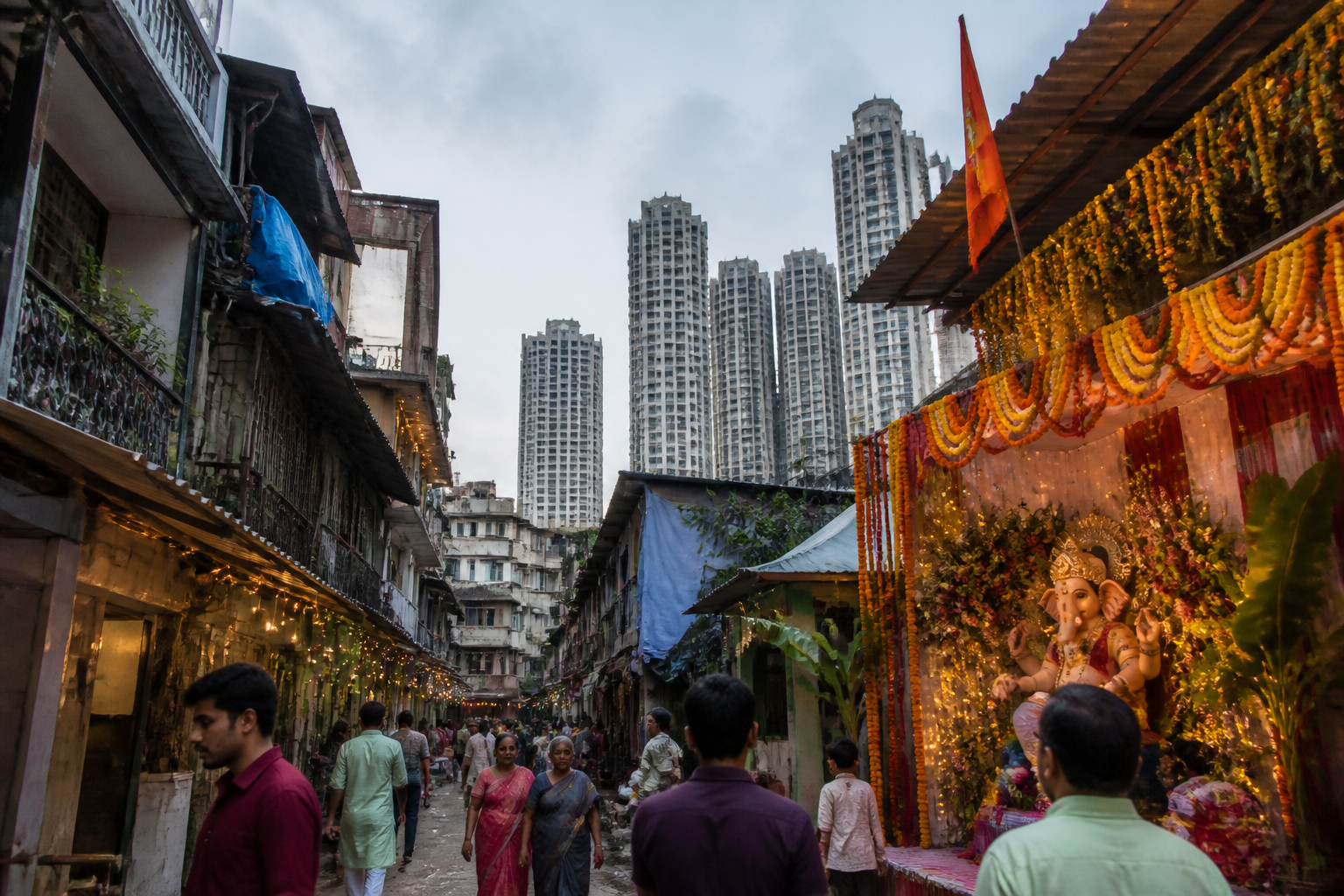
South Mumbai redevelopment is changing more than the skyline. In Girgaon, Kalbadevi, Bhuleshwar, Byculla and Lalbaug, the replacement of old chawls with redeveloped buildings and high-rises is altering the shared spaces and everyday relationships that once shaped Ganeshotsav. The festival continues to draw residents and visitors, but the neighbourhood life around it is becoming less intimate, according to residents and organisers quoted in a report by Mid-Day.
The change is not presented as a conflict between tradition and modernity. New buildings offer better homes and facilities, and the report does not suggest that residents want redevelopment to stop. The deeper question is whether the physical form of redevelopment is preserving the social infrastructure that allowed older neighbourhoods to function as closely connected communities.
In the older parts of South Mumbai, Ganeshotsav historically extended beyond the home or the mandal. Chawl corridors, courtyards and narrow lanes acted as common areas where residents met, children moved between homes and preparations for decoration, aarti and visarjan became collective activities. These spaces were not designed as formal community infrastructure, but they supported a dense pattern of daily interaction.
That pattern mattered during the festival because the celebration was already embedded in ordinary neighbourhood life. Residents did not need to organise every meeting separately. Doors remained open, people knew one another and the local mandal became a gathering point for an entire building or cluster of buildings. The festival amplified relationships that already existed instead of having to create them from scratch.
Redevelopment changes that physical and social arrangement. A chawl, with shared corridors and relatively visible movement between homes, is replaced by a vertical building with private flats, controlled entrances, lifts and more separated domestic spaces. The report does not establish that every redeveloped building functions in the same way, but the accounts from Girgaon point to a consistent perception: residents can live close to one another without developing the same familiarity that existed earlier.
“Earlier everyone knew each other. During Ganeshotsav you didn’t have to call people for the celebrations. They were already downstairs,” 82-year-old South Mumbai resident Yashwanti M told Mid-Day. Her account captures the difference between a festival organised within an existing community and one that must work harder to assemble a community inside a new building.
Yashwanti also described Girgaon’s earlier Ganeshotsav as a collective process involving decoration, aarti and visarjan. Her recollection is significant because it connects the festival to the everyday design of the neighbourhood. The old building was not merely a backdrop for celebration. Its shared spaces made participation visible and convenient, allowing residents of different ages to encounter one another repeatedly.
Milind Vanarse, a 39-year-old Girgaon resident and private-sector manager, described the present condition differently. “Now you can live in the same building for years and barely know your neighbour. Earlier the whole building was like one family,” he said. This is a perception rather than a citywide measurement, but it identifies the central urban issue raised by the report: redevelopment can improve the private dwelling while weakening the informal networks that connect households.
The distinction between a better home and a stronger neighbourhood is important. A redeveloped building may provide improved physical conditions, but those improvements do not automatically reproduce the social life of the chawl. Community depends not only on proximity but also on the opportunities residents have to meet, linger, participate and see one another in shared places. When those interactions decline, cultural events can remain active while their local meaning changes.
The physical memory of the neighbourhood is also being affected. Older residents associate particular balconies, shops, lanes and building facades with past celebrations. When these landmarks disappear, the festival remains but its familiar setting is altered. Vanarse said that when he looks at new buildings, he wonders where the Mumbai he grew up in has gone. He also observed that Ganpati remains the same while everything around it has changed.
This matters because urban redevelopment is often assessed through the delivery of new housing, construction quality, amenities or the replacement of ageing structures. Those are important outcomes, but the Mid-Day report points to another layer that is harder to measure: whether a redevelopment project retains the social geography of the original neighbourhood. The question is not simply how many homes are created, but how residents continue to meet after the old shared spaces disappear.
Lalbaug offers a related example. It remains one of Mumbai’s recognised Ganeshotsav hubs, and its mandals continue to bring people together. However, a 45-year-old organiser quoted by Mid-Day said the surrounding neighbourhood spaces are disappearing. In that view, the festival is still capable of creating community, but it has to work harder because everyday opportunities for contact have reduced.
This shifts the role of the mandal. Earlier, the mandal operated within a dense network of familiar buildings, lanes and residents. As those networks change, it becomes a more important organiser of neighbourhood contact. Yet the report also records a second pressure: the rise of famous mandals and elaborate decorations as citywide attractions.
Abhishek Tondankar, treasurer of the 5th Kumbharwada Sarvajanik Ganeshotsav Mandal in Girgaon, said that earlier the local Ganpati was the event, while visitors now often want to see five or six famous mandals. This suggests a change in scale. The festival remains popular, but attention can move from the local building or lane to a circuit of high-profile destinations across the city.
The two changes reinforce each other. Redevelopment can reduce the everyday contact that sustains a local celebration, while the growing prominence of large mandals can make smaller neighbourhood events appear less central. Neither development means that community has disappeared. Rather, the institutions that once produced it informally now carry a greater burden of maintaining it.
The report does not provide figures on the number of chawls redeveloped, the size of affected populations, participation rates or the number of mandals that have changed their format. It therefore cannot establish a citywide trend in statistical terms. Its evidence is based on accounts from residents and organisers in specific South Mumbai neighbourhoods. That limitation is important: the experience of one building, mandal or locality cannot automatically represent all redevelopment projects.
At the same time, qualitative evidence is valuable when the issue concerns belonging, familiarity and the use of shared space. These outcomes are not captured easily through housing counts. A resident may receive a larger or better-equipped home while losing the informal access to neighbours that previously made the building feel collective. The report’s accounts bring that tension into view without arguing that one form of housing is universally better than another.
The institutional challenge is therefore broader than preserving an annual celebration. Redevelopment authorities, housing societies, developers and resident groups must contend with how new buildings relate to the public and semi-public spaces around them. The source material does not describe a specific redevelopment policy, project approval condition or municipal intervention aimed at preserving community networks. It does, however, show why the social consequences of redevelopment cannot be inferred only from completed construction.
The phrase “community has to be rebuilt too”, used by Tondankar, summarises the issue. It does not imply that an old neighbourhood can be frozen in place. South Mumbai has changed before, and the festival has adapted with it. But adaptation becomes more difficult when residents lose not only familiar structures but also the everyday settings in which relationships were formed.
For planners and housing institutions, the unresolved question is whether new developments can support the collective functions once performed by chawls and lanes. For residents, the question is more immediate: where will people meet when the old courtyards, corridors and street edges are gone? For mandals, the challenge is how to remain local community institutions while operating in neighbourhoods increasingly shaped by vertical living and citywide festival tourism.
The evidence in the report confirms a clear change in perception among several South Mumbai residents and organisers: Ganeshotsav remains strong, but the social landscape around it is less close-knit than before. What remains uncertain is how widespread this experience is and which redevelopment designs or community practices can sustain local ties. The future of the festival may depend not on preserving every old building, but on ensuring that the new city still provides places and institutions where neighbours can become a community.
