


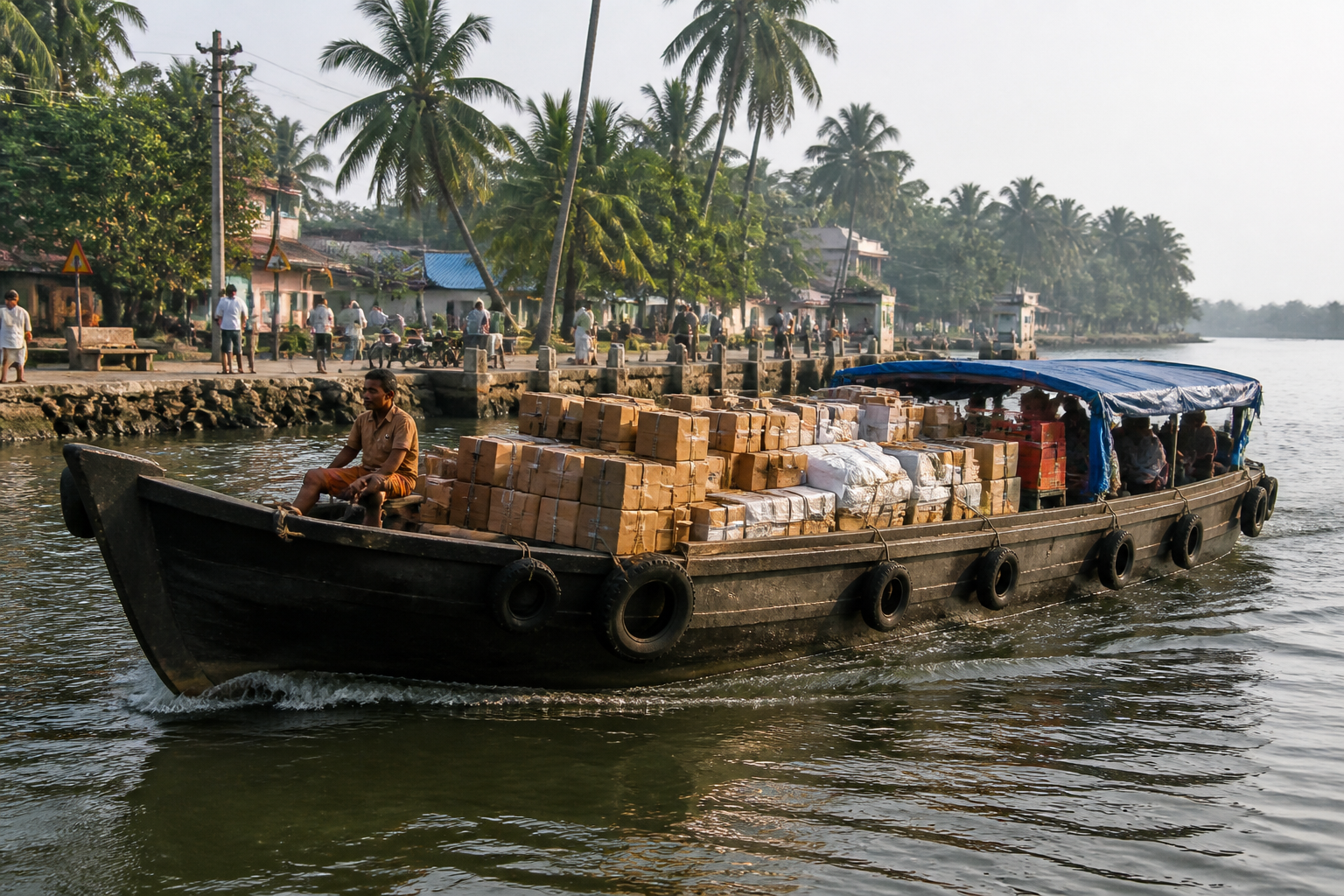
Subheadline: Inland waterways could complement roads in difficult-to-reach settlements, but their value will depend on how well they connect with jetties, hubs, technology and local delivery networks.
Standfirst: India’s digital economy is reaching consumers in riverine, island and backwater regions faster than logistics networks are adapting to their geography. The country’s rural internet users exceeded 427.7 million during FY 2025-26, while the logistics industry is forecast to grow to as much as $281.74 billion by 2026. Yet the expansion of roads and digital commerce has not removed the final access barrier for dispersed settlements. This analysis examines whether waterway logistics can become a practical part of India’s last-mile system, what current infrastructure figures reveal, and why schemes such as PM Gati Shakti and Jalvahak matter. It also considers the limits of treating waterways as a replacement for roads, using Kerala’s Vallam Express as an example of how local knowledge and organised logistics can work together.
India’s last-mile logistics problem is increasingly less about whether consumers can order goods and more about whether delivery networks can reach them reliably. Online commerce has expanded into communities located around rivers, islands and backwaters, but these geographies do not always fit the highway- and road-centred systems on which large logistics networks have developed. The result is a gap between digital access and physical accessibility.
That gap is important because road connectivity alone does not guarantee delivery access. The report notes that 99 per cent of eligible habitations have been connected through PMGSY-I. However, a road reaching a settlement does not automatically make the final journey from a logistics hub to an individual customer affordable, quick or operationally straightforward. In dispersed and water-bound areas, the last segment can remain the most difficult part of the network.
Waterway logistics therefore enters the debate not as a substitute for roads, but as a response to places where water is already a practical transport corridor. Rivers, canals and backwaters can offer routes that are more aligned with local geography than a system designed around continuous road access. The question is whether these routes can be connected to the rest of the logistics chain in a way that is consistent enough for consumer deliveries.
The scale of the opportunity is set against two parallel trends. The Indian logistics industry is forecast to grow up to $281.74 billion by 2026, while rural internet users crossed 427.7 million during FY 2025-26. Those figures indicate expanding demand and a broadening digital market. They do not, by themselves, establish that waterways can deliver parcels at scale. They do show why the design of the physical network matters: more consumers may be able to shop online even when the transport system serving their homes remains fragmented.
India’s inland waterway network has also begun to acquire greater operational significance. Of the 111 National Waterways covering more than 20,000 kilometres, 32 waterways covering over 5,100 kilometres were functional by March 2026, according to the report. Goods movement through these waterways exceeded 198 million tonnes by February. These figures indicate progress in network activation and freight volumes, but they also show the present structure of the market. Bulk cargo accounts for much of the increase, while consumer logistics represents a different operational challenge.
Bulk movement and parcel delivery do not use a transport network in the same way. A bulk shipment can be organised around larger consignments and defined terminals. Consumer logistics requires frequent movement, smaller loads, dependable handovers and a final connection to individual households. The report does not provide parcel volumes or delivery-cost comparisons for waterways, so it does not establish whether inland water transport is already competitive for e-commerce. It does, however, identify the shift that would be required if waterways are to serve this market: infrastructure and operations would need to connect transport corridors with aggregation points and local delivery systems.
The government’s stated objective of increasing the share of freight carried on waterways from about 2 per cent to 5 per cent by 2030 provides the policy setting for that shift. The report identifies PM Gati Shakti and the Jalvahak scheme as mechanisms that could support the objective. Their relevance to last-mile delivery lies in integration. A water route on its own is not a delivery network; it becomes useful when it is linked to roads, logistics hubs, jetties, storage or aggregation facilities, and the systems that track and hand over consignments.
This makes the infrastructure question more complex than adding kilometres of navigable routes. The usable capacity of a multimodal network depends on the points where one mode meets another. If a parcel can travel by boat but cannot be efficiently transferred at a jetty, sorted at an aggregation point or delivered from the landing site, the water segment may not improve the customer experience. The report’s central proposition is therefore about coordination rather than mode selection.
Kerala’s Vallam Express initiative illustrates that principle at a local level. Operating in the Alappuzha region, the initiative serves 14 villages and nearly two lakh residents. It combines organised logistics with local boat operators familiar with routes that are inaccessible by road. The example is significant because it links formal logistics processes with knowledge held by communities that already understand the geography.
The model also complicates the conventional idea that scale must come from standardisation. Abhishek Chakraborty, CEO of DTDC Express, told NDTV that India’s diverse geographies, infrastructure and ways of living require networks capable of adapting to local conditions. He described the opportunity as a move away from a one-size-fits-all model towards an adaptive network combining multiple modes, local ecosystems and modern logistics capabilities.
That argument is consistent with the evidence presented in the report, but it does not mean that every local water route can be incorporated into a national delivery system without changes. The source does not detail the cost structure, safety arrangements, service frequency, regulatory requirements or technology used by Vallam Express. Nor does it compare the initiative’s performance with road-based delivery. Those unanswered questions matter if a local demonstration is to inform wider policy or commercial decisions.
The broader policy landscape is consequently one of integration. PM Gati Shakti and Jalvahak are presented as part of an effort to expand the role of waterways in freight, while the road network remains essential to the wider chain. The available material does not specify the exact division of responsibility among central agencies, state authorities, local administrations, logistics firms and boat operators. It does make clear that public schemes alone cannot resolve the last mile unless the physical and institutional interfaces between modes are addressed.
There is also a difference between infrastructure presence and accessibility. A road, waterway or jetty can exist without providing a reliable service to residents. Accessibility depends on whether the route operates when needed, whether goods can be transferred without excessive delay, and whether the final leg reaches households across dispersed settlements. For digital commerce, this distinction is particularly important because the customer interface may be standardised while the physical delivery conditions are not.
The report’s figures help define the scale of the transition. India has 111 National Waterways spanning more than 20,000 kilometres, but only 32 covering over 5,100 kilometres were described as functional by March 2026. Freight movement had exceeded 198 million tonnes by February, and the national target is to increase waterways’ freight share from approximately 2 per cent to 5 per cent by 2030. Together, these numbers show a network with substantial physical reach, a smaller operational footprint and an ambitious policy target. They do not yet demonstrate that consumer delivery has become a major component of waterway freight.
That distinction should guide how the opportunity is assessed. Waterways may be most valuable in specific geographies rather than as a universal logistics solution. Riverine and backwater settlements may benefit where roads are indirect or difficult to use, while other locations may continue to be served more efficiently by road. The evidence supplied supports a complementary model, not a wholesale replacement of existing transport infrastructure.
The larger urban question is how India defines connectivity as its economy becomes more digitally distributed. Traditional measures often focus on whether a habitation is linked by road or whether a transport corridor exists. The logistics experience of residents depends on a wider chain: the route, the terminal, the transfer point, the local operator, the information system and the final delivery interface. In that sense, accessibility is a measure of how infrastructure works together rather than how much infrastructure has been built.
The evidence confirms that waterway logistics has a credible role in India’s last-mile discussion, particularly in areas where water is already embedded in daily movement. It also confirms that the current waterway freight system is still primarily described through network activation and bulk cargo volumes, not consumer delivery performance. The developments that merit monitoring are the implementation of PM Gati Shakti and Jalvahak, progress towards the 2030 freight-share target, and whether initiatives such as Vallam Express can connect local geographic knowledge with dependable, measurable logistics services.
