


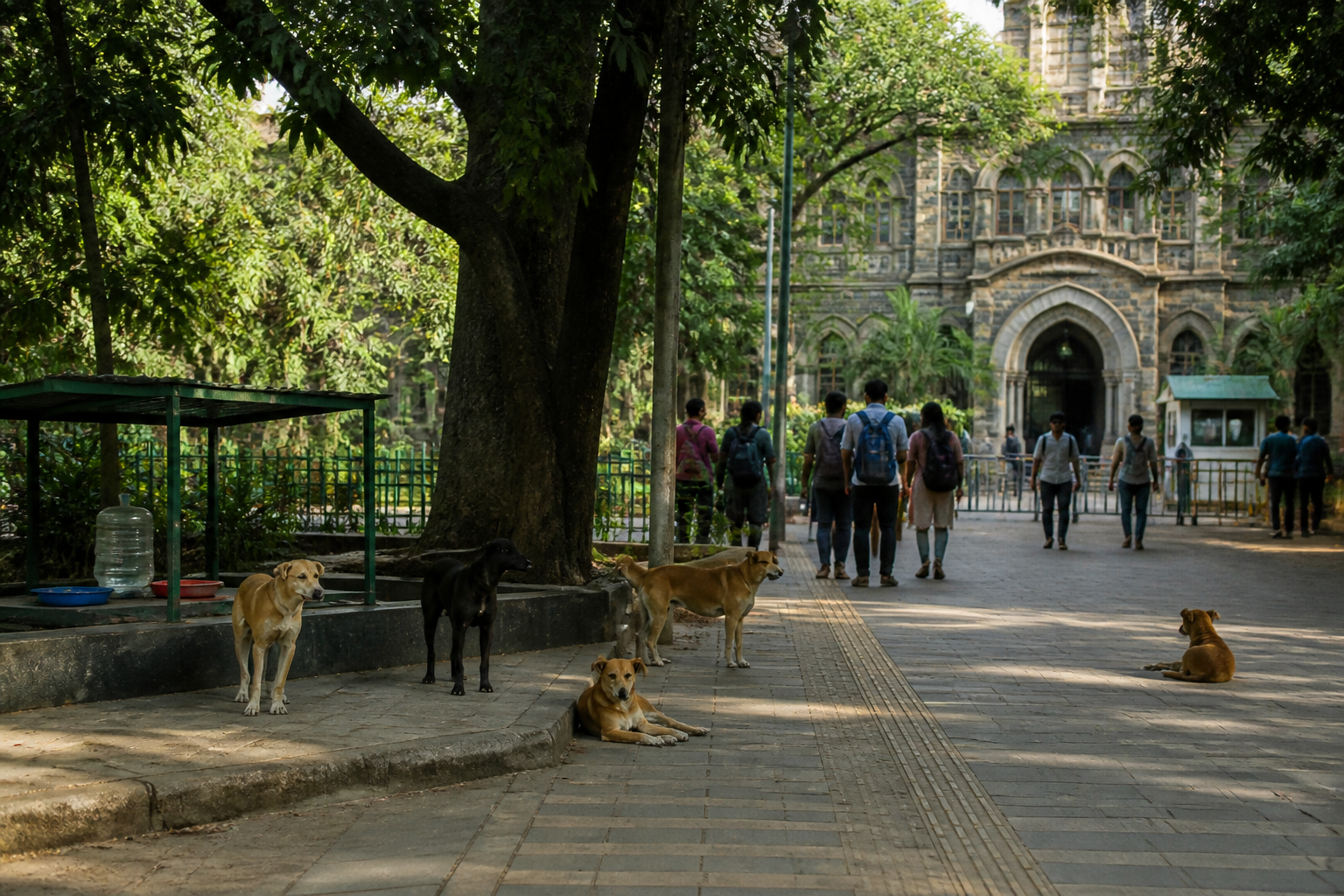
Mumbai University’s dog-feeding dispute at its Kalina campus is being presented as a conflict between animal feeders and university officials. But the episode also reveals a larger urban-management problem: what happens when a large institutional campus becomes a shared habitat for people, free-ranging animals and competing interpretations of responsibility?
Feeders who have cared for dogs on the campus for years say they were stopped from entering the premises and feeding the animals. They claim the dogs have gone without food for nearly 10 days. The university, however, says internal feeding has not been stopped and that it is complying with orders issued from time to time by the Supreme Court and the government.
The disagreement is therefore not only about whether feeding is taking place. It is about who is authorised to feed, where feeding should happen, how animals should be identified and monitored, and what interim arrangement should apply if the university wants to change the existing system.
The available material contains two different counts of the campus dog population. The report’s summary refers to 68 dogs, while the university’s comment lists 94 dogs in total, including 78 that have been neutered and 16 that have not. The difference is not explained in the supplied material, but it is significant because any feeding, vaccination, sterilisation or relocation plan depends on an agreed and current record of the animals concerned.
The feeders’ account is that the dogs have been dependent on them for years. Vikrant Urval, a Wadala resident who began caring for the campus dogs during the pandemic, said feeders had helped feed and neuter the animals. He argued that depriving them of food for several days could affect their health and behaviour. His account is a claim from the feeders and is not independently established in the supplied material.
Another feeder, Gurudev Singh, said the size of the Kalina campus made it difficult for students and faculty to reach every animal. He also referred to young puppies that, according to him, depend entirely on feeders for food. The argument points to a practical limitation in informal systems: even when an institution permits feeding in principle, access, timing and coverage can determine whether the arrangement works in practice.
The university’s response introduces a different administrative position. It says internal feeding has not been stopped and that it is following applicable directions from the Supreme Court and the government. The statement does not, in the supplied report, set out the specific operational rules being applied on the campus, identify feeding locations or explain how authorised feeders are expected to work within the premises.
That gap between a general institutional statement and the practical details demanded by feeders is at the centre of the dispute. A policy can permit feeding while still restricting access to particular parts of a campus. Conversely, feeders may experience a restriction as a complete stoppage if there are no clearly communicated locations, access procedures or named officials responsible for coordination.
The citizens’ representation to university officials and BMC Commissioner Ashwini Bhide seeks an interim arrangement until BMC stray-dog shelters are ready and the animals can be relocated responsibly. The requests include multiple designated feeding points and identity cards for feeders. These demands indicate that the immediate dispute is not necessarily about maintaining an unregulated system. They are asking for a system that combines access control with continuity of care.
Designated feeding points could provide the university with a way to regulate where food is distributed while allowing feeders to reach animals across a large campus. Identity cards could clarify who is permitted to feed and give the institution a mechanism for coordination. Neither proposal, however, is described in the supplied material as having been accepted by the university.
The request for an interim plan is important because the proposed long-term alternative—relocation to shelters—does not appear to be immediately available. The feeders have asked for time until such shelters are ready. The report does not establish the number, location, capacity or readiness of those shelters, nor does it provide a confirmed relocation schedule. As a result, relocation remains a requested future arrangement rather than an operational solution described in the available evidence.
The campus itself makes the issue more complicated. The report describes Kalina as a sprawling campus used by students and educators and also inhabited by free-ranging dogs. In such settings, animal management intersects with everyday institutional administration. Access rules, public health concerns, campus safety, feeding practices and responsibility for sterilisation and vaccination can all become linked, even when the immediate trigger is a restriction on entry.
The university’s figures suggest that sterilisation and vaccination have already formed part of the animals’ management. It says 78 dogs have been neutered and all 94 are vaccinated, while 16 remain unneutered. The figures establish the university’s stated position, but the supplied report does not identify who carried out the procedures, when they occurred, how the animals were tracked or whether the figures have been independently verified. Those details would be necessary for a complete assessment of the campus’s animal-management system.
The dispute also shows why population data matters in urban governance. The difference between the reported figure of 68 dogs and the university’s stated total of 94 is not a minor editorial detail. A reliable count is the foundation for estimating food requirements, planning vaccination and sterilisation, identifying puppies, deciding whether relocation is feasible and determining the number of designated feeding locations. Without a shared count, even well-intentioned interventions can leave animals unaccounted for.
The role of informal caregivers is another part of the governance question. Feeders say they have maintained continuity of care over several years, including during the pandemic. Their involvement may provide local knowledge about individual dogs, territories and feeding patterns. At the same time, an institution may seek to regulate access to its land because it is responsible for managing a functioning campus. The supplied material does not establish that either side’s position has resolved the operational concerns of the other.
That is why the proposed identity-card system is more than a demand for entry. It could become a formal interface between the university and people who already perform a caregiving role. But such a system would require clear rules: who issues the cards, which dogs are covered, where feeding is allowed, how complaints are handled and what happens when a feeder is unavailable. The report does not say whether these administrative questions have been discussed or answered.
The proposed feeding points raise a similar issue. Multiple locations may be necessary on a large campus, but the report does not provide a site plan or evidence about how locations would affect students, staff, sanitation or the movement of animals. That information is not available in the supplied material and should not be assumed. It is, however, central to any plan that aims to regulate feeding rather than merely shift it elsewhere.
The involvement of the Maharashtra Navnirman Vidyarthi Sena adds pressure for a faster response. Nitin Nanavare said the group had written to the authorities and sought action within 24 hours, while warning that it was prepared to protest. The statement establishes a protest threat, not that a protest has taken place. It also shows how an animal-management dispute on a university campus can quickly become a question of institutional responsiveness and student politics.
The immediate evidence therefore supports a limited conclusion. There is a documented disagreement over access and feeding at Kalina, competing accounts of the current arrangements, a discrepancy in the reported dog population and a request for designated interim mechanisms. The university says internal feeding has not been stopped; feeders say the practical restrictions have left dogs without adequate access to food. The supplied material does not resolve that contradiction.
What remains to be established is equally important: the precise court or government directions being applied, the university’s written feeding protocol, the current verified dog count, the status of the requested identity cards and feeding points, and the readiness of any proposed shelters. Until those details are made clear, the dispute will continue to be treated as a clash between access and welfare rather than as a defined institutional management plan.
The next development will depend on the university’s response to the representation and the 24-hour action request. Whether the authorities publish an interim arrangement, clarify feeding access or provide a documented relocation timeline will determine if the Kalina campus moves from an informal caregiving system to a regulated one. The evidence currently shows that the central challenge is not simply where food is placed, but whether responsibility for the campus’s animals is clearly assigned and publicly verifiable.
