


Subheadline: Bengaluru’s 32nd-place finish in the 2026 Swachh Vayu Sarvekshan shows how traffic, industrial emissions, waste practices and household fuel costs complicate clean-air efforts.
Standfirst: Bengaluru has ranked 32nd among India’s million-plus cities in the 2026 Swachh Vayu Sarvekshan, placing it among the bottom 10 performers in a national assessment of clean-air action. The city scored 152.6 points, well below the scores recorded by the leading cities in its category. The result is not explained by a single pollution source. The assessment and expert comments cited in the available report point to a combination of slow-moving traffic, inadequate road infrastructure, rising emissions from small-scale industry, weak waste management and continued use of wood and charcoal in some low-income settlements. The ranking therefore offers more than a comparative position: it reveals the difficulty of converting individual schemes and pollution-control measures into a coordinated urban clean-air system.
Bengaluru’s position in the latest air-quality rankings is a measure of an urban system struggling to control several emissions sources at once. The city placed 32nd among million-plus cities in the fifth Swachh Vayu Sarvekshan, with a score of 152.6 points. Only seven cities in that population category ranked below it, according to the report on the Union Ministry of Environment, Forest and Climate Change’s awards announced on Monday.
The ranking was released as part of Swachh Vayu Diwas 2026, held on the International Day of Clean Air for Blue Skies. The programme evaluates cities participating in the National Clean Air Programme across multiple categories, including action on road dust, solid waste, vehicle emissions, industrial emissions, construction and demolition waste, diesel generator sets and emissions from commercial establishments. It also considers information, education and communication activities.
That breadth is important. Bengaluru’s result does not represent only ambient pollution readings or the performance of one municipal department. It reflects how the city plans, regulates and documents action across transport, waste, construction, industry and public communication. A low position in such an assessment suggests that clean-air performance depends on coordination between institutions and sectors, not simply on the presence of a clean-fuel scheme or an emissions-control programme.
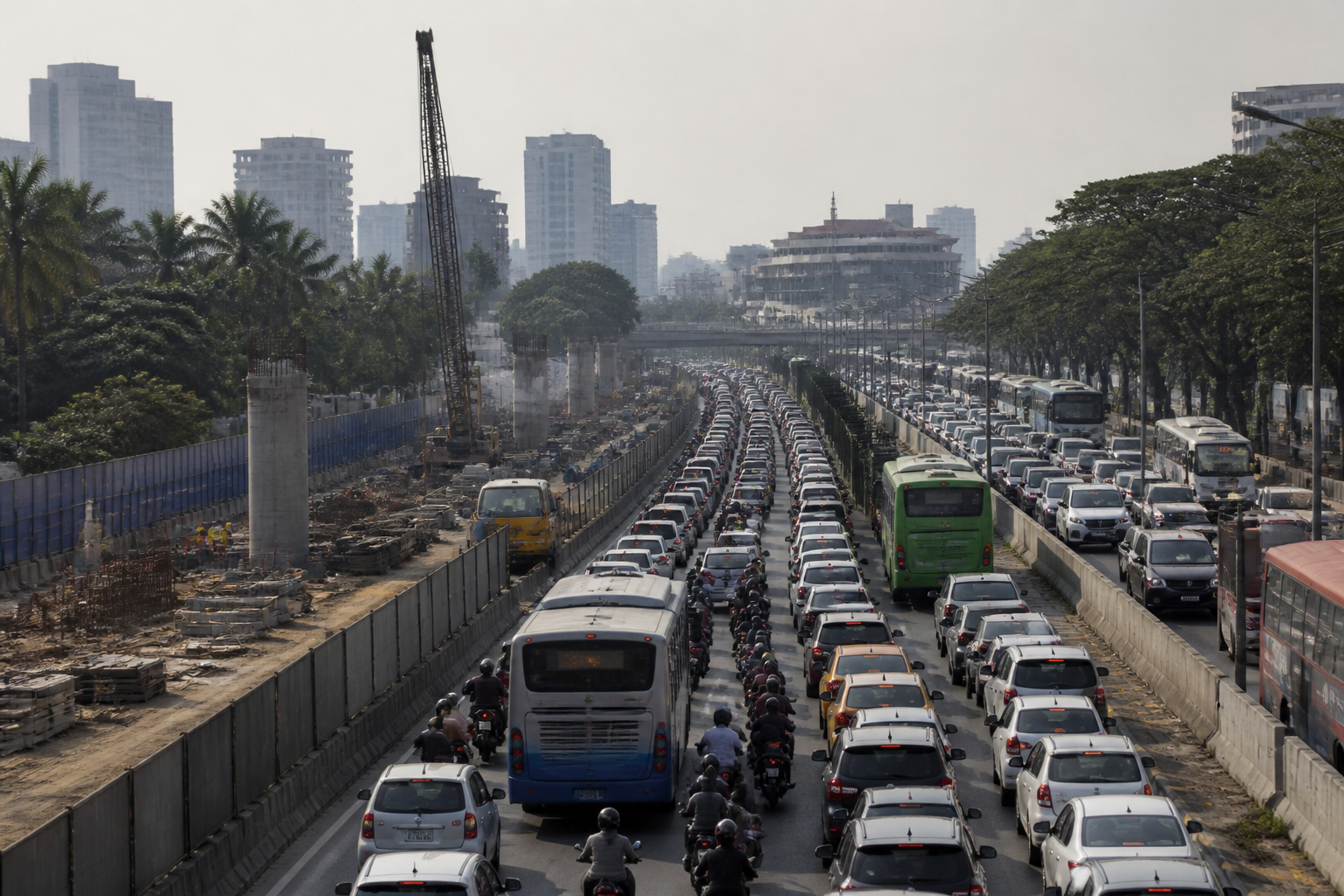
The largest pressure identified in the report is traffic. Professor Gufran Beig, chair at the National Institute of Advanced Studies, attributed a significant share of the problem to Bengaluru’s slow-moving and congested traffic. He said the city faces a difficult combination of slow-speed, low-speed and high-speed vehicles, with the resulting emissions affecting air quality.
The issue is not merely the number of vehicles on the road. Traffic conditions determine how long vehicles remain in operation, how frequently they accelerate and stop, and how efficiently the road network moves them. In Bengaluru, persistent congestion means that transport emissions remain a structural challenge even though the city’s geographical location is considered favourable for improving air quality. Geography may help disperse pollution, but it does not remove emissions generated repeatedly across a congested road network.
The report also links the traffic problem to inadequate road infrastructure and management. This connection makes the ranking a mobility and planning issue as much as an environmental one. If road space, intersections and traffic flows produce prolonged delays, emissions control cannot be separated from how the city manages movement. The assessment’s treatment of vehicular emissions therefore places pressure on transport authorities and urban agencies to address the conditions that produce pollution, rather than focusing only on the vehicles themselves.
Industrial emissions add another layer of difficulty. The report cites experts who identified rising emissions from small-scale industries as a concern and said these sources remain largely unaccounted for. That observation points to a monitoring gap: pollution-control efforts may be less effective when smaller or dispersed industrial activities are not adequately measured, recorded or regulated.
The distinction between large, identifiable sources and smaller establishments matters for city governance. A programme can set targets for industrial emissions, but the targets are difficult to enforce when the source inventory is incomplete. The available report does not establish the scale of emissions from these units or identify particular industrial clusters. It does, however, indicate that the city’s pollution challenge includes sources that are not fully captured by the existing system.
Waste management is another area included in the assessment and cited by experts as a weakness. Improper waste practices can affect air quality through several pathways, including the handling and disposal of solid waste. The report does not provide a separate emissions estimate for waste management in Bengaluru, so its precise contribution to the city’s score cannot be determined from the available material. Its inclusion in the assessment nevertheless shows that clean-air administration is tied to everyday municipal services.
The same applies to emissions from construction and demolition waste, diesel generator sets and commercial establishments. These categories appear in the national assessment framework, but the report does not provide Bengaluru’s individual scores or performance in each area. The overall ranking therefore identifies a broad governance problem without showing which category contributed most to the city’s final position. That breakdown would be necessary to determine whether Bengaluru’s weakest performance came from transport, waste, industrial compliance, documentation or a combination of factors.
The report highlights a further gap between policy coverage and actual household behaviour. Clean-fuel schemes cover most households in the city’s shantytowns, according to the government data cited by Professor Beig. However, he said many residents continue to use wood and charcoal because the cost of refilling cooking-gas cylinders is high. The result is that household emissions may remain higher than programme coverage figures suggest.
This is a critical distinction for evaluating clean-fuel policy. Access to a connection or eligibility under a scheme does not necessarily mean regular use of that fuel. If refilling costs make the cleaner option unaffordable, households may return to traditional fuels even after being included in a government programme. The report describes this as a reason emissions in these settlements have returned to levels seen before the Ujjwala scheme, although it does not provide a city-level emissions measurement or a household survey to quantify the change.
The point also broadens the meaning of urban air pollution. Household fuel use in low-income settlements is not simply an environmental compliance issue. It is linked to the affordability and continuity of essential services. A clean-air strategy that counts connections but does not track sustained use may overstate its effect on emissions. The evidence available here does not show how many households have shifted back to wood or charcoal, but it identifies affordability as a factor that can weaken the impact of clean-fuel interventions.
Bengaluru’s ranking can therefore be read as an assessment of implementation rather than intent. The city has access to national programmes and has been evaluated under a framework that recognises action across several pollution sources. Yet the reported score of 152.6 points remains far behind the leading million-plus cities. Lucknow topped the category with 198 points, followed by Indore with 197 and Jabalpur with 195.
The gap between Bengaluru and the leaders is 45.4 points relative to Lucknow, 44.4 relative to Indore and 42.4 relative to Jabalpur. These figures do not, on their own, explain why the cities performed differently. The assessment process includes city self-assessments, approval by State-level Monitoring Committees, evaluation by the Central Pollution Control Board and field verification by independent committees. The final rankings therefore combine reported action with review and verification, but the supplied material does not provide city-by-city evidence on the measures behind the scores.
That limitation matters when interpreting rankings. A position on a national list can identify relative performance, but it cannot substitute for a detailed local emissions inventory. Bengaluru’s 32nd-place result establishes that the city performed poorly within its population category under the assessment framework. It does not establish that one source alone caused the outcome, nor does it show whether the city’s position changed because of worsening emissions, stronger action elsewhere, differences in documentation or the interaction of all three.
The institutional design of the survey is nevertheless significant. Cities conduct self-assessments, state committees approve submissions, the Central Pollution Control Board evaluates them and independent committees carry out field verification. This structure distributes responsibility across municipal, state and central institutions. It also means that improvement requires more than a single agency’s intervention. Transport management, industrial regulation, waste services, household energy access and monitoring must operate as connected parts of the clean-air programme.
For Bengaluru, the immediate evidence points to a mismatch between the city’s clean-air ambitions and the conditions experienced on its roads, in smaller industrial units, in waste systems and in lower-income settlements. Traffic congestion is visible and persistent; industrial emissions are described as undercounted; waste management is identified as inadequate; and clean-fuel coverage does not guarantee clean-fuel use. These are different problems, but they converge in the same urban air-quality outcome.
The next stage of public scrutiny should focus on the detailed category-wise assessment behind the 152.6-point score. The available report does not state Bengaluru’s individual scores for traffic, industry, waste, construction, generators or commercial establishments. Nor does it provide the underlying monitoring data needed to compare the city’s emissions with those of Lucknow, Indore or Jabalpur. Without that information, the ranking is a clear warning but an incomplete diagnosis.
What the result confirms is that Bengaluru’s air-quality challenge cannot be addressed through a single clean-fuel scheme or a standalone pollution campaign. The city’s performance is being shaped by the interaction of mobility, infrastructure, municipal services, industrial monitoring and household affordability. What remains uncertain is the weight of each factor in the final score. The next significant milestone will be the release or review of the detailed assessment evidence that shows where Bengaluru lost points and which interventions produced measurable improvement.

