


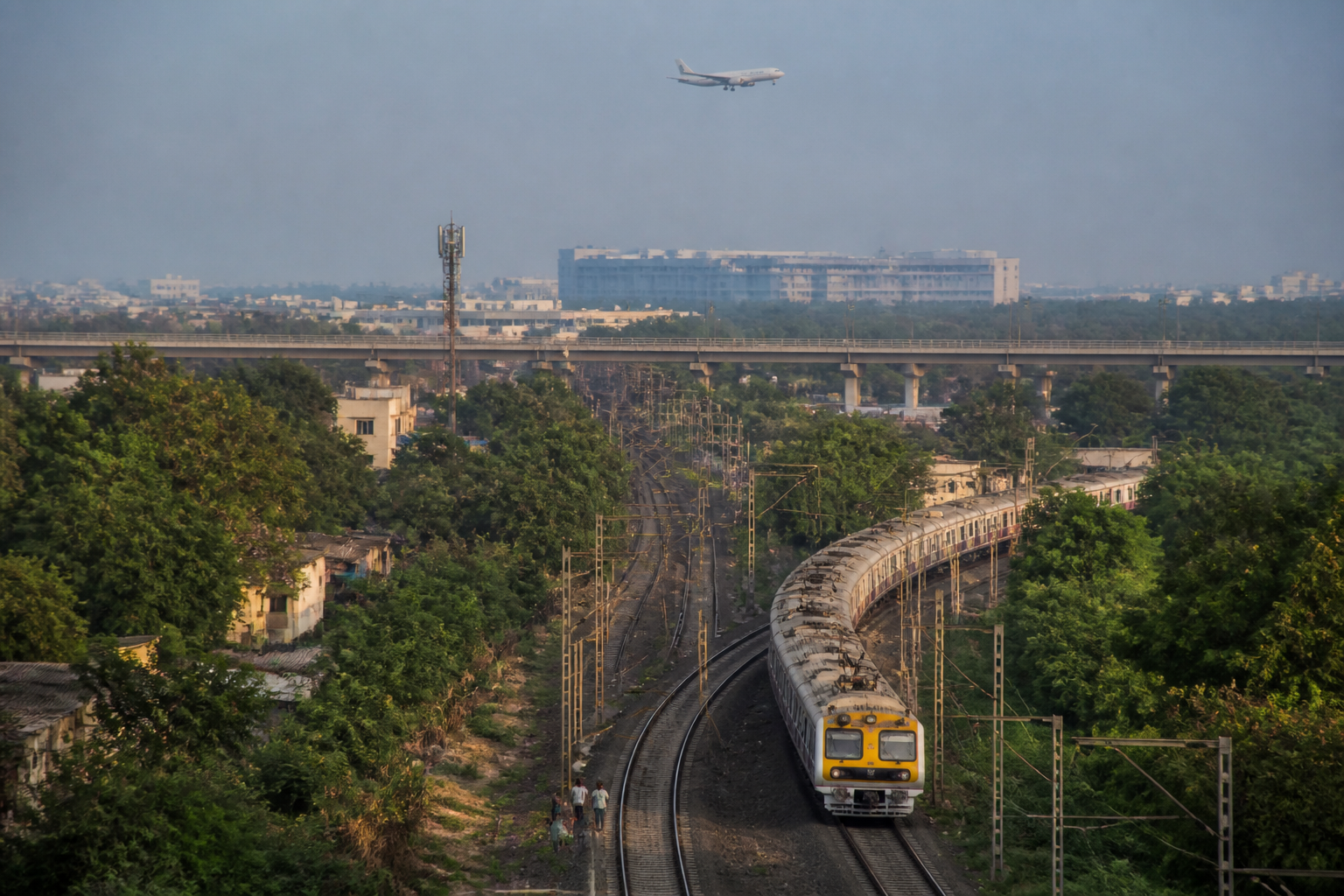
The proposed Panvel-Vasai railway corridor has reached a familiar but consequential stage in metropolitan infrastructure planning: a state-level approval has been secured, yet construction cannot begin because the project is still awaiting clearance from the Railway Ministry. The 69.2-kilometre suburban rail link was conceived to connect Mumbai’s western, central and harbour-side travel networks more directly, while also improving access between Vasai-Virar, Panvel, Navi Mumbai and the region’s emerging airport infrastructure.
According to a report by Loksatta – Vasai-Virar, the Maharashtra state cabinet’s infrastructure committee approved the proposal in September 2025. The state government subsequently forwarded it to the Railway Ministry for final approval on October 3, 2025. As of the report published on September 8, 2026, that approval had not been received, and physical work on the corridor had not started.
The delay matters because the corridor is not being proposed as an isolated railway line. Its stated purpose is to connect several parts of the Mumbai Metropolitan Region that currently have limited direct suburban rail access to one another. Residents of Vasai-Virar travelling towards Panvel and Navi Mumbai often have to depend on indirect routes, crowded services or a combination of local and MEMU trains. The proposed corridor is therefore linked to an existing mobility problem rather than representing only a future expansion of the railway network.
The project was proposed under the Mumbai Urban Transport Project framework. The report identifies its planned length as 69.2 kilometres, but the supplied material does not provide the detailed alignment, station list, estimated cost, land requirement, construction schedule or financing structure. Those details are important because the practical value of a regional rail corridor depends not only on its length, but also on where stations are located, how they connect with existing lines and whether services can operate at frequencies that match commuter demand.
The corridor’s institutional history also illustrates the multiple approvals required for major urban transport projects in the Mumbai region. A state infrastructure committee approved the proposal, after which the matter moved to the Railway Ministry. The report also refers to a representation submitted by former corporator Jospine Fargose to the Mumbai Railway Vikas Corporation and the state government, seeking that the project be expedited. This indicates that the project is being pursued through a combination of state-level decision-making, railway approval and implementation by a specialised metropolitan rail institution.
That sequence is central to understanding why an approved project may still remain inactive. A state decision can establish political and administrative support, but it does not by itself authorise construction when the project involves the railway system. The final status of the proposal, including the reasons for the pending approval and any conditions attached to it, is not specified in the supplied report. No Railway Ministry response is included, and the report does not establish whether the proposal is undergoing technical, financial, operational or inter-agency review.
The proposed connection is especially significant because Vasai-Virar and Navi Mumbai sit on different sides of the metropolitan region’s existing transport geography. The report states that many residents from Vasai-Virar travel towards Panvel and Navi Mumbai for employment and business. At present, the lack of a direct and sufficiently frequent suburban connection makes those journeys more difficult. Travellers may have to change trains, use less frequent services or rely on MEMU trains, while the available local services on some relevant routes are described as limited.
This is a regional commuting issue, but it is also a question of how the metropolitan area distributes jobs, housing and transport access. When employment centres expand away from the traditional core, a city’s transport system has to support cross-regional movement rather than only radial journeys into the historic centre. The Panvel-Vasai proposal reflects that shift in travel demand. Its stated objective is to provide a direct link between areas that are increasingly connected through work and business, even though their rail systems remain only partially integrated.
The airport connection is another important part of the project’s public case. The report says that completion of the corridor would provide direct access from Vasai-Virar, Nalasopara, Palghar and Borivali towards Navi Mumbai International Airport. It also states that this could reduce travel time and cost and support industry and employment in the surrounding areas. These are expected benefits presented by the project’s supporters, not outcomes that have yet been demonstrated. Until the alignment, stations, interchange arrangements and operating plan are published, the scale of the airport access improvement cannot be independently assessed.
The same caution applies to the claim that the corridor would reduce crowding. A new rail link can provide relief only if it attracts a meaningful share of existing trips and offers adequate capacity. The supplied report establishes that commuters currently face crowding and limited local services, but it does not provide passenger counts, existing train frequencies, projected ridership or the number of services planned for the new corridor. Without those figures, it is possible to identify the problem the project is intended to address, but not to measure the likely effect of the proposed line.
The absence of these details does not make the approval delay insignificant. It does, however, define what can responsibly be concluded at this stage. The available evidence confirms that the state infrastructure committee approved the proposal, that it was sent to the Railway Ministry on October 3, 2025, and that construction had not begun by September 2026. It also confirms that local representatives and commuters are asking for faster movement on the project. The evidence does not establish a construction start date, a final project cost, a confirmed funding arrangement or a guaranteed airport service.
The project’s status also raises a broader governance issue: how large transport proposals move from announcement to implementation. Each stage can affect the next. A proposal requires administrative approval, technical examination, coordination among agencies, financial clarity and an implementation mechanism before construction can begin. For commuters, these stages are often experienced simply as delay. For institutions, however, each represents a separate decision point. The supplied material does not identify which specific point is holding up the Panvel-Vasai corridor, making the Railway Ministry’s pending decision the immediate unresolved issue.
For the Mumbai Metropolitan Region, the corridor’s importance lies in the connections it is intended to create. The proposal would link Vasai-Virar and Panvel through a suburban railway route and potentially connect western and eastern employment and transport zones more directly. It would also create a possible rail interface with Navi Mumbai International Airport. But connectivity is not produced by a line on a map alone. It depends on the final alignment, station access, transfers to existing networks, service frequency, fare structure and the timing of construction. None of those operational details is available in the supplied report.
The present evidence therefore supports a limited but clear assessment. The Panvel-Vasai railway corridor responds to a documented regional commuting demand and has received a state-level infrastructure approval. Its progress has stalled before construction because final approval from the Railway Ministry remains pending. The delay keeps unresolved the transport difficulties described by commuters in Vasai-Virar and surrounding areas, including dependence on crowded or indirect services when travelling towards Panvel and Navi Mumbai.
The next meaningful development will be the Railway Ministry’s decision and any accompanying technical, financial or implementation details. Until then, the corridor remains a proposed regional connection rather than an active construction project. The key facts to monitor are whether final approval is granted, whether an implementation agency and funding plan are confirmed, and whether the authorities publish the alignment, stations, timeline and operating assumptions needed to judge how much relief the project can actually provide.
